
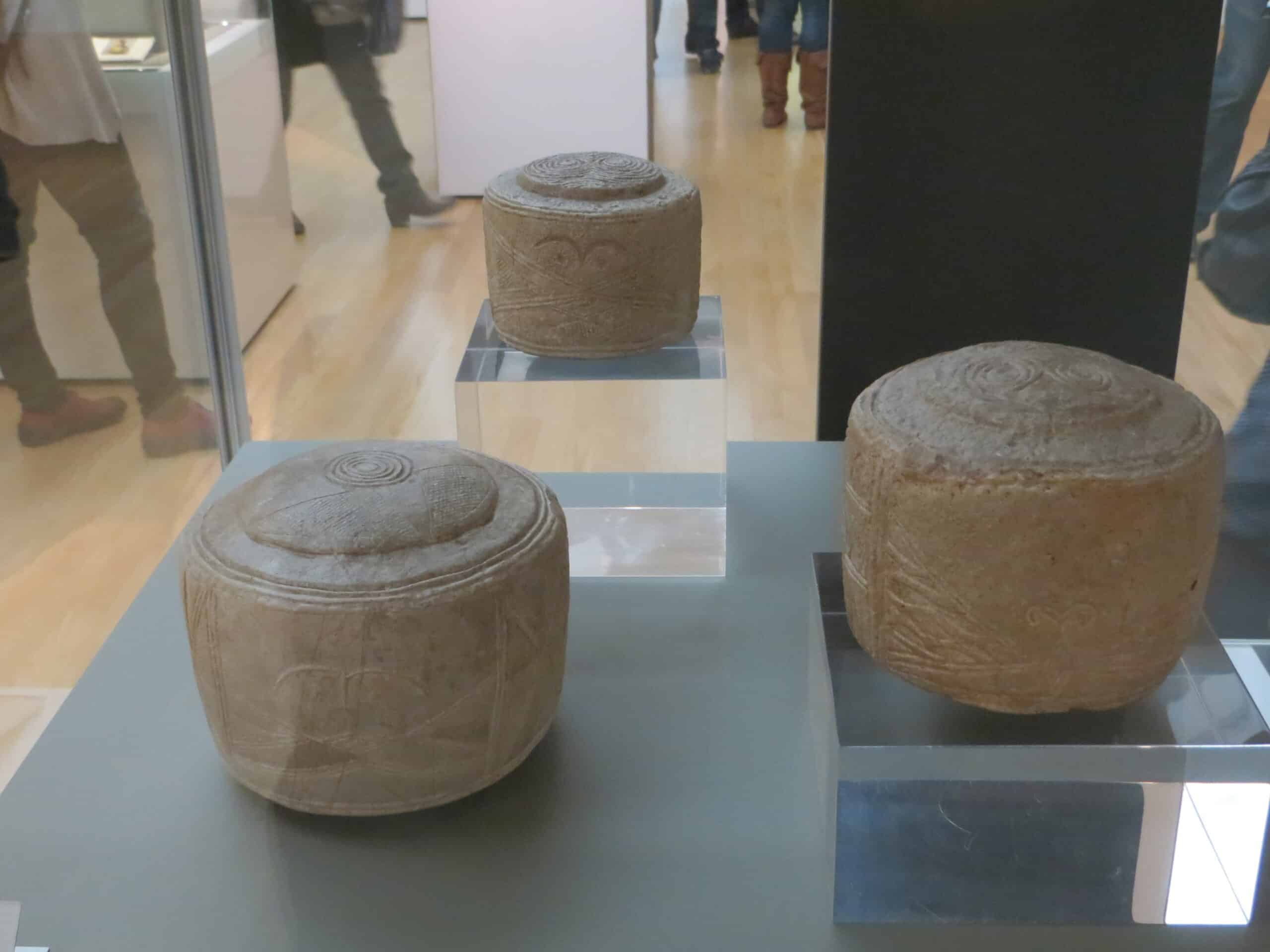
The Folkton Drums represent one of Britain’s most puzzling archaeological discoveries. These three chalk cylinders were found in 1889 beside a child’s body in a Neolithic grave near Folkton, Yorkshire. Dating back over 4,000 years, they’ve baffled experts ever since. What were these strange objects used for? Why were they buried with a child? The answers remain shrouded in mystery.
William Greenwell, an amateur archaeologist, made the discovery while excavating a prehistoric barrow. Inside the ancient burial mound, he found several bodies. One was a child, and beside this small skeleton lay the three decorated cylinders. The objects were crafted from local chalk and covered in intricate patterns. Two featured stylized human faces with prominent eyes staring out from the stone. The third bore geometric designs that seemed to follow some unknown pattern.
The rarity of this find suggests the child came from an elite family. Few objects like these have ever been discovered. The burial itself was unusual too. Most Neolithic graves contain simple pottery or tools. But these drums were different. They were clearly special, important enough to accompany a child into the afterlife.
The Folkton Drums Discovery Reveals Ancient Secrets
The excavation revealed more than just mysterious objects. The grave contained multiple bodies, suggesting a family burial or perhaps a tragic event that claimed several lives at once. The child found with the Folkton Drums appeared to be the most important person in the burial. This young individual was positioned carefully, with the drums placed deliberately nearby.
Each drum measures about 8.7 centimeters in height. They’re solid chalk cylinders, not hollow like real drums. The name “drum” describes their shape rather than any musical purpose. The decorations are what make them truly extraordinary. Concentric circles cover the tops of each cylinder. The geometric patterns include chevrons and diamond shapes that appear on other Neolithic artifacts across Britain.
Two of the drums feature schematic human faces. These aren’t realistic portraits but stylized representations. The eyes are particularly striking – large circles that seem to watch anyone who looks at them. Some researchers believe these faces represent ancestors or spirits. Others think they might be maps or astronomical charts. The British Museum now houses these enigmatic objects, where visitors can see them up close.
Mathematical Mysteries of the Folkton Drums
Related article: Cleveland sports curse
Recent research has revealed something incredible about these ancient objects. In 2018, scientists discovered that the drums’ circumferences follow precise mathematical relationships. Each drum’s circumference divides evenly into multiples of an ancient unit called the “long foot.” This measurement was apparently used throughout Neolithic Britain.
The three drums measure exactly ten, nine, and eight times this ancient unit respectively. This can’t be coincidence. Someone designed these objects with careful mathematical precision. The discovery suggests Neolithic people understood complex geometry far better than previously thought. They weren’t primitive farmers stumbling through life. They were sophisticated mathematicians.
The diameters also form what’s called a harmonic sequence. This mathematical relationship creates pleasing proportional ratios. Professor Andrew Chamberlain noted that this reveals “advanced knowledge in prehistoric Britain of geometry and mathematical properties of circles.” The implications are staggering. These people were using standardized measurements across vast distances.
This mathematical precision suggests the drums served as measuring tools. They might have helped builders create consistent proportions in stone circles and other monuments. Stonehenge itself shows evidence of similar mathematical planning. The drums could have been portable standards, allowing different construction sites to use the same measurements.
Strange Discoveries and the Burton Agnes Connection
The mystery deepened in 2015 when archaeologists found another similar object. The Burton Agnes drum was discovered just 15 miles from the original Folkton site. This find was even more poignant than the first. Alice Beasley, the archaeologist who found it, described an heartbreaking scene.
The Burton Agnes drum lay in a grave with three children. The oldest child, about 12 years old, was positioned holding two smaller children aged three and five. They appeared to have been buried in an embrace. The drum was placed near the eldest child’s head. Three holes carved into the drum’s top seemed to represent the three buried children.
“It was quite a poignant thing to see,” said Mark Allen, the archaeological director. The children showed no signs of trauma, but they’d died at the same time. Disease? Accident? The cause remains unknown. What’s clear is that someone cared enough to bury them with this precious object.
The Burton Agnes drum has been called “the most important prehistoric art found in Britain in the last 100 years” by the British Museum. Radiocarbon dating revealed it’s actually 500 years older than the original Folkton Drums. This pushes the tradition back to around 3000 BC, making these objects contemporary with Stonehenge’s earliest construction phase.
Theories and Ongoing Archaeological Debates
What were these mysterious objects really used for? Theories abound, but none provide complete answers. The measuring device theory is compelling, but it doesn’t explain the faces and symbolic decorations. Why would practical tools need such elaborate artwork?
Some researchers believe they were ceremonial objects used in religious rituals. The faces might represent ancestors or deities watching over the living. The geometric patterns could be maps of sacred sites or astronomical observations. Ancient people often combined practical and spiritual purposes in single objects.
Another theory suggests they were status symbols. Only elite families could afford such elaborate grave goods. The mathematical precision required skilled craftsmen. The time needed to carve the intricate patterns represented significant investment. Burying them with children showed the family’s wealth and importance.
The connection between multiple sites suggests a shared culture across ancient Britain. People were traveling long distances, sharing ideas and artistic styles. The drums might have been gifts between elite families, cementing political alliances. They could have marked membership in exclusive religious or social groups.
Recent digital analysis has revealed even more mysteries. Advanced imaging techniques show evidence of reworking and modification. The drums weren’t created according to single designs. They were carved, then recarved multiple times. This suggests they were used and modified over many years, possibly passing between generations.
The Folkton Drums continue to challenge our understanding of Neolithic Britain. These aren’t simple artifacts from primitive people. They represent sophisticated mathematical knowledge, complex social relationships, and deep spiritual beliefs. Each new discovery raises more questions than answers. What other secrets lie buried in Britain’s ancient past? The drums remind us that our ancestors were far more complex and capable than we often imagine. Their true purpose may remain forever mysterious, but their impact on archaeology continues to grow.
Related Posts
 Longyou Caves: China’s 2,000-Year-Old Underground Mystery That Defies Explanation
 Coles Mills, Ohio: The Lost Ghost Town of Delaware County
 Spook Hill: Florida’s Mysterious Gravity-Defying Road That Captivated America
 Dancing Plague of 1518: When Hundreds Danced Themselves to Death in Medieval Strasbourg