
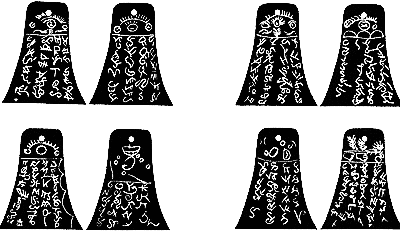
The Kinderhook Plates are one of American history’s most audacious cons. Six small, bell-shaped pieces of brass. Strange engravings. A fake burial in an ancient Native American mound. And a prophet who took the bait. What started as a small-town prank in Illinois spiraled into a controversy that haunted a religious movement for nearly 140 years. The story has everything , secret forgeries, dream-driven excavations, acid-etched hieroglyphics, and a translation that was never supposed to exist. This wasn’t just a joke. It was a trap. And it worked.
How the Kinderhook Plates Were Forged in Secret
It began with two men who didn’t want to be converted. Wilburn Fugate was a farmer. Robert Wiley ran a merchant shop. Both lived near Kinderhook, Illinois, in the early 1840s. Latter Day Saint missionaries had been knocking on doors. They used a pamphlet called A Voice of Warning by Parley Pratt. One phrase stuck with Fugate and Wiley: “Truth would spring up out of the earth.”
They decided to make that prophecy literal , as a joke.
The two men recruited Bridge Whitton, the village blacksmith and postmaster. Together, the trio cooked up a scheme. Whitton cut six small plates from pieces of copper. Fugate and Wiley etched strange symbols onto them using a clever trick. They pressed designs into beeswax, filled the impressions with acid, and applied the acid to the metal. Then they aged the plates artificially. They mixed nitric acid, old iron, and lead to create fake rust. They bound the plates together with a hoop iron ring. When finished, the plates looked ancient. They looked real.
Fugate later described the whole operation in an 1879 letter preserved in historical archives. He insisted the goal was simple: a joke on the local Latter Day Saint congregation. Not an elaborate trap for Joseph Smith himself. Just a prank to “startle the natives,” as his son put it.
But things got out of hand fast.
The Kinderhook Plates Emerge from an Ancient Mound
For more strange history, see: Bananadine: The Great Banana Peel Hoax That Fooled America in 1967
On April 16, 1843, Wiley started digging. He chose an Indian burial mound near Kinderhook. His cover story was strange. He claimed he had dreamed , three nights in a row , that treasure was buried beneath the mound. Neighbors believed him. Or at least they were curious enough to watch.
Wiley dug alone at first. He reached about ten feet down before giving up. The work was brutal. A week later, on April 23, he returned with ten or twelve helpers. Together they pushed deeper. They hit a layer of limestone. It looked charred, as if scorched by ancient fire. Two feet below that, they found human bones. Also charred. And then , the plates.
Six brass pieces. Bell-shaped. Bound together with a ring. Covered in strange symbols nobody could read.
A man named W. P. Harris took the plates home. He washed them and treated them with sulfuric acid. The cleaning revealed even more mysterious engravings. The symbols looked like hieroglyphics. Word spread immediately. The plates were put on display in Kinderhook before being shipped north to Nauvoo, Illinois , where Joseph Smith was waiting.
The timing was electric. Smith had already claimed to translate the Book of Mormon from buried golden plates just thirteen years earlier. Now here were more mysterious buried plates. Would he translate these too?
He said he could.
Joseph Smith and the Kinderhook Plates Translation
Smith examined the plates. He declared them genuine ancient artifacts. He said they contained the record of a descendant of Ham , a biblical figure. He claimed to have partially translated the engravings. A Latter Day Saint publication, The Times and Seasons, announced that the plates confirmed the Book of Mormon’s authenticity. Parley Pratt wrote that the plates contained Egyptian engravings and genealogical records of ancient peoples.
The faithful were thrilled. Critics were watching closely.
But Smith’s translation was never formally canonized. It never became official scripture. It existed in a strange limbo , believed by many, but never fully adopted. And then Smith was killed in 1844. The plates scattered. One ended up in the Chicago Historical Society’s collection. The others vanished.
For decades, the LDS Church defended the plates as genuine. That defense lasted until the evidence became impossible to ignore.
Science Exposes the Truth Behind the Brass Plates
In 1980, researchers at Northwestern University got their hands on the surviving plate from the Chicago Historical Society. They ran a battery of scientific tests. X-ray fluorescence analysis revealed the chemical composition of the metal. The results were damning.
The plate wasn’t ancient copper or bronze. It was a 19th-century brass alloy. The kind of metal that simply didn’t exist in pre-Columbian America. The acid-etching technique matched exactly what Fugate had described in his 1879 letter. The artificial rust was a modern creation. Every test pointed to the same conclusion: the plates were made in the 1840s.
The Church of Jesus Christ of Latter-day Saints officially acknowledged the hoax in 1981. After nearly 140 years of defense, the verdict was in. The Kinderhook Plates were fakes. Fugate had been telling the truth all along.
But questions lingered. If the plates were so obviously a hoax, why did Smith , a man who claimed divine translating gifts , fall for them? Did he genuinely believe in their authenticity? Was he performing for his followers? Or did he see an opportunity and take it? No one can answer that now. Smith took whatever he knew to his grave.
The story of the Kinderhook Plates remains one of the strangest intersections of faith, fraud, and frontier America. Three small-town men with acid, beeswax, and a sense of humor managed to fool a prophet, embarrass a church, and create a mystery that lasted over a century. Historical records from the period show just how seriously the discovery was taken at the time. The hoax worked too well. And the questions it raised about revelation, translation, and religious authority never fully went away.