
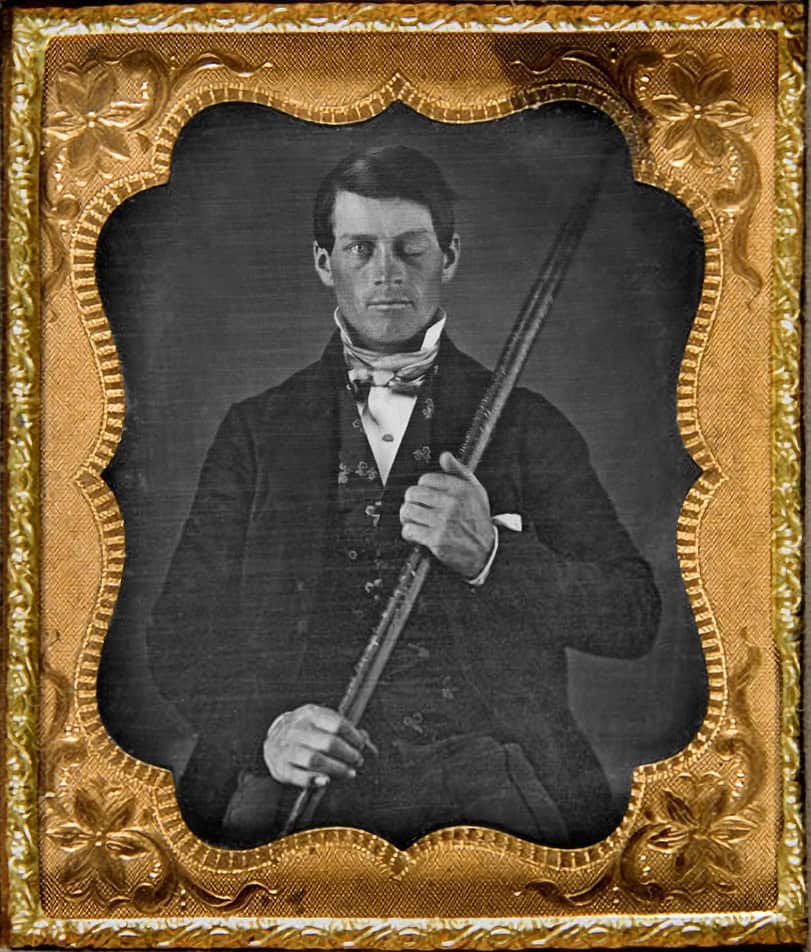
In 1848, Phineas Gage survived something that should have killed him instantly. An iron tamping rod , 3.5 feet long and over an inch thick , blasted clean through his skull. It entered beneath his left cheekbone. It exited through the top of his head. It landed 80 feet away, slick with blood and brain matter. Gage not only survived the explosion. He sat up, spoke to bystanders, and rode into town on a cart. But the man who walked away from that Vermont railway cutting was not the man who had walked into it. Something had changed. Something deep, invisible, and deeply unsettling. His story became one of the most disturbing and debated medical cases in history , a real-life horror story about identity, the brain, and what makes us us.
The Day Phineas Gage Lost Part of His Mind
September 13, 1848. Cavendish, Vermont. Gage was a 25-year-old railroad construction foreman. He was good at his job. Reliable. Calm under pressure. His crew respected him. That afternoon, he was tamping blasting powder into a rock with his iron rod. The powder ignited early. The explosion launched the rod like a missile. It punched through his left cheekbone, tore through his brain’s left frontal lobe, and burst out the top of his skull. The rod was later found with “blood and brains” on it.
Here’s the truly eerie part. Gage never lost consciousness. He spoke within minutes. He walked with help. Local physician Dr. John Harlow treated him, later writing that he found Gage sitting in a chair, calmly telling him what had happened. Half the man’s brain was effectively destroyed. Yet he was talking.
He survived the initial trauma. He survived dangerous infections over the following weeks. By early 1849, he was physically recovered. Medical records from the period confirm he walked, worked, and functioned. But something was profoundly, permanently wrong.
Phineas Gage and the Personality That Vanished
This event shares similarities with: The Voracious Appetite of Tarrare: A 18th-Century French Enigma
Before the accident, Gage was described as efficient, responsible, and well-liked. His employers called him their most capable foreman. After the rod went through his head, those qualities seemed to evaporate.
Dr. Harlow documented the transformation in chilling detail. Gage became fitful and irreverent. He showed little respect for others. He made grandiose plans and abandoned them instantly. He used profane language constantly , something completely out of character. He became impatient and obstinate. He couldn’t hold down steady work.
His friends said it plainly: he was “no longer Gage.”
This is what makes the case so deeply strange. His body healed. His speech returned. His memory functioned. But the person , the personality, the social awareness, the ability to make decisions and stick to them , seemed to have leaked out through that hole in his skull along with the blood and brain matter.
His case became known as the “American Crowbar Case.” Doctors and scientists argued about what it meant. It challenged everything people believed about the brain. Could personality live in a specific piece of tissue? Could a single injury erase who someone was? These were terrifying questions for the 19th century. They’re still unsettling today.
The frontal lobe damage Gage suffered is now understood to affect impulse control, decision-making, and social behavior. But in 1848, this was revolutionary , and deeply disturbing , territory.
Wandering Years: The Strange Afterlife of Phineas Gage
After his recovery, Gage drifted. He spent time at Barnum’s American Museum in New York, displaying himself and his famous iron rod to curious crowds. He carried the rod everywhere. It became his “constant companion.” There’s something haunting about that image , a man walking around with the object that destroyed part of his identity, showing it off for money.
He later worked as a stagecoach driver in Chile, managing horses across difficult terrain for nearly seven years. Historians now believe this period may have actually helped him recover some social function. The demanding, structured daily work may have forced his damaged brain to adapt. Some researchers call this a “social recovery” , the brain rewiring itself through routine and necessity.
He returned to the United States around 1859. His health was failing. He moved in with his mother in San Francisco. He began having seizures. On May 21, 1860, Phineas Gage died during a severe seizure episode , status epilepticus , at age 36. He was buried in San Francisco. Period medical journals documented his case extensively, treating it as one of the most remarkable in recorded history.
His skull and the tamping iron were later exhumed. They now sit in the Warren Anatomical Museum in Boston , a macabre monument to the most famous brain injury in history.
The Questions That Still Haunt This Case
The story doesn’t end neatly. It never does with the truly strange ones.
Historians and neuroscientists have argued for over 170 years about what really happened to this man’s personality. The dramatic accounts , the monster who emerged from the accident , were almost certainly exaggerated. Later evidence suggests he recovered more function than early reports indicated. The man driving stagecoaches across the Andes wasn’t a raving madman. He held a job. He managed animals and passengers. He functioned.
But was he the same person? Nobody who knew him before seemed to think so.
There’s also the question of the portrait. A daguerreotype identified in 2009 shows a well-dressed, composed man holding his tamping iron like a trophy. He doesn’t look like a broken person. He looks proud. Maybe even defiant. That image “exploded the common image of Gage as a dirty, disheveled misfit,” according to researchers who analyzed it.
So who was he, really? The charming, capable foreman? The erratic, profane wanderer? The dignified man in the portrait? The answer might be all three , and none of them. The rod took something from him that couldn’t be named or measured. That’s what makes this case so enduringly creepy.
A piece of iron flew through a man’s brain. He lived. But the thing that made him him , that ineffable quality we call a self , was never quite the same again. And that might be the strangest, most unsettling thing about the entire story.
Related Posts
 The Bone Wars: A Fossil Frenzy that Shaped Paleontology
 Tailings Dam Failure: A Century of Environmental Disasters and Mining Industry Negligence
 Himalayan Fossil Hoax: The Greatest Paleontological Fraud That Fooled Science for Decades
 French Guillotine Blinking Experiment: The Macabre Quest to Prove Consciousness After Death