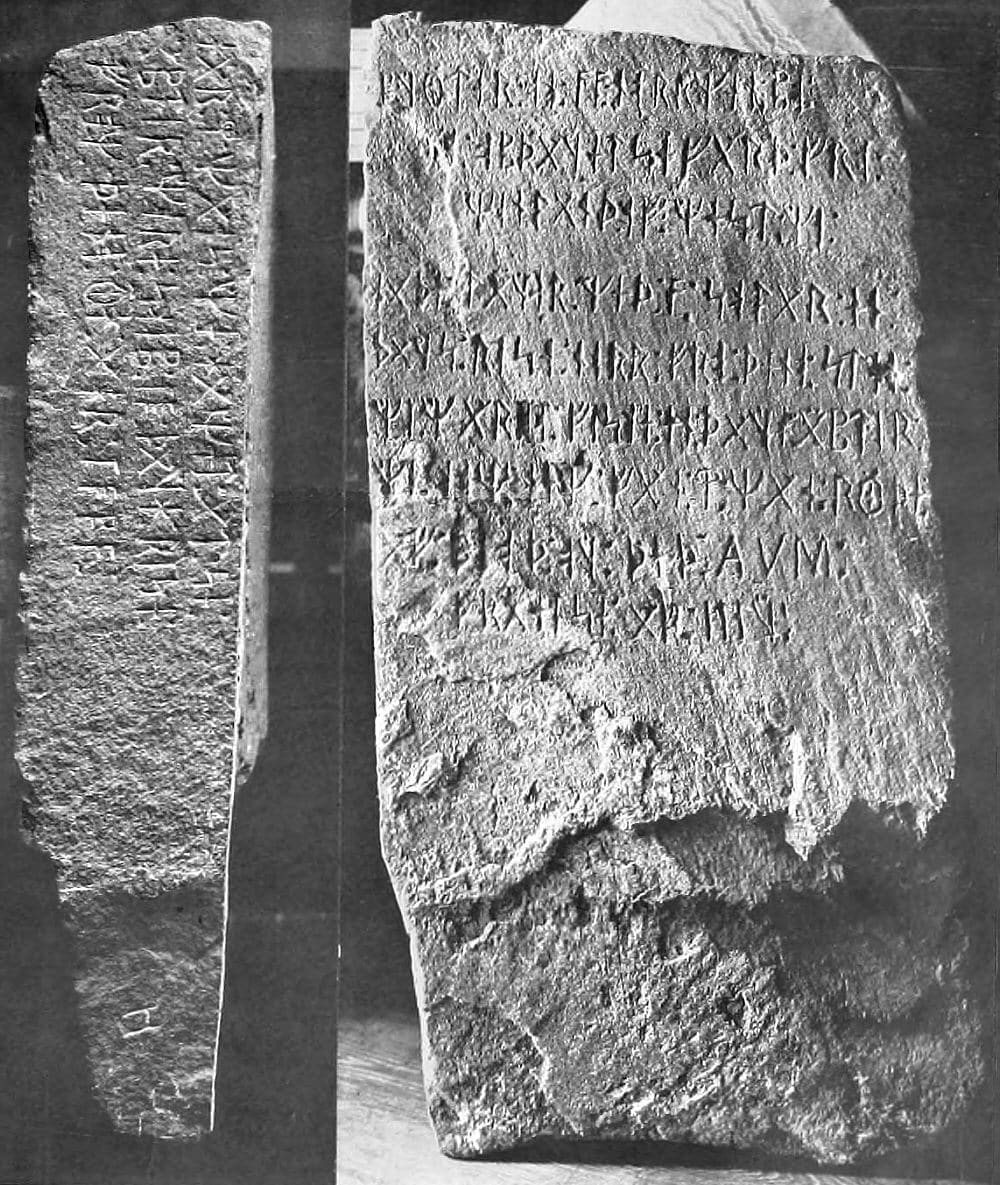
In 1898, a Swedish immigrant farmer named Olof Ohman pulled something deeply unsettling from the roots of a tree on his Minnesota property. The Kensington Runestone was a slab of greywacke rock covered in runic carvings. The inscription told a chilling story. It described a party of Scandinavian explorers in 1362. It described a fishing trip. And it described coming home to find ten of their companions “red from blood and dead.” Those four words have haunted historians, hoax hunters, and true believers ever since. Was this genuine proof of medieval Norse explorers deep in the American heartland? Or was it the most audacious forgery ever planted in a farmer’s field? More than a century later, nobody can fully agree. The mystery refuses to die quietly.
The Kensington Runestone’s Bloody Message from 1362
The inscription carved into the stone is genuinely disturbing to read. It doesn’t just claim Norse explorers reached Minnesota. It records a massacre.
The text translates roughly as follows. Eight Götalanders and 22 Northmen were on an exploration journey from Vinland, far to the west. They camped one day’s journey north from the stone. They went fishing. When they returned to camp, they found ten men soaked in blood. All of them were dead.
The carver then added a desperate plea: “Ave Maria, save from evil.”
That’s not a land claim. That’s a cry for help scratched into rock by someone terrified.
The side of the stone adds more detail. Ten more men were left by an inland sea to guard the ships. The party was fourteen days’ journey from that location. The year given is 1362.
Think about what that means. A group of medieval Scandinavians allegedly penetrated deep into the North American continent. They were ambushed or attacked. Half their party was slaughtered. The survivors were alone, hundreds of miles from their ships, carving a message into a rock in what is now Douglas County, Minnesota.
If true, it would rewrite American history entirely. The Norse didn’t just briefly touch the coast at L’Anse aux Meadows. They pushed into the continent’s interior. And something terrible happened to them there.
The stone was found tangled in the roots of a large aspen tree. Ohman claimed the roots had grown around it, suggesting it had been buried for centuries. Neighbors confirmed the roots were tightly wrapped around the stone. That detail is important. It’s also deeply contested.
The Kensington Runestone Forgery Debate Gets Ugly
For more strange history, see: Edward Mordake: The Tragic Tale of England’s Two-Faced Heir
Almost immediately, experts smelled a hoax. The first scientific examination came in 1910. Scholars looked at the runic alphabet used on the stone. They found problems. Some of the runes didn’t match any known medieval system. Others looked suspiciously like 19th-century Swedish dialect forms. The scholarly consensus hardened quickly. This was a fake. A clever one, but a fake.
Suspicion fell directly on Olof Ohman himself. He was a Swedish immigrant with some education. He owned books about runes. Critics argued he had both the knowledge and the motive. Scandinavian immigrant communities in Minnesota were large and proud. A stone proving Norse ancestors had walked this land before Columbus would have been enormously meaningful to them.
But Ohman denied it until his death. He never profited from the stone. He actually seemed annoyed by the whole affair. He sold the stone for a pittance and spent years watching others debate it. That’s an odd behavior for a master forger basking in his creation.
The debate didn’t stay polite. Researchers accused each other of bias. Linguists clashed over obscure grammatical forms. Geologists argued about weathering patterns. One researcher claimed the stone showed centuries of natural erosion. Others said it looked freshly carved. The arguments grew personal and bitter.
Historical accounts from the early 20th century show just how heated this controversy became in academic circles almost immediately after the stone’s discovery.
Strange Details the Kensington Runestone Skeptics Can’t Fully Explain
Here’s where things get genuinely weird. The case against the stone being authentic is strong. But the case isn’t airtight. Some details don’t fit the simple hoax narrative neatly.
The stone uses certain runic forms that weren’t documented in published sources available in 1898. Researchers who support authenticity argue Ohman couldn’t have known these forms existed. They claim the runes match a medieval Swedish dialect that wasn’t properly studied until decades after the stone appeared. How would a Minnesota farmer forge something that anticipated future linguistic scholarship?
The geology also causes headaches. Some experts who examined the stone’s weathering patterns concluded the carvings showed significant age. The edges of the runes had rounded in ways consistent with long burial. Skeptics countered that Minnesota soil conditions could accelerate that process. The argument goes in circles.
Then there’s the geography. The stone was found in an area near lakes that genuinely could have been reached by canoe from Hudson Bay. Medieval Norse explorers knew Hudson Bay existed. The route is difficult but not impossible. The fourteen-day journey mentioned on the stone’s side roughly matches the distance to the inland sea if you trace the waterways.
None of this proves the stone is real. But it keeps the mystery alive. Every time researchers think they’ve buried it for good, something pops up to restart the argument.
The town of Alexandria, Minnesota, leaned fully into the mystery. They erected a giant Viking statue named “Big Ole.” The city calls itself the “Birthplace of America.” The stone now sits in the Runestone Museum, drawing curious visitors who want to see the object at the center of one of America’s strangest historical controversies.
A Mystery That Won’t Stay Buried
The stone endures because it taps into something primal. It’s not just about Vikings in Minnesota. It’s about a massacre. Ten men found soaked in blood. A desperate prayer carved into rock. Survivors fleeing toward ships they might never reach.
Even if the stone is a 19th-century forgery, someone sat down and invented that story. They chose to write about death and terror rather than triumph. They included a Catholic prayer , Ave Maria , in what was supposedly a Norse inscription. That’s a strange choice for a forger trying to prove Viking glory.
And if it’s real? Then somewhere in the Minnesota wilderness in 1362, a group of frightened men buried a stone and walked away into history. We don’t know if they made it back. We don’t know who killed their companions. We don’t know what they found out there.
The mystery of the stone is inseparable from that bloody message. Whatever its origin, it speaks of violence, fear, and people who vanished without another trace.