
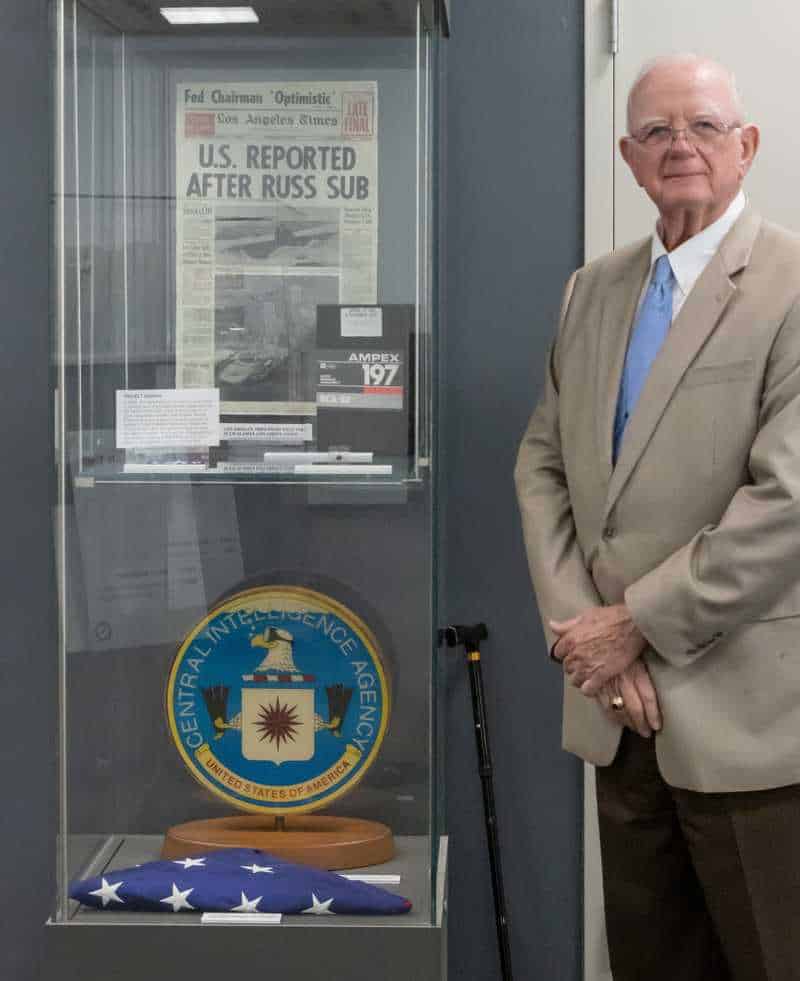
Project Azorian is one of the strangest, most audacious covert operations in American history. In 1974, the CIA attempted something that sounds like science fiction. They tried to secretly steal a sunken Soviet nuclear submarine from the bottom of the Pacific Ocean. The sub had been sitting nearly three miles underwater for six years. The Soviets didn’t even know where it was. But the Americans did. And they wanted what was inside it , badly enough to spend $800 million and build an entirely fake mining company to get it.
This wasn’t just espionage. This was something far weirder and more desperate. It was a ghost hunt at the bottom of the sea.
Project Azorian and the Ghost Submarine Nobody Could Find
On February 24, 1968, Soviet submarine K-129 left its base in Kamchatka on a routine patrol. It never came back.
The sub carried three nuclear ballistic missiles. It had a crew of 98 men. And somewhere out in the vast, cold Pacific, something went terribly wrong.
The Soviets launched a massive search operation. Ships and aircraft scoured the North Pacific for weeks. They found nothing. The K-129 had simply vanished. The Soviet Navy eventually gave up. The crew was listed as lost. Families were left with no answers. No wreckage. No explanation.
But the Americans had been listening.
The U.S. Navy’s SOSUS hydrophone network , a secret web of underwater microphones stretched across the ocean floor , had picked up something chilling. On March 8, 1968, sensors at multiple stations detected a distinct acoustic event. It was the sound of an implosion. Something had catastrophically collapsed deep underwater.
Naval analysts cross-referenced data from four Air Force Technical Applications Center sites and the Adak, Alaska SOSUS array. Using five separate lines of bearing, they triangulated the location to within five nautical miles. The Americans knew exactly where the K-129 had gone down. The Soviets did not.
Then the USS Halibut was sent to confirm it. The submarine dragged a 12-foot, two-ton camera sled called “the Fish” through the crushing darkness. It was built to survive extreme depths. After weeks of searching, the Fish found the wreck sitting at 16,500 feet below the surface. The images it returned were haunting. The K-129 lay broken and silent on the ocean floor, surrounded by debris and the remains of its crew.
The CIA saw an opportunity too valuable to ignore.
The Project Azorian Cover Story Was Gloriously Bizarre
Another fascinating historical case is: Michael Malloy: The Unkillable Man Who Survived 40 Murder Attempts
How do you secretly raise a Soviet submarine from the bottom of the ocean without anyone noticing?
You pretend to mine for rocks.
The CIA’s cover story was that eccentric billionaire Howard Hughes was funding a deep-sea mining operation to collect manganese nodules from the Pacific floor. Hughes was the perfect front man. He was famously reclusive and obsessive. Nobody would dare question his strange business decisions. The media accepted the story without much suspicion.
The CIA secretly funded the construction of a massive custom ship called the Hughes Glomar Explorer. It was unlike anything ever built. The ship had a giant derrick capable of lowering nearly three miles of pipe. It had a hidden moon pool , a secret chamber in its hull , where the submarine could be lifted without anyone seeing it from the outside. A specially designed mechanical claw called the “capture vehicle” or grapple would grab the wreck from the ocean floor.
The whole operation cost roughly $800 million. In today’s money, that’s over $4 billion.
The CIA worked with scientists to develop methods for preserving waterlogged paper documents. They hoped to recover the K-129’s codebooks and cryptological equipment. An intact Soviet nuclear missile would also be a spectacular prize. The intelligence value was almost unimaginable.
Declassified CIA records confirm just how obsessively detailed the planning was. Every contingency was considered. Except one.
Project Azorian’s Terrifying Moment of Failure
In the summer of 1974, the Hughes Glomar Explorer moved into position above the wreck site. The crew lowered the massive pipe string into the abyss. It took days. The mechanical claw descended nearly three miles in total darkness, guided by cameras and sonar.
Then it grabbed the submarine.
The recovery began. Slowly, agonizingly, the broken hull of K-129 began rising from the ocean floor. It had been down there for six years. The metal was corroded and fragile. The weight was immense.
And then something broke.
A mechanical failure in the grapple caused two-thirds of the recovered section to simply fall away. The massive chunk of submarine plunged back into the darkness, tumbling back toward the ocean floor. Whatever secrets it held vanished with it.
The crew managed to recover only the forward section of the submarine , roughly 38 feet of the boat. Inside, they found the remains of six Soviet sailors. The CIA gave them a burial at sea. The ceremony was filmed and later offered to Russia after the Cold War ended.
What the recovered section contained remains partially classified. Some reports suggest the Americans found torpedoes and other equipment. The nuclear missiles and codebooks , the primary targets , were almost certainly in the section that fell away.
The whole truth may never be known.
The Cover-Up That Couldn’t Stay Covered
The operation stayed secret for a while. Then, in early 1975, burglars broke into a Hughes corporate office in Los Angeles. Among the stolen documents were papers referencing the submarine recovery mission. The story leaked to the press.
The CIA scrambled to contain the damage. They contacted major news organizations and asked them to hold the story on national security grounds. Most complied , for a time. Then journalist Jack Anderson broke the news on his radio program. The story exploded.
The public learned that the U.S. government had secretly built a fake mining company, used Howard Hughes as a front, and tried to steal a Soviet nuclear submarine from the bottom of the Pacific Ocean.
The Soviets, naturally, were furious. But they could say very little publicly without admitting they’d lost a nuclear submarine in the first place.
The strange legacy of this mission endures. The Hughes Glomar Explorer continued operating for decades as a legitimate deep-sea drilling ship. The phrase “We can neither confirm nor deny” , now famous as a standard government response to sensitive inquiries , was first coined specifically to handle press questions about this operation. It’s called the “Glomar response,” and it’s still used by intelligence agencies today.
Project Azorian remains one of the most audacious covert operations ever attempted. A ghost submarine. A fake billionaire mining company. A mechanical claw reaching into the abyss. And a secret that the ocean ultimately refused to give up entirely. Some mysteries, it seems, belong to the deep.
More strange stories
 Operation Northwoods: The Terrifying Secret Plan to Bomb Americans Into War
 The Gemstone File: The Most Dangerous Conspiracy Document in American History
 Uvb-76: The Mysterious Russian Radio Station That Never Stops Broadcasting
 Sherwood Syndrome: The Shadowy Police Doctrine That Haunts Barcelona’s Streets