
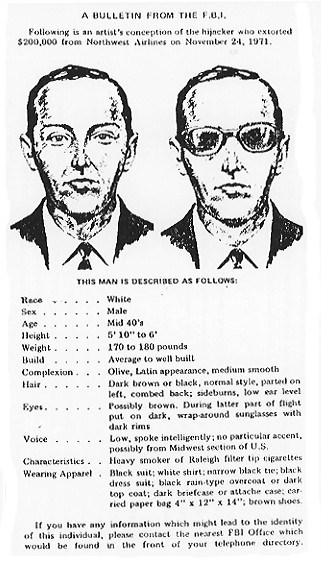
On November 24, 1971, D. B. Cooper pulled off one of the most audacious crimes in American history , and then simply disappeared. He hijacked a commercial airplane. He extorted $200,000 in ransom. He strapped on a parachute and leaped into a cold, rainy night over the wilderness of the Pacific Northwest. Then he was gone. No body was ever found. No identity was ever confirmed. No arrest was ever made. Decades later, the case still haunts investigators, armchair detectives, and anyone who loves a good mystery. This wasn’t just a crime. It was a vanishing act so complete it borders on the supernatural. How does a man jump from a moving aircraft in a storm, over dense forest, and simply cease to exist? That question has never been answered , and it may never be.
The Night D. B. Cooper Hijacked Flight 305
It was Thanksgiving Eve. A quiet, ordinary man in a dark business suit bought a one-way ticket with cash at Portland International Airport. He called himself Dan Cooper. He boarded Northwest Orient Airlines Flight 305 , a Boeing 727 headed to Seattle , and took seat 18-E at the back of the plane. He ordered a bourbon and 7-Up. He seemed calm. Unremarkable. Then he handed a note to flight attendant Florence Schaffner. She assumed it was a phone number from a lonely traveler. She slipped it into her purse without reading it. Cooper leaned close and told her she’d better look at it.
The note said he had a bomb.
Inside his black attaché case, he showed her what appeared to be red cylinders, wires, and a battery. The crew had no reason to doubt him. Cooper made his demands clearly. He wanted $200,000 in cash. He wanted four parachutes , two primary, two reserve. He wanted the plane refueled in Seattle. And he wanted to be flown to Mexico City. Authorities scrambled to comply. The ransom was assembled. The parachutes were delivered. All 36 passengers were released safely on the tarmac in Seattle. Then the plane took off again , with Cooper, the crew, and a bag full of cash.
Somewhere over the dark forests of southwest Washington, Cooper tied the money bag to his body. He lowered the aircraft’s rear airstair. He stepped off into the stormy night. The temperature outside was near freezing. Rain was falling. The terrain below was some of the most rugged wilderness in the country. According to the FBI’s case file, no one saw him land. No one saw him again.
D. B. Cooper and the Money That Washed Ashore
This event shares similarities with: Polybius Arcade Game: 1981 Portland Oregon Government Experiment The Mind Control Urban Legend That Won’t Die
For nine years, nothing turned up. Then in February 1980, a young boy named Brian Ingram was digging in the sand along the Columbia River near Vancouver, Washington. His fingers hit something strange. He pulled out three small bundles of decaying cash. The bills were from the ransom. The serial numbers matched. About $6,000 worth of notes were recovered that day , soggy, rotted, and partially decomposed.
It was the only physical trace ever found.
The discovery raised more questions than it answered. How did the money get there? Did Cooper land nearby and lose the cash in the river? Did he drown? Was the money planted? The bills were so degraded that investigators couldn’t determine how long they’d been in the water. Some experts believed the bundles had washed downstream over years. Others weren’t so sure. The rest of the ransom , nearly $194,000 , has never surfaced anywhere.
The FBI investigated for 45 years. They built one of the most extensive case files in American history. They interviewed hundreds of suspects. They chased leads across the country. They used forensic techniques unavailable in 1971. And they found nothing definitive. In 2016, the bureau officially suspended the active investigation. The case remains the only unsolved case of air piracy in the entire history of commercial aviation. The FBI’s own case page acknowledges the mystery remains open to the public even after the formal investigation closed.
Who Was D. B. Cooper? The Theories That Won’t Die
The name “D. B. Cooper” wasn’t even his alias. The real alias was “Dan Cooper.” A reporter confused it with another suspect during early coverage, and the wrong name stuck forever. That small error became part of the legend.
Over the decades, investigators and obsessives have proposed dozens of suspects. Some were military veterans with parachute training. Some were former criminals. One theory pointed to a man named Richard Floyd McCoy Jr., who pulled off a nearly identical hijacking just months later in 1972. The FBI investigated him but ultimately ruled him out. Others have pointed to a man named L.D. Cooper, a Northwest resident whose family came forward in 2011 with what they believed was evidence. DNA tests were inconclusive.
What makes this case so eerie is how perfectly Cooper seemed to vanish. He knew about the Boeing 727’s rear airstair , a feature most passengers didn’t know existed. He knew enough about parachutes to reject one of the reserve chutes offered to him. He was calm under extreme pressure. He wasn’t cruel. He never threatened violence beyond the bomb claim. Witnesses described him as polite, even pleasant. He tipped the flight attendants.
Who trains for something like this? Who pulls it off so cleanly? And who then disappears so completely that not a single confirmed trace of them surfaces in over fifty years?
The Legend Lives On , And Gets Stranger
The hijacking changed American aviation forever. Metal detectors appeared in airports almost immediately. Baggage inspection became mandatory. The Boeing 727’s rear airstair was modified so it couldn’t be lowered in flight. A whole wave of copycat hijackings followed in 1972, all inspired by the same audacious crime. None of the imitators succeeded. None vanished as cleanly.
But Cooper’s legend only grew. He became a folk hero to some , a working-class Robin Hood who outsmarted the government and got away clean. Movies, books, podcasts, and documentaries have all tried to crack the case. Every few years, a new suspect emerges. A new piece of “evidence” surfaces. And then it falls apart under scrutiny.
The truth is, we don’t know if Cooper survived his jump. Experts who’ve studied the conditions that night , the rain, the cold, the terrain, the speed of the aircraft , believe survival was unlikely. Some think he died in the wilderness within hours. His body may still be out there, deep in the forests of southwest Washington, slowly becoming part of the earth.
Or maybe he walked out of those woods with $200,000 and lived out his days in quiet anonymity. Maybe he’s buried in a cemetery somewhere under a different name. Maybe he sat in a diner the next morning, drinking coffee and reading about himself in the newspaper.
The mystery of Dan Cooper , the man the world knows as D. B. Cooper , may be the greatest unsolved riddle in American criminal history. And the most unsettling part? We may never know the answer.
More strange stories
 The Disappearance of Frederick Valentich: The Pilot Who Vanished After Reporting a UFO
 Baron 52: The Vanished Airmen Who May Have Been Taken to Soviet Gulags
 Air Rage: The Dark, Violent History of Sky-High Meltdowns That Changed Aviation Forever
 Emergency Landing at 41,000 Feet: The Gimli Glider’s Impossible Flight