
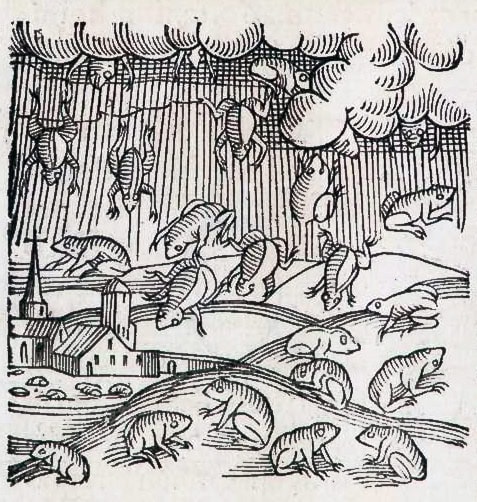
Raining animals sounds like something from a nightmare. But this bizarre phenomenon has been documented across centuries, cultures, and continents. Witnesses describe ordinary skies suddenly unleashing cascades of living creatures. Fish flopping on rooftops. Frogs blanketing entire town squares. Snakes coiling in the streets after a storm. These aren’t fairy tales. These are real historical accounts , and science still can’t fully explain them.
The sheer strangeness of these events is what makes them so unsettling. We expect rain to bring water. When it brings life instead, something feels deeply, fundamentally wrong. People who witnessed these falls often described feelings of terror and awe in equal measure. Were they being punished? Blessed? Or had the sky simply lost its mind?
Animal rain is classified as a rare meteorological phenomenon. But “rare” doesn’t mean it only happened once or twice. Reports stretch back thousands of years , and they keep coming.
The Ancient History of Raining Animals
The oldest accounts of raining animals aren’t folklore. They’re recorded history.
The Bible describes a rain of frogs as one of the ten plagues of Egypt. This wasn’t a gentle shower of amphibians. It was a devastating, suffocating deluge. Frogs covered every surface. They filled ovens and kneading bowls. They crawled into beds. The Egyptians couldn’t escape them.
The Greeks documented similar horrors. In the fourth century BC, the historian Athenaeus described a rain of fish that lasted three full days. The location was the region of Chaeronea in the Peloponnese. Three days. Imagine the smell. Imagine the sound of fish hitting stone streets hour after hour.
By the Middle Ages, these events were so common in certain regions that locals developed entire cosmologies around them. Some believed fish were born in the clouds. They thought the sky was a kind of celestial ocean, and storms simply released its inhabitants onto the land below.
In 1625, a rain of frogs struck Tournai, Belgium. Witnesses were baffled and terrified. Then in 1794, French soldiers fighting near Lille reported toads falling from the sky during heavy rain at Lalain. These weren’t trained observers prone to exaggeration. These were hardened military men. And they were shaken.
In 1680, snakes reportedly rained down on a community, an event disturbing enough to be illustrated and preserved in historical records. A sky full of writhing serpents descending onto your village is the stuff of pure horror.
Raining Animals in Honduras: The Fish That Fall Every Year
Another fascinating historical case is: Bridgewater (1785 Eic Ship): The Cursed East Indiaman That Vanished Without a Trace
One of the most persistent and documented cases of raining animals happens in Yoro, Honduras. The locals call it the lluvia de peces: the rain of fish.
Every summer, dark storm clouds gather over Yoro. Then the rain comes , heavy, violent, and relentless. When it finally stops, the streets and fields are covered in small, living fish. The fish are still alive. People collect them and eat them. It happens every single year.
The tradition is so established that Yoro now holds an annual festival to celebrate it. But the origin story is stranger still. Local legend says the phenomenon began after a 19th-century Spanish missionary named Father José Manuel Subirana prayed for three days and three nights. He begged God to feed his starving congregation. Then the fish fell from the sky.
Scientists have visited Yoro. They’ve studied the fish. Here’s the truly unsettling part: the species found on the streets after these storms don’t live in any nearby rivers or lakes. Some researchers believe they may come from underground water systems. Others think waterspouts carry them from the Atlantic coast. But nobody has ever witnessed the actual moment the fish appear. They’re simply there when the storm ends.
Historical scientific records show that investigators have puzzled over similar cases worldwide for centuries without reaching firm conclusions.
What Science Says About Raining Animals
The leading scientific explanation involves tornadic waterspouts. These are tornadoes that form over water. The theory suggests that a powerful waterspout can scoop up fish, frogs, or other small creatures from a lake or ocean. It then carries them for miles through the air. Eventually, the storm weakens. The animals fall.
This explanation has some merit. Most reported cases involve small, lightweight creatures. They’re almost always aquatic animals. The events are usually preceded by storms. These details fit the waterspout theory reasonably well.
But the theory has serious problems. Scientists have never actually observed a waterspout sucking up animals. Not once. Every account is secondhand. Every piece of evidence is circumstantial.
There’s another problem that nobody has solved. When animals rain down, they’re almost always a single species. If a waterspout grabbed creatures from a pond or lake, you’d expect a chaotic mix of different animals. Instead, witnesses report only frogs. Or only one type of fish. Or only pink frogs, as happened in Gloucestershire, England in October 1987.
In that case, residents of three towns , Stroud, Cirencester, and Cheltenham , reported dozens of tiny pink frogs falling during rainstorms over two weeks. Pink frogs. All the same species. All the same size. Some researchers suggested winds had carried frog eggs from Africa. But that explanation raises more questions than it answers.
French physicist André-Marie Ampère was one of the first scientists to take these reports seriously. He suggested that violent winds could pick up large groups of frogs roaming the countryside and carry them great distances. It was a reasonable hypothesis for his era. We haven’t improved much on it since.
The Unexplained Details That Keep This Mystery Alive
The waterspout theory is tidy. Real life is messier.
Consider the selectivity problem. Waterspouts don’t discriminate. They pull up everything in their path , weeds, mud, rocks, sticks, multiple species of fish. Yet raining animal events almost always feature just one type of creature. This precision suggests something else is happening. Something we don’t understand.
Consider the altitude problem. For a waterspout to carry animals over long distances, it would need to lift them to considerable heights. At those altitudes, temperatures drop sharply. Most small amphibians and fish would freeze or die. Yet many reported creatures arrive alive and healthy.
Consider the timing. In Honduras, the fish fall every summer. Not randomly. Not unpredictably. Every. Single. Summer. That regularity doesn’t fit the random chaos of tornado activity.
And then there are the truly inexplicable cases. In 1861, fish rained on Singapore. French naturalist Francis de Laporte de Castelnau suggested the fish had simply walked overland from puddle to puddle after heavy rain. Walking catfish do exist. But the sheer volume of fish reported made that explanation seem absurd.
Raining animals remains one of the few phenomena that sits at the uncomfortable intersection of documented history and complete scientific mystery. The events are real. The witnesses are credible. The evidence is physical , you can pick up the fish and eat them.
We just can’t explain where they come from.
—
The sky has been dropping creatures on us for thousands of years. Raining animals appears in ancient texts, military records, religious scripture, and modern news reports. Science offers theories. None of them fully hold up. Something is pulling creatures from one place and delivering them to another , silently, selectively, and without leaving behind a single piece of definitive proof. Until we catch it happening in real time, the mystery stays open. And the next storm might bring anything.
Related Posts
 Biblical Conspiracy Theory: The Hidden Truth About Sacred Texts and Secret Societies
 Eye of Providence: The All-Seeing Symbol That Has Haunted History for Centuries
 The Antikythera Mechanism: Ancient Greece’s Impossible Computer from the Deep
 Forced Landing: The Strangest and Most Sinister Incidents in Aviation History