
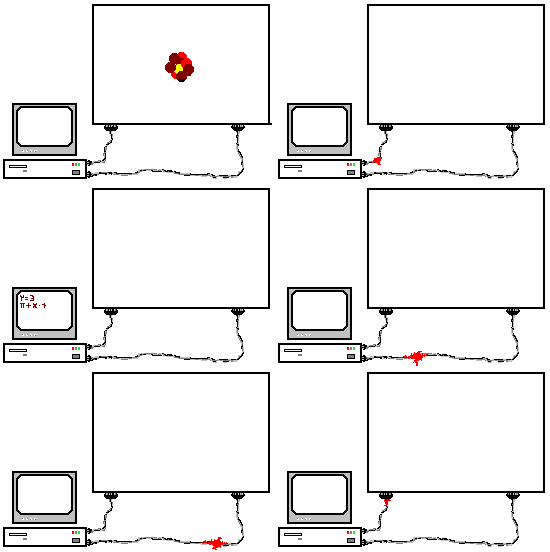
The Simulation Hypothesis claims that everything you see, touch, and remember might be computer code. Your coffee, your childhood, the stars overhead. All of it could be a program running on hardware you’ll never see.
That sounds like a late-night dorm room theory. But serious philosophers, physicists, and tech billionaires have wrestled with it. Some say the odds are strong that we’re living in a simulation. Others say the idea is unfalsifiable nonsense.
Here’s the creepy part. Humans have suspected something like this for thousands of years. Ancient sages, Gnostic mystics, and French philosophers all worried that reality might be a stage set. Then, in 2003, a Swedish philosopher turned the old fear into a cold piece of logic. It’s been hard to shake ever since.
You can read the full academic overview on Wikipedia’s simulation hypothesis page. But the real story is stranger than a summary. It’s a story about dreams, demons, and doubt.
Ancient Whispers Behind the Simulation Hypothesis
Long before computers, people felt the world wasn’t quite real. In ancient China, the sage Zhuangzi dreamed he was a butterfly. When he woke, he couldn’t tell if he was a man who’d dreamed of a butterfly. Or a butterfly now dreaming he was a man.
That’s unsettling. It’s also the Simulation Hypothesis in embryonic form.
Indian philosophy offered the idea of Maya, the veil of illusion. Greek thinkers like Anaxarchus and Monimus compared existence to a painted stage backdrop. They said life resembled the impressions of sleep or madness. Aztec texts went further. They described the world as a painting, or a book, written by a divine force called the Teotl.
Then came the Gnostics. Their belief was darker. They taught that our reality was built by a lesser being, a demiurge. This creator was flawed, maybe even malevolent. Humanity’s task was to escape its handiwork.
Think about that for a second. A fake world, built by a sketchy creator, designed to keep you trapped. Sound familiar? Hollywood would borrow the plot nearly two thousand years later.
Plato added his famous cave. Prisoners sit chained, watching shadows on a wall. They think the shadows are everything. They’ve never seen the fire, or the sun beyond it.
None of these thinkers had a computer. But they all sensed the same thing. The world might be a surface. And something stranger could be running underneath.
Descartes, Demons, and the Digital Universe
Related article: Uvb-76: The Mysterious Russian Radio Station That Never Stops Broadcasting
In the 1600s, René Descartes made the doubt personal. He imagined an evil demon. This being was powerful and cunning. Its only job was to deceive him about everything. The sky, the earth, even his own body might be illusions fed straight into his mind.
Later thinkers updated the nightmare. The “brain in a vat” showed up, a brain floating in fluid, wired to a machine that creates experience. Every sight and sound would be fake. And the brain would never know.
Then the computer age arrived, and the demon got a new costume.
In 1969, German engineer Konrad Zuse published a book called Calculating Space. He proposed that the universe itself was computational. Reality, he argued, might run like a vast cellular automaton. This idea became known as digital physics.
Roboticist Hans Moravec pushed the thought further. He explored mind uploading, the transfer of a human mind into a machine. He also speculated that our own reality could be a simulation built by future intelligences.
Notice the shift. Descartes feared a demon. Moravec imagined engineers. The deceiver wasn’t supernatural anymore. It was technological, and maybe even human in origin.
Pop culture ate it up. Simulacron-3 appeared in 1964. Then in 1999, The Matrix and The Thirteenth Floor both hit theaters. Audiences left cinemas staring at ceiling tiles, wondering if anything looked a little too perfect.
Bostrom’s Trilemma: The Simulation Hypothesis Gets Mathematical
In 2003, philosopher Nick Bostrom published what he called the simulation argument. Here’s the twist. It doesn’t actually claim we live in a simulation. Instead, it says one of three wild propositions must be true.
First option: almost no civilizations survive long enough to build realistic simulations. They die out first. War, plague, or some self-made catastrophe wipes them out. That’s a grim possibility.
Second option: advanced civilizations could build simulations, but almost none of them want to. They lose interest, or they find it unethical.
Third option: we’re almost certainly living in a simulation.
Why that third one? The logic is cold and clean. If advanced beings run simulations of their ancestors, they might run millions. Each would contain billions of conscious minds. Simulated minds would then vastly outnumber the real ones. Pick a conscious being at random, and odds are overwhelming that you’ve picked a simulated one.
That’s a statistical gut punch.
There’s a catch. The argument assumes consciousness isn’t tied to biology. It assumes a mind could arise from the right computations, even on silicon. Philosophers call this functionalism. If consciousness requires living tissue, the whole house of cards collapses.
You can explore the original paper through the official simulation argument website. It’s surprisingly readable, and it’ll make your next commute feel weird.
Critics push back hard. Some argue we can’t know how simulators would behave. Others say the argument smuggles in assumptions about consciousness. A few point out that we have zero evidence. But the trilemma sticks around, because nobody has cleanly broken it.
Glitches, Déjà Vu, and Searching for the Seams
If reality is code, shouldn’t there be bugs? That’s the question that keeps the idea alive at the fringes. And it’s where things get delightfully strange.
People report all kinds of oddities. Déjà vu, that eerie sense of having lived a moment before. Sudden memory conflicts, like the famous “Mandela effect,” where large groups remember the same detail differently. Objects that vanish and reappear in plain sight. Some folks call these glitches in the matrix.
Is there anything to it? Almost certainly not. Psychologists have mundane explanations for most of these experiences. Memory is messy. Brains fill in gaps. Still, the human mind loves a pattern, and the glitch idea is a perfect pattern machine.
Some physicists have tried to look for real seams. Certain limits in nature, like the speed of light or the tiny scale called the Planck length, look a bit like resolution settings. A few researchers have suggested hunting for pixel-like structure in cosmic rays. So far, nothing conclusive has turned up.
That’s the maddening part. If the simulation is good enough, you’d never find the edges. And if you did find them, how would you know it wasn’t part of the program?
Think of it as the ultimate locked-room mystery. The room is the universe.
More strange stories
 The Furtive Fallacy: History’s Darkest Obsession With Hidden Conspiracies and Secret SinsDebunker: The Strange History of Those Who Challenged the Paranormal, the Occult, and the Unexplained
 Raining Animals: History’s Most Terrifying Sky Falls
 Eye of Providence: The All-Seeing Symbol That Has Haunted History for Centuries