
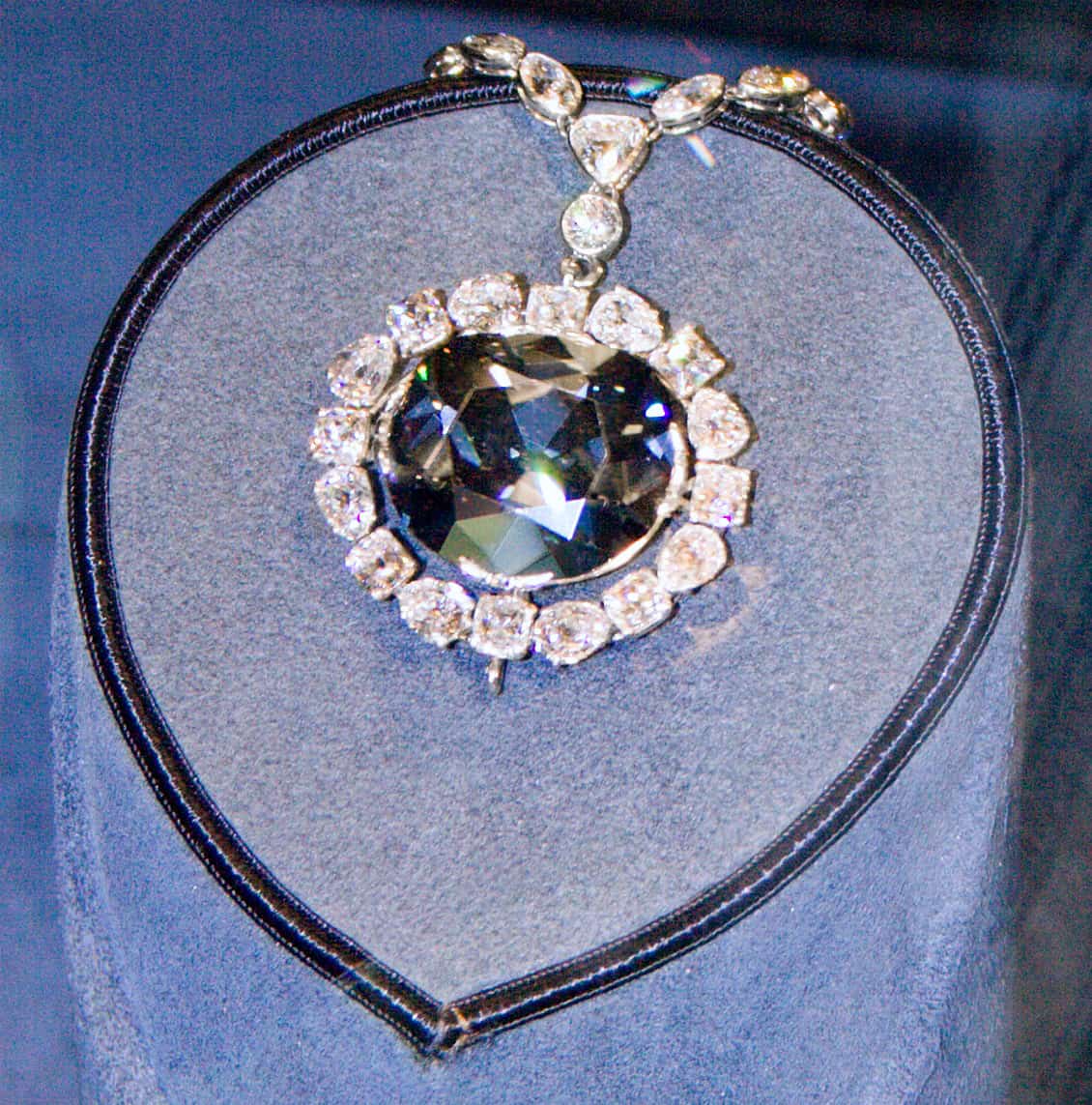
The Hope Diamond is a 45.52-carat blue gem that glows an eerie red after dark. That alone is strange. Add a trail of ruined fortunes, a daring theft, and whispers of a curse, and you’ve got one of history’s creepiest jewels. It was pulled from the earth in India centuries ago. Today it sits behind glass in Washington, D.C., watched by millions of visitors every year.
Is it cursed? Scientists say no. But the stone’s history reads like a ghost story. Kings lost their heads. Owners lost their fortunes. And the gem itself does something no ordinary rock should do. It seems to burn with a ghostly light.
Let’s follow the trail. It starts in the dirt of southern India and ends in a museum case. The middle part is where things get dark.
The Hope Diamond’s Bloody Beginning in India
The story begins in the Kollur Mine in Andhra Pradesh, India. Workers there dug up a rough blue stone sometime before 1666. Nobody recorded their names. Nobody knows what happened to them.
That year, a French gem merchant named Jean-Baptiste Tavernier bought the raw stone. He was a famous traveler and dealer. He described its color as a beautiful violet. He carried it back to Europe and had it cut.
Then came the first piece of the legend. Some tales claim the stone was ripped from the eye of a Hindu idol. The story says a priest cursed anyone who dared own it. Here’s the problem. No solid evidence backs that up. Historians suspect the tale was invented later, because it made the gem more thrilling to buyers.
Still, the legend stuck. It followed the stone across oceans and centuries.
Tavernier sold the cut gem to King Louis XIV of France in 1668. The king renamed it the French Blue, or Le bleu de France. He wore it on a ribbon around his neck at royal ceremonies. It was a symbol of absolute power.
Power doesn’t last, though. The Sun King’s descendants would pay dearly for owning that blue fire.
Stolen Jewels and the Hope Diamond Vanishing Act
Related article: Bass Strait Triangle: Australia’s Paranormal Hotspot Where Planes and Ships Vanish Without a Trace
The French Blue passed down through the royal family. Louis XV and Louis XVI both kept it among the crown jewels. Then the French Revolution tore the country apart.
In 1792, thieves broke into the royal storehouse in Paris. Over several nights, they walked off with a fortune in jewels. The French Blue vanished with them. The robbery was careless and almost comically easy. Guards barely tried to stop it.
Louis XVI was executed in January 1793. Queen Marie Antoinette followed in October. Some storytellers say the stone doomed them both. That’s a stretch, since the jewel was already stolen when they died. Still, the timing gives people chills.
The gem dropped out of sight for about twenty years. Then a blue diamond of similar color appeared in London. It was smaller. Someone had cut it down. Experts later proved it was the French Blue, recut to hide its identity.
Who cut it? Nobody knows. That’s one of the great unsolved puzzles of the story. A thief, a dealer, or a nervous buyer may have altered it. The trail goes cold right when it should get interesting.
By 1839, the stone showed up in a catalogue owned by the Hope banking family of London. That’s where the name comes from. The family tree wasn’t lucky, though. One heir ended up broke, and the gem was sold off to pay debts.
The Curse of the Hope Diamond Owners
Now we reach the part that fuels every campfire telling. The curse stories exploded in the early 1900s. Newspapers loved them. A jeweler named Pierre Cartier reportedly sold the gem in 1911 to Evalyn Walsh McLean, a wealthy American socialite.
Cartier knew how to sell a story. Some historians believe he helped spread the curse rumors to make the stone irresistible. A cursed jewel sounds dangerous. It also sounds priceless.
The tales that followed were wild. Some claimed a Russian prince was stabbed to death after owning the gem. Others said a sultan went mad. A Greek jeweler allegedly drove off a cliff with his family. Many of these people may never have existed. Researchers have checked, and most of the death stories collapse under scrutiny.
But McLean’s life was genuinely tragic. Her first son died in a car accident at age nine. Her husband ran off and ended up in a mental institution. Her daughter died of an overdose. McLean always insisted she didn’t blame the stone. She even wore it to parties and let her dog wear it at times.
Believe in curses or not, the pattern is hard to ignore. Wealth, fame, and grief seem to orbit this gem. Maybe that’s just human nature. Or maybe something stranger is going on.
You can read more about the gem’s recorded history on the Hope Diamond Wikipedia page.
The Ghostly Red Glow Scientists Can Explain
Here’s where the legend meets real science. Shine ultraviolet light on this blue stone, then switch it off. It keeps glowing. The afterglow is a deep, burning red.
Imagine seeing that in a dark room in 1850. No wonder people whispered about witchcraft. The glow lingers for several seconds, like an ember refusing to die.
Scientists have solved this part of the mystery. The stone contains traces of boron, which gives it the blue color. It also holds nitrogen. Together, these elements trap and slowly release energy as red light. Researchers even use this glow as a fingerprint to tell natural blue diamonds from fakes.
The Smithsonian’s research has revealed more. The stone is a rare type IIb diamond. It likely formed far deeper in the earth than most diamonds. Its size has taught geologists new things about how diamonds form.
The stone also changed hands one last time in a surprising way. Jeweler Harry Winston bought it in 1949. Then in 1958, he mailed it to the Smithsonian in a plain brown paper package, with registered mail postage of about $145. Yes, really. The most famous gem on Earth traveled through the postal system.
You can see the gem today through the Smithsonian Institution at the National Museum of Natural History.
Some people claim the curse struck Winston’s mail carrier. The story says the man broke his leg, lost his family, and had a house fire. It’s a fun tale. It’s also almost certainly invented.
So what do we make of it all? The Hope Diamond has outlasted kings, thieves, and widows. It has survived revolutions, recuts, and the mail. Its glow is science. Its curse is probably marketing. But a stone that burns red in the dark and leaves grief in its wake sure feels haunted. Maybe the strangest thing is that it’s still here, quietly glittering, waiting for the next story to be told about it.
More strange stories
 Ghost Town Secrets: The World’s Most Haunted and Mysterious Abandoned Places
 Ball Lightning: The Unexplained Glowing Orbs That Have Terrified Witnesses for Centuries
 The Boiling Frog: The Creepy 19th-Century Experiment That Became History’s Most Disturbing Warning
 Mummy Forgeries: The Shocking Fakes That Fooled Museums and Historians for Decades