
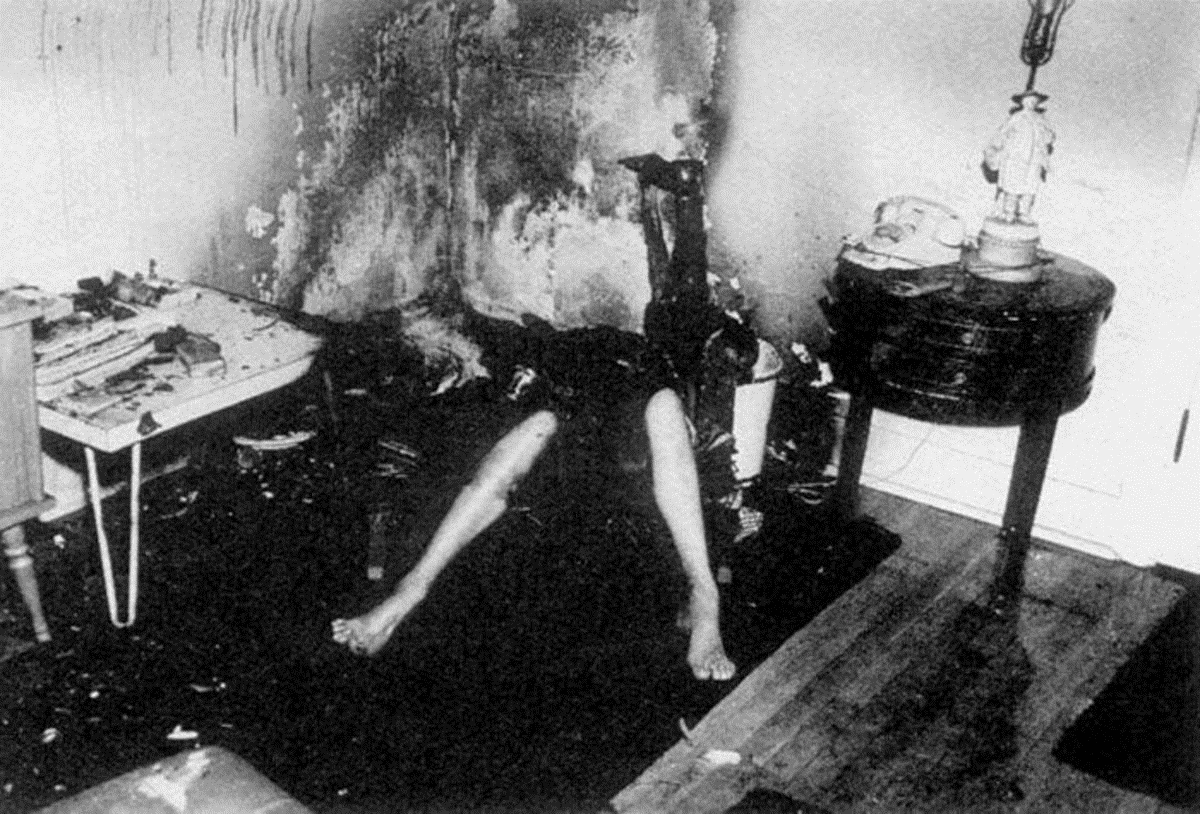
Spontaneous Human Combustion is one of the most disturbing mysteries in recorded history. A person is found burned to ash , yet the chair they sat in is barely singed. The floor beneath them is untouched. The room shows no signs of a fire spreading. Just a pile of greasy ash, a pair of feet still wearing shoes, and an oily residue coating the walls. No explanation. No source of flame. Just gone. This phenomenon has terrified physicians, baffled investigators, and haunted literature for over three centuries. And despite modern science, nobody has a truly satisfying answer.
The Shocking History of Spontaneous Human Combustion
The term “Spontaneous Human Combustion” was first coined in 1746. A Fellow of the Royal Society named Paul Rolli used it to describe the death of Countess Cornelia Zangari Bandi. She was found one morning reduced almost entirely to ash. Her legs remained intact. A greasy soot covered the walls and ceiling of her bedroom. The bed was barely damaged. No fire had been reported. No candle had fallen. Nothing explained it.
Rolli published his findings in the Philosophical Transactions of the Royal Society, giving the phenomenon scientific credibility , at least for a time. The case sent shockwaves through European medical communities. Doctors began collecting similar reports. What they found was deeply unsettling.
By the mid-1800s, enough cases had been gathered to identify a disturbing pattern. The victims were typically older, overweight women. Many drank heavily. Their bodies burned with an intense, localized heat. Water couldn’t extinguish the flames. The fire left behind a greasy, foul-smelling ash. Surrounding furniture often showed little to no damage. It was as if the fire came from inside the body itself.
Victorian physicians had a theory. They believed alcohol-soaked tissues became highly flammable. Some claimed the bodies burned with a light-blue flame. Others said the victims subsisted almost entirely on spirits. The moral undertone was impossible to miss. In that era, SHC was sometimes used as a cautionary tale against drinking.
The Most Disturbing Spontaneous Human Combustion Cases Ever Recorded
Another fascinating historical case is: Phantom Barber of Pascagoula: The Hair-Cutting Terror That Haunted Mississippi in 1942
The case files are genuinely horrifying. One of the most famous is Mary Reeser, found in her St. Petersburg, Florida apartment in 1951. Investigators discovered a skull shrunk to the size of a teacup. One foot remained in a slipper. The rest of her body , all 175 pounds of her , had been reduced to less than a pound of ash. The nearby walls were coated with a greasy film. The temperature required to reduce a human body to ash in a crematorium reaches over 1,600 degrees Fahrenheit. Yet Reeser’s plastic alarm clock, just feet away, had barely melted.
The FBI investigated. They couldn’t rule out an external ignition source. But nothing conclusive was ever found.
Then there’s the case of Dr. John Irving Bentley, discovered in 1966. Only his lower leg and foot remained. The rest had burned through the bathroom floor, leaving a hole in the wood. The bathtub next to him was untouched. His walker still stood nearby. The fire had been impossibly contained , burning with ferocious intensity in one small spot while leaving everything else alone.
Historical medical journals from this era document similar cases with clinical detachment. But the details are anything but clinical. They’re terrifying.
These cases share the same chilling fingerprints. Extreme localized burning. Intact extremities. Minimal surrounding damage. A greasy, foul residue. And no clear ignition source.
What Science Says About Spontaneous Human Combustion
Modern science has pushed back hard on the supernatural explanations. The most widely accepted theory today is called the “wick effect.” The idea is grim but logical. A small external flame , a cigarette, a candle , ignites clothing. The fabric acts like a candle wick. Human body fat acts like the wax. The body essentially slow-burns from the outside in. Over many hours, this process can reduce a body to ash while keeping surrounding temperatures low enough to spare nearby objects.
Forensic scientist John de Haan tested this theory in 1998. He wrapped a pig carcass in fabric and ignited it. The results were striking. The body burned slowly but completely. The surrounding area stayed largely undamaged. It matched many SHC crime scenes almost perfectly.
But critics aren’t satisfied. They point out that many victims showed no signs of having been near an open flame. Some were found in positions that suggested they died almost instantly , not over the course of several hours. And the shrunken skulls, the completely incinerated torsos, the perfectly preserved feet , these details still don’t sit comfortably with the wick theory.
The current scientific consensus holds that all cases involve overlooked external ignition sources. But “overlooked” is doing a lot of heavy lifting in that sentence.
Why This Mystery Still Keeps People Up at Night
What makes these cases so deeply unsettling isn’t just the gore. It’s the helplessness. If the wick theory is correct, then anyone who falls asleep near a flame could theoretically suffer the same fate. But if something else is at work , something we don’t yet understand , then the implications are far darker.
Larry E. Arnold, writing in his 1995 book Ablaze!, documented around 200 reported cases spanning 300 years. He argued that some cases simply cannot be explained by conventional fire science. He proposed that some unknown internal energy source might be responsible. The scientific community dismissed his work. But the cases he documented remain deeply strange.
Charles Dickens famously used the phenomenon in Bleak House, where a character named Krook dies by spontaneous combustion. Dickens defended his use of the concept against critics who called it unscientific. He believed it was real. The image he created , a man reduced to a smear of soot on the wall , has haunted readers ever since.
Spontaneous Human Combustion sits in that uncomfortable space between science and the unexplained. The official answer , external ignition, wick effect, case closed , feels tidy. But the actual case files don’t feel tidy at all. They feel like something went terribly, inexplicably wrong. Something that science hasn’t fully accounted for. And somewhere out there, another case file is waiting to be opened.
Related Posts
 Women and Children First: The Deadly Maritime Code That Failed When It Mattered Most
 Museum of Hoaxes: The Website That Exposes History’s Most Shocking Deceptions
 The Captain Goes Down with the Ship: The Eerie Code That Haunts Maritime History
 Iron Maiden: The Medieval Torture Device That Never Existed