
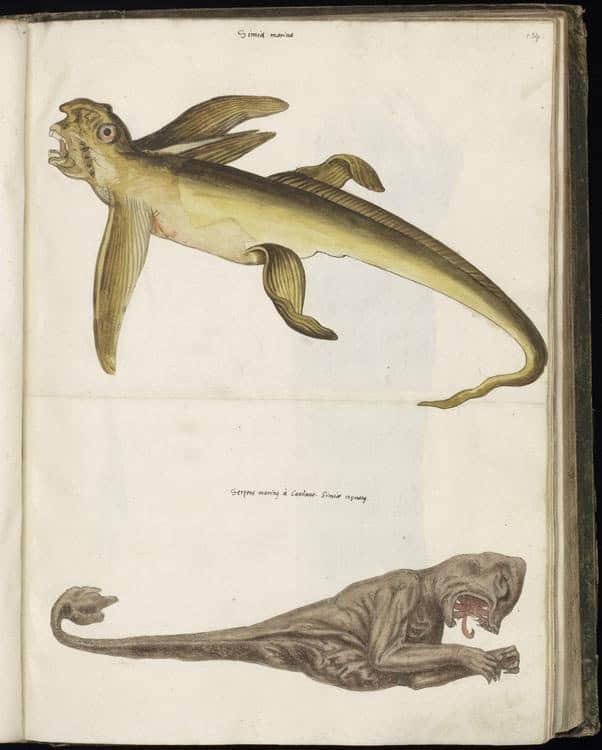
In 1741, a trained scientist watched something impossible swim alongside his ship. Steller’s Sea Ape was no fleeting glimpse. Georg Steller observed the creature for two full hours. He was a careful man. He documented new species throughout his voyage. But this animal left him baffled , and it has puzzled researchers ever since. It didn’t match anything known to science. It juggled seaweed like a circus performer. It dove under the ship repeatedly, as if playing a game. And then it vanished into the cold Alaskan waters, leaving behind nothing but a description that would haunt naturalists for centuries.
Steller’s Sea Ape: The Night a Scientist Saw Something Impossible
August 10, 1741. The sun was setting near the Shumagin Islands, Alaska. Georg Steller stood aboard the St. Peter, part of Vitus Bering’s Great Northern Expedition. Then something surfaced near the ship.
It was about five feet long. Its head looked like a dog’s. It had pointed, erect ears. Long whiskers drooped from both its upper and lower lips , Steller compared them to a Fu Manchu mustache. Its body was thick and elongated. It tapered toward the tail. The tail itself had two fins, the upper one twice the size of the lower, much like a shark’s.
There were no visible forelimbs. No pectoral fins. Just a sleek, fur-covered body unlike anything Steller had catalogued before.
The creature stared at the ship. It raised a third of its body out of the water and held that pose , almost human-like , for several minutes at a time. The crew tried to approach. It swam back. They stopped. It crept closer again. This went on for two hours.
Then a long strand of seaweed drifted by. The creature shot toward it. It grabbed the stalk in its mouth. Then , and this is the part that defies easy explanation , it appeared to juggle and play with the seaweed like a trained monkey. It even ate pieces of it between tricks.
Steller grabbed a gun. He fired. He missed. The creature disappeared briefly, then returned. He fired again. It swam away and was never seen again.
What Was Steller’s Sea Ape? The Theories Are Stranger Than You’d Expect
This event shares similarities with: Jersey Devil: The Cursed Thirteenth Child That Terrorized New Jersey for Centuries
Scientists have tried to classify the creature at least four times. It’s been assigned the names Simia marina, Siren cynocephala, Trichechus hydropithecus, and Manatus simia. None of these classifications stuck. None fully matched the description Steller provided.
The most popular explanation is simple: Steller misidentified a northern fur seal. Fur seals live in those waters. They have whiskered faces and thick coats. They can be playful. Case closed, right?
Not quite.
Steller was not an amateur. He discovered and documented entirely new species on that same voyage , Steller’s sea cow, Steller’s sea lion, and Steller’s jay among them. He knew what a fur seal looked like. He had spent years studying marine life in the North Pacific.
The Simia marina comparison is also troubling. Steller linked his creature to an illustration in Swiss naturalist Conrad Gessner’s Historia animalium. But the original reporter of that creature, Italian biologist Gerolamo Cardano, believed it was likely a snake. Gessner himself described it as having a covering more like a turtle , green and hairless. Steller’s creature had reddish-white fur on its belly and gray fur on its back. The descriptions don’t line up at all.
So what exactly did Steller see? The honest answer is: nobody knows.
The 1965 Sighting: Steller’s Sea Ape Spotted Again?
The story doesn’t end in 1741. In June 1965, sailor Miles Smeeton was aboard his ketch, the Tzu Hang, near the northern coast of Atka Island, Alaska. He was with his daughter Clio and his friend Henry Combe.
Something surfaced near the boat.
The encounter lasted only 10 to 15 seconds. But what they saw was striking. The creature was about five feet long , the same size Steller reported. It had reddish-yellow fur, roughly four to five inches thick. Its face resembled a shih-tzu dog.
Smeeton later wrote about the sighting in his book Misty Island. He noted how closely Steller’s original account matched what he and his companions had witnessed. Two sightings. Two centuries apart. Both near the Aleutian Islands. Both describing the same basic animal.
Smeeton wasn’t a crank. He was a decorated British military officer and experienced sailor. His account is detailed and matter-of-fact. He wasn’t trying to start a legend. He was simply reporting what he saw.
You can explore historical maritime records and expedition accounts at Archive.org, where accounts from sailors of this era reveal how frequently strange creatures were reported in these remote Alaskan waters , and how seriously experienced mariners took such encounters.
The Creature That Science Still Can’t Explain
The Aleutian Islands remain one of the most remote and least-explored marine environments on Earth. The waters there are cold, deep, and full of life that science is still cataloguing. New species of marine mammals have been identified in the 21st century. The ocean keeps its secrets well.
Steller’s all-important writings were published only after his death. Most of his notes were lost entirely. What survived was published in two installments by Prussian zoologist Peter Simon Pallas in 1781 and 1793. In his famous work De Bestiis Marinus, Steller himself admitted the account was imperfect , he never collected a specimen. He could only offer his observations and a sketch.
That sketch has never been found.
What remains is a description from a credible scientist, a corroborating sighting 224 years later, and a creature that fits no known species perfectly. Was it a fur seal with unusually playful behavior? A species now extinct? Something that still lurks in those frigid waters?
Steller’s Sea Ape sits in a strange category. It’s too well-documented to dismiss entirely. It’s too elusive to confirm. It exists in that uncomfortable space between zoology and mystery , observed, recorded, and utterly unresolved. The Aleutian waters are dark and deep. Whatever Steller saw that August evening may still be out there, watching ships pass overhead, waiting to be seen again.
—
In 1741, a German zoologist spotted Steller’s Sea Ape near Alaska , a bizarre, unclassified creature that still haunts the waters of cryptid history.
Related Posts
 Anguila Peluda: The Terrifying Hairy Eel That Haunted Tenerife’s Dark Waters
 Snallygaster: Maryland’s Terrifying Winged Beast That Terrorized Communities for Centuries
 Proctor Valley Monster: The Hairy Giant Terrorizing San Diego’s Back Roads
 Popobawa: The Bat-Winged Terror of Zanzibar’s Dark Nights