
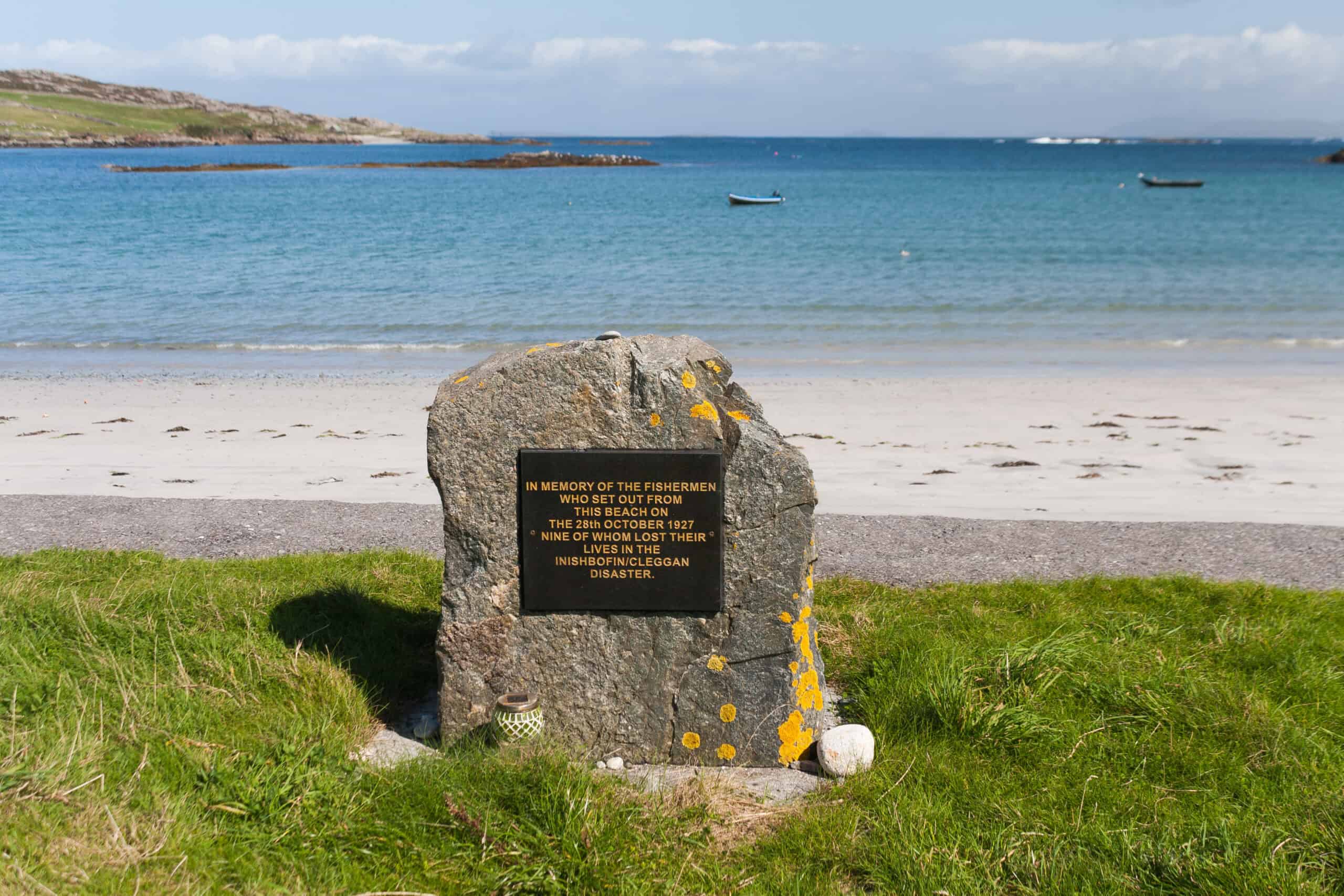
The Cleggan Bay Disaster is one of Ireland’s most haunting and heartbreaking tragedies. On the night of October 27, 1927, the Atlantic Ocean turned savage without warning. Forty-five fishermen were swallowed by the darkness. No distress signals. No time to pray. Just men who left home that morning and never came back. The waters off County Galway had always been dangerous. Locals knew it. They fished those waters anyway because they had no choice. But nothing could have prepared the coastal communities of Connemara for what was about to happen. In a matter of hours, entire villages lost their fathers, brothers, and sons. The grief was so total, so absolute, that one village simply ceased to exist. What happened that night still sends a chill through anyone who hears the story. The sea gave no explanation. It never does.
The Night of the Cleggan Bay Disaster
October 27, 1927 started like any other fishing day. The men set out into the Atlantic to catch mackerel. The season was good. The waters looked manageable. Then everything changed.
A violent gale erupted without warning. There were no weather forecasts. No radio alerts. No coast guard helicopters circling overhead. Just a wall of wind and water that hit the small fishing boats with terrifying force. The vessels were traditional wooden craft. They stood no chance against a storm of that ferocity.
Sixteen men came from the village of Rossadilisk. Nine came from the island of Inishbofin. Twenty more came from County Mayo. In total, 45 fishermen died that night. The scale of the loss was staggering for communities where every man was essential to survival.
Think about what that means for a small fishing village. Sixteen men from Rossadilisk alone. That’s not just a tragedy. That’s the complete destruction of a community’s future. Fathers, uncles, older brothers , gone. The boats that carried them were found wrecked along the coastline in the days that followed. Some bodies were recovered. Others were not.
The storm gave no warning. That detail haunts survivors’ accounts. One moment the sea was rough but workable. The next, it was a killing machine. Witnesses on shore described watching helplessly as the gale rolled in from the Atlantic like a living thing. There was nothing anyone could do.
A Village That Vanished: The Aftermath of the Cleggan Bay Disaster
Another fascinating historical case is: Capsizing: A Maritime Disaster That Changed Naval History Forever
What happened to Rossadilisk after the disaster is one of the eeriest chapters in Irish history. The village didn’t just mourn. It died.
Sixteen men from one small settlement were gone in a single night. The women left behind faced an impossible situation. Fishing was the only industry. Without men to fish, there was no income. Without income, there was no survival. One by one, the remaining families abandoned their homes. Rossadilisk became a ghost village in the most literal sense. The stone walls still stand today. Empty. Silent. The wind moves through them like a memory.
Visitors who walk through the ruins of Rossadilisk describe an overwhelming sense of sadness. Some describe something stranger. A feeling of being watched. A heaviness in the air that doesn’t lift. Whether that’s grief embedded in the landscape or something more unexplained, it’s hard to say. But the feeling is consistent. Almost everyone who visits mentions it.
The island of Inishbofin also carries its scars. Nine men from that small island community were lost. Historical records of County Galway document how deeply the disaster reshaped the social fabric of the entire region. Memorials were built. Songs were written. But nothing truly filled the void.
The grief spread far beyond Connemara. Funds were raised in the United Kingdom, the United States, and Australia to help the devastated families. Even across oceans, people understood that something terrible had happened on that Irish coastline.
Eerie Echoes: How the Cleggan Bay Disaster Lives On
Disasters of this magnitude leave marks that go beyond history books. They embed themselves in the culture. They haunt the landscape. The Cleggan Bay Disaster did all of that.
Poet Richard Murphy wrote about the tragedy in haunting verse. His work captures the terror of the storm and the silence that followed. Local songwriter Saoirse Mhór also turned the disaster into song. Music became the way communities processed grief that was too big for ordinary words.
TG4, the Irish language television channel, produced a documentary exploring the disaster’s impact. Survivors’ descendants shared stories passed down through generations. Many described a persistent local belief that the sea “took what it was owed” that night. That idea , of the ocean as a conscious, hungry force , runs deep in Connemara folklore.
The memorial on Inishbofin stands as a quiet but powerful reminder. People still visit it. They still leave flowers. On the anniversary of the disaster, locals gather to remember the men who never came home. Some claim the atmosphere around the memorial changes on October 27th each year. A stillness. A weight. Something that feels like more than just memory.
Strange stories cluster around the coastline where the boats went down. Fishermen in the area have reported hearing voices on the water during storms. Others describe seeing lights beneath the surface on calm nights. These accounts are impossible to verify. But they keep coming. Decade after decade.
Ireland’s Forgotten Tragedy and What It Means Today
The 1927 disaster is not as widely known as it should be. Outside of Connemara and Irish history circles, most people have never heard of it. That’s a strange kind of second tragedy. Forty-five men died. A village was erased from the map. And the world mostly moved on.
Marie Feeney’s 2001 book, The Cleggan Bay Disaster: An Account of the Savage Storm in October 1927, helped bring renewed attention to the event. It documented the communities of Rossadilisk and Inishbofin in detail. It gave names and faces to the statistics. That matters enormously.
Because these weren’t statistics. They were men who woke up that morning thinking about the day’s catch. Men who kissed their children goodbye. Men who had no idea the sea was about to claim them forever.
The ruins of Rossadilisk still stand on the Connemara coast. The memorial on Inishbofin still faces the Atlantic. And every year, on October 27th, the communities of County Galway remember. They remember the storm that came from nowhere. They remember the 45 men who never returned. And they remember that the sea keeps its secrets. It doesn’t explain itself. It doesn’t apologize. It just takes, and leaves silence behind.
—
The Cleggan Bay Disaster of 1927 killed 45 fishermen in one terrifying night. Discover the eerie story behind Ireland’s forgotten tragedy.
Related Posts
 Tristan Da Cunha Lifeboat Disaster: 15 Men Vanished Without a Trace in 1885
 Detroit Wayne (1919 Ship): The Cursed Freighter That Met Its Doom in the Graveyard of the Atlantic
 French Destroyer Framée: The Doomed Warship That Vanished in Minutes
 The Captain Goes Down with the Ship: The Eerie Code That Haunts Maritime History