
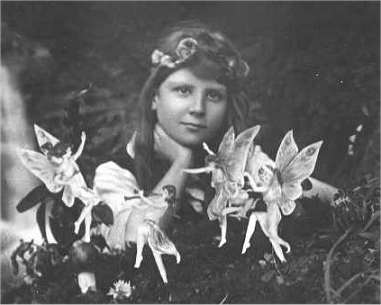
The Cottingley Fairies began as a simple prank in 1917 that would grow into one of history’s most enduring supernatural hoaxes. Two young cousins, 16-year-old Elsie Wright and 9-year-old Frances Griffiths, created five photographs that appeared to show real fairies dancing in their Yorkshire garden. What started as children’s mischief would captivate the world for over 60 years, fooling even the brilliant creator of Sherlock Holmes.
The girls lived in the village of Cottingley, near Bradford in England. They often played by the beck at the bottom of their garden, returning with wet clothes and wild stories about fairy encounters. When the adults scolded them, the girls insisted they were only getting wet because they went to see the fairies. To prove their claims, Elsie borrowed her father’s camera and returned triumphant with photographic “evidence.”
Arthur Wright, Elsie’s father and an experienced photographer, immediately suspected trickery. He knew his daughter’s artistic talents and dismissed the dancing figures as cardboard cutouts. But the damage was done – the photographs had been created, and they would soon escape the confines of a Yorkshire village to enchant the entire world.
The Cottingley Fairies Capture Global Attention
The photographs remained a family curiosity until 1919, when Elsie’s mother attended a Theosophical Society meeting in Bradford. The evening’s lecture focused on “fairy life,” and afterward, attendees shared their own supernatural experiences. When Polly Wright mentioned her daughter’s fairy photographs, the audience was electrified.
Word spread quickly through spiritualist circles. The images eventually reached Edward Gardner, a prominent Theosophist who became convinced of their authenticity. Gardner had the photographs examined by Harold Snelling, a photography expert who declared them genuine. Unknown to many at the time, Snelling was given contradictory instructions – both to authenticate the images and to enhance them for publication.
The story reached its pinnacle when Sir Arthur Conan Doyle encountered the photographs. The famous author was researching an article on fairies for The Strand Magazine’s Christmas 1920 edition. Doyle, a devoted spiritualist despite his creation of the logical detective Sherlock Holmes, saw the images as irrefutable proof of supernatural phenomena. His endorsement gave the story international credibility and sparked a media sensation that would persist for decades.
Strange Details Behind The Cottingley Fairies Deception
Related article: Phantom Time Hypothesis: The Conspiracy Theory That Claims 300 Years Never Existed
The truth behind the photographs reveals a conspiracy more complex than simple childhood mischief. Recent research has uncovered the intricate web of minor deceptions that made the hoax so convincing. Each participant unknowingly contributed to the elaborate fiction, creating a perfect storm of believability.
Elsie had copied the fairy figures from Princess Mary’s Gift Book, a popular children’s publication of the era. She carefully traced the illustrations onto cardboard, cut them out, and positioned them in the garden using hatpins. The girls’ knowledge of photography, gained from Elsie’s work in a photographer’s studio, helped them create convincing compositions.
Harold Snelling’s role proved crucial to the deception’s success. While tasked with authentication, he was simultaneously asked to improve the images for publication. His expert retouching added details to the fairies’ wings and enhanced their ethereal appearance. The enhanced photographs looked far more impressive than the originals, lending credibility to claims of supernatural encounters.
The conspiracy succeeded because no single person understood the full extent of the deception. Conan Doyle never personally investigated the photographs or met the girls, despite writing about them as if he had. He delegated the investigation to Gardner while serving as the story’s public face, giving the hoax global reach through his celebrity status.
The Long Road to Confession
For over 60 years, the secret remained locked away. Both girls married and moved abroad, carrying their childhood deception into adulthood. Frances sent one photograph to a friend in South Africa, casually noting on the back: “It is funny, I never used to see them in Africa. It must be too hot for them there.”
Interest in the story periodically resurged. In 1966, a Daily Express reporter tracked down Elsie, who had returned to England. She tantalizingly suggested she might have photographed her thoughts, reigniting media fascination. The photographs continued to captivate new generations, inspiring books, documentaries, and endless speculation about their authenticity.
The truth finally emerged in the early 1980s when both women, now elderly, admitted to the hoax. Elsie viewed the photographs as her greatest performance – a practical joke that brought her the attention she craved. Historical newspaper accounts from the period reveal how the story dominated headlines and sparked fierce debates about supernatural phenomena.
Frances maintained a different perspective throughout her life. While acknowledging the deception, she insisted the fifth and final photograph showed real fairies. Until her death in 1986, she clung to her childhood belief that she had genuinely encountered magical beings by the beck.
Legacy of an Extraordinary Hoax
The Cottingley Fairies photographs now reside in the National Science and Media Museum in Bradford, alongside the cameras used to create them. In 2025, complete sets of the photographs sold at auction for thousands of pounds, testament to their enduring fascination. The rarity of surviving prints adds to their mystique – most copies were destroyed over the decades.
Recent academic research continues to uncover new aspects of the story. Dr. Merrick Burrow from the University of Huddersfield has contributed fresh insights to the global understanding of the hoax. International interest remains strong, with Japanese media seeking expertise on the story due to ongoing fascination with Conan Doyle and nature spirits in Japanese culture.
The photographs succeeded because they arrived at the perfect moment in history. The aftermath of World War I had left many people desperate for wonder and magic in a world that seemed increasingly mechanical and brutal. The images offered hope that mystery and enchantment still existed, hidden in quiet Yorkshire gardens where children played.
The Cottingley Fairies represent more than a simple hoax – they reveal humanity’s deep desire to believe in magic. Even after the truth emerged, many people preferred the enchanting fiction to the mundane reality. The story continues to inspire new generations, proving that sometimes the most powerful truths are the ones we choose to believe, regardless of evidence to the contrary.
Related Posts
 Mary Toft: The Woman Who Fooled Doctors Into Believing She Gave Birth to Rabbits
 Prillwitz Idols: The Bronze Forgeries That Fooled European Nobility for Decades
 Iron Maiden: The Medieval Torture Device That Never Existed
 Pompey Stone: The 70-Year Archaeological Hoax That Fooled New York’s Best Scholars