
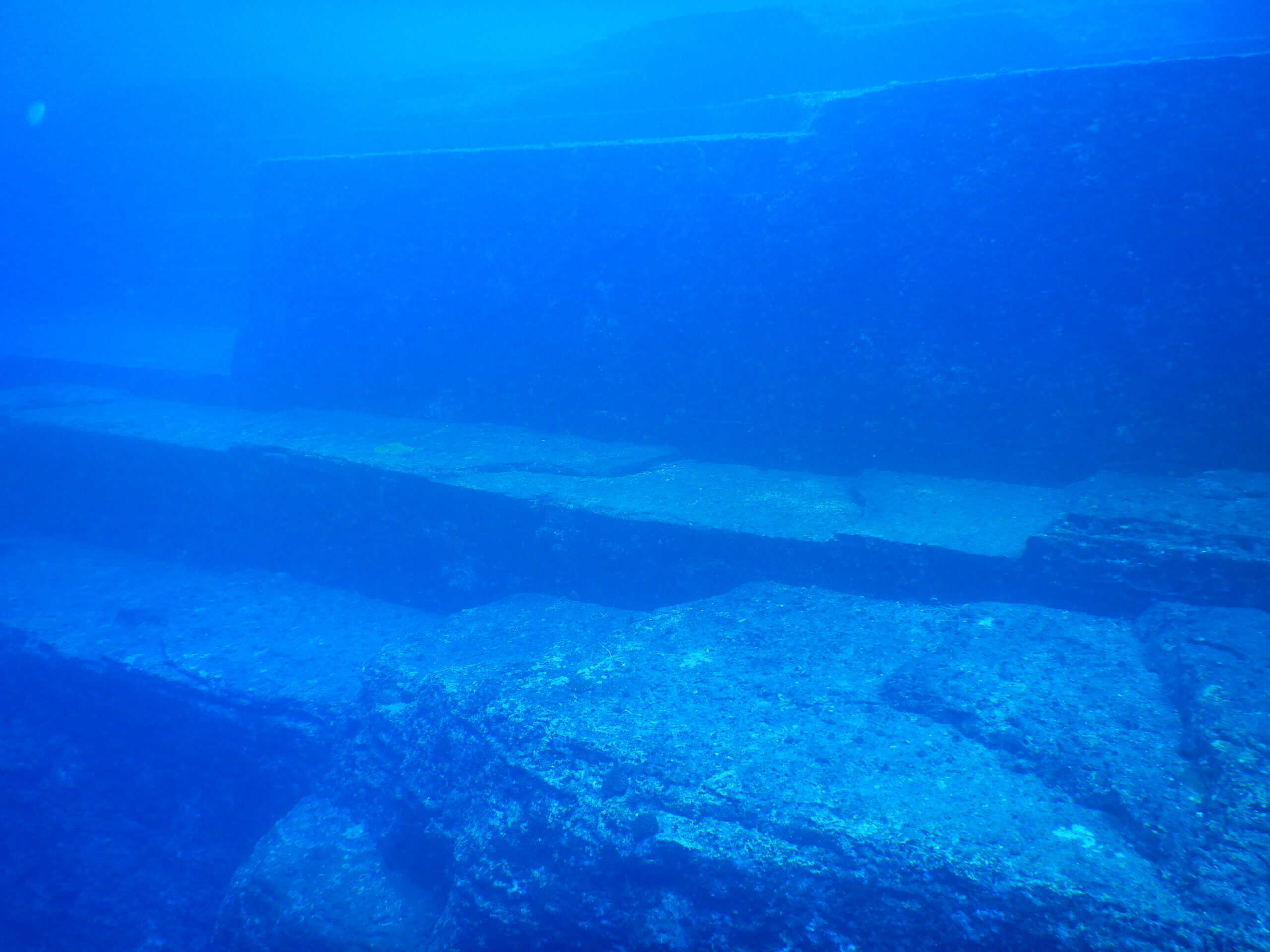
The Yonaguni Monument sits eerily beneath the waves off Japan’s southernmost island, defying easy explanation for nearly four decades. This massive underwater formation has sparked fierce debates between scientists, archaeologists, and believers in lost civilizations. Some claim it’s nature’s handiwork carved by millennia of erosion. Others insist it’s proof of an advanced prehistoric culture that vanished beneath the sea over 12,000 years ago.
The monument’s perfectly angular terraces and mysterious carved features continue to baffle experts. Divers describe swimming through what feels like an ancient temple complex, complete with steps, platforms, and intricate stone carvings. Yet no government agency recognizes it as a cultural artifact, leaving its true origins shrouded in mystery.
The Yonaguni Monument’s Shocking Discovery
In 1986, dive operator Kihachiro Aratake made a discovery that would challenge everything we thought we knew about prehistoric Japan. He was searching for hammerhead sharks in the waters off Yonaguni Island when he spotted something impossible on the seafloor below. Massive stone structures rose from the ocean floor like the ruins of a sunken city.
The formations didn’t look natural. They featured sharp right angles, perfectly straight edges, and what appeared to be carved steps and platforms. Aratake immediately contacted marine geologist Masaaki Kimura from the University of the Ryukyus. What Kimura saw during his first dive left him stunned.
The structures stretched for hundreds of feet underwater. Kimura identified what looked like quarry marks, primitive writing, and even animal sculptures carved into the stone. Over the next 15 years, he mapped ten distinct structures around Yonaguni and five more near Okinawa’s main island. His conclusion was revolutionary: these weren’t natural rock formations but the remains of an ancient civilization.
Mysterious Features That Challenge the Yonaguni Monument Skeptics
This event shares similarities with: Phantom Time Conspiracy Theory: The Missing 297 Years That Never Existed
The most unsettling aspect of the monument isn’t its size but its impossible precision. Divers report swimming through narrow passageways with perfectly straight walls and 90-degree corners. The main structure features massive terraces that look like giant steps, each one precisely cut and angled.
Recent expeditions have uncovered even stranger details. Explorers found what appears to be a triangular pool structure and possible ancient script carved into stone faces. One of the most bizarre discoveries is a rock formation shaped like a turtle that’s “almost star-shaped” with perfect geometric angles in multiple directions.
Perhaps most mysterious of all is a rock pillar found in a submerged cave. Scientists believe this formation could only have been created above water, suggesting the entire area was once dry land. If true, this means the monument was built over 12,000 years ago when sea levels were much lower.
The Yonaguni Monument’s Paranormal Encounters
Divers exploring the monument report experiences that go beyond scientific observation. Many describe an overwhelming sense of being watched while swimming through the structures. The water around the monument often feels unnaturally cold, even in tropical temperatures.
Local dive guides whisper about strange currents that seem to guide visitors toward specific areas of the ruins. Some divers claim to have seen shadowy figures moving through the stone corridors, only to find nothing when they investigate. The monument’s narrow passages create an acoustic effect where sounds seem to echo from impossible directions.
The official scientific position dismisses these reports as imagination fueled by the monument’s eerie atmosphere. However, experienced dive operators note that even the most skeptical visitors emerge from the depths visibly shaken by their encounter with the mysterious structures.
The monument’s location adds to its otherworldly atmosphere. It sits at the southern tip of Yonaguni Island, where powerful currents create an underwater environment unlike anywhere else in Japan. The combination of the monument’s impossible geometry and the area’s natural forces creates an experience that defies rational explanation.
Scientific Battle Over Ancient Origins
The monument has sparked one of archaeology’s most heated debates. Professor Kimura maintains his position after diving the site over 100 times in 20 years. He points to tool marks, carved symbols, and architectural features that he insists could only be human-made. His research suggests the monument represents evidence of a sophisticated culture that predates known Japanese civilization by thousands of years.
Boston University geologist Robert Schoch strongly disagrees. After extensive underwater investigation, he concluded the formations result entirely from natural erosion. Recent studies by Japanese researchers support this view, documenting ongoing weathering processes that could create the monument’s angular features over millions of years.
The debate intensified in 2025 when the monument gained renewed attention during a public discussion between researcher Graham Hancock and archaeologist Flint Dibble. Historical sea level data shows the area was indeed above water during the last ice age, making human construction theoretically possible.
What makes the controversy so compelling isn’t just the scientific evidence but the monument’s refusal to fit neatly into either explanation. Even skeptical dive teams admit that the accumulation of precise geometric features “forces even the most scientific minds to admit that nature alone building this doesn’t make sense.”
The Yonaguni Monument continues to guard its secrets beneath Japan’s waters, challenging our understanding of both natural geology and human prehistory. Whether carved by ancient hands or sculpted by the sea itself, this underwater enigma remains one of the world’s most compelling archaeological mysteries. Until definitive proof emerges, the monument will continue to spark imagination and debate, drawing adventurous divers into its shadowy depths where the line between natural wonder and human achievement becomes impossibly blurred.
Related Posts
 Okinoshima: Japan’s Forbidden Island Where Ancient Gods Dwell and Women Are Banned Forever
 Biblical Conspiracy Theory: The Hidden Truth About Sacred Texts and Secret Societies
 Ballista Balls of Gamla: The Cursed Ancient Weapons That Keep Coming Home
 Sanxingdui Culture: Ancient Chinese Mystery of Ritual Destruction and Alien Theories