
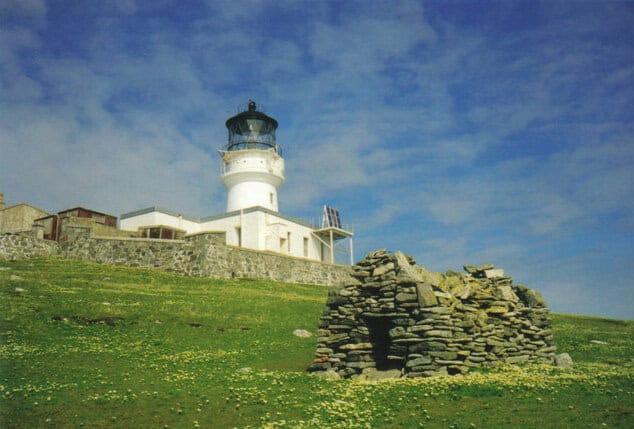
The Flannan Isles Lighthouse Mystery is one of the most chilling unsolved disappearances in maritime history. Three experienced lighthouse keepers vanished from a remote Scottish island in December 1900. No bodies were ever found. No witnesses came forward. The lighthouse itself stood perfectly intact. The meal on the table was half-eaten. And the men were simply… gone. More than 120 years later, nobody knows exactly what happened on those dark, storm-battered rocks off the Outer Hebrides.
The Flannan Isles Lighthouse Mystery: What the Relief Crew Discovered
On December 26, 1900, the supply vessel Hesperus arrived at the Flannan Isles , a cluster of tiny, windswept islands 18 miles northwest of Lewis, Scotland. Captain James Harvey immediately noticed something wrong. No flag flew from the lighthouse. No keeper appeared on the landing platform. The signal horn went unanswered.
When relief keeper Joseph Moore rowed ashore, he found a scene that defied explanation. The lighthouse door was closed but unlocked. Inside, the clock had stopped. One chair was knocked over. A meal sat on the table, barely touched. Two sets of oilskin waterproofs were missing from their hooks. One set remained behind.
That last detail is deeply strange. Lighthouse keepers never left the island without their protective gear. Whoever walked out that door left in a hurry , or didn’t plan to leave at all.
The three missing men were James Ducat, the principal keeper; Thomas Marshall, his first assistant; and Donald McArthur, an occasional keeper filling in for a sick colleague. All three were experienced. All three knew these dangerous waters well. The Flannan Isles Lighthouse had only been operational since December 7, 1899 , the men vanished barely a year after it opened.
The Flannan Isles Lighthouse Mystery: Theories, Myths, and Missing Logbooks
Another fascinating historical case is: Why Are Warm-water Ports Important to Russia: The Cursed Quest That Haunts Moscow’s Naval Dreams
Here’s where things get even stranger. The official investigation pointed to a rogue wave. The west landing showed clear storm damage. A box had been displaced. Iron railings were bent. The evidence suggested a massive wave had swept the platform clean , and possibly swept the men with it.
But that theory has serious problems. Why would all three men be outside at once? Lighthouse protocol strictly required one keeper to remain inside at all times. And why was McArthur outside without his oilskins?
One persistent theory involves Marshall’s financial desperation. Records show he had previously been fined five shillings for losing equipment in a storm. Five shillings was meaningful money in 1900. Perhaps Marshall rushed outside to secure equipment during a sudden storm surge , and Ducat and McArthur followed to help. One wave. Three men gone.
What you won’t find is the famous “final log entry” that circulates online. Stories describe a staged logbook filled with lines about terror, an unnatural storm, and a last prayer. That logbook never existed. The National Records of Scotland confirms the actual station log was never deposited , it simply vanished along with the men. Contemporary accounts from 1901 make no mention of any dramatic final entries.
The myth was largely invented by poet Wilfrid Wilson Gibson, whose 1912 poem Flannan Isle conjured haunting, fictional details. His poem proved so powerful that generations of readers began treating his invented imagery as historical fact.
The Flannan Isles Lighthouse Mystery: Paranormal Theories and Ancient Curses
Of course, rational explanations have never satisfied everyone. The Flannan Isles had a dark reputation long before the lighthouse was built. Local Hebridean fishermen called them the “Seven Hunters.” They believed the islands were sacred , or cursed. Fishermen refused to land there without performing specific rituals. They spoke in hushed tones. They avoided certain words entirely while near the rocks.
Some believed the islands were inhabited by supernatural forces. Ancient Celtic lore described mysterious “little men” who guarded these remote places. Locals whispered about strange lights seen over the islands on dark nights.
After the disappearance, these stories took on new life. Some claimed the men were taken by something that couldn’t be explained by wind or water. Others pointed to the untouched meal as proof of sudden, inexplicable terror. What could make three experienced, unshakeable lighthouse keepers abandon everything in an instant?
A gamekeeper named Roderick MacKenzie had been paid £8 per year to watch for signals from the lighthouse at Gallan Head. He reported nothing unusual. No distress signals. No strange lights. Whatever happened, it happened fast , and it left no witnesses.
The Northern Lighthouse Board conducted a formal inquiry. They concluded that a freak wave was the most likely cause. But they couldn’t prove it. No bodies washed ashore. No wreckage appeared. The men had simply ceased to exist.
What the Records Reveal , and What They Don’t
In 2023, newly digitised records from the Northern Lighthouse Board became available through Scotland’s People genealogy service. These documents include work records for Ducat, Marshall, and McArthur. They also contain letters authorising pensions for the keepers’ widows and families.
Mrs. Ducat received a pension. Mrs. McArthur received a gratuity. A man named John Marshall filed a claim over the loss of his son. These dry administrative records are somehow the most heartbreaking part of the story. Behind every mystery are real people , families left behind, waiting for answers that never came.
The lighthouse itself continued operating for decades after the disappearance. Automated in 1971, it still flashes its warning light over those cold, grey waters today. Visitors can reach the Flannan Isles by boat from Lewis. Some find the place peaceful. Others report an uncomfortable feeling , a sense of being watched from the rocks.
The islands themselves remain as remote and unforgiving as ever. No permanent residents. No easy answers.
The Flannan Isles Lighthouse Mystery endures because it offers something rare in historical investigation , a complete absence of resolution. Three men walked out into the dark. The sea kept its secret. And on those lonely, wave-battered rocks, the light still burns.