The Green Children of Woolpit remain one of the strangest and most unsettling mysteries from medieval England. Two children , a boy and a girl , emerged from a pit in the village of Woolpit in Suffolk around 1140 to 1150. Their skin was green. They spoke an unknown language. They refused all food except raw beans. And they claimed to come from a land where the sun never shone. No one could explain them then. No one fully can now.
The story wasn’t written by a single crank. Two separate medieval chroniclers recorded it. William of Newburgh and Ralph of Coggeshall both documented the children’s appearance. These were serious scholars of their time. That two independent sources preserved the account gives it a weight that’s hard to dismiss.
What The Green Children of Woolpit Actually Experienced
The children were found near wolf pits , deep trenches dug to trap wolves , on the edge of the village. Harvesters discovered them huddled together. The boy was sickly from the start. He refused most food. He grew weaker and died not long after his arrival. The girl survived. She eventually learned English and told her story.
She said they came from a place called “St. Martin’s Land.” There, she claimed, everything existed in a kind of perpetual twilight. No bright sun. A luminous land lay across a great river, just visible in the distance. She had no explanation for how they ended up in Woolpit. She and her brother had followed the sound of bells through a cavern. Then suddenly, they were blinking in the blinding Suffolk sunlight.
The girl adapted to English life over time. Her green color faded as she ate a normal diet. She was eventually baptized. Some accounts claim she later married a man from King’s Lynn. But she never fully explained where she had come from. The full medieval accounts of the green children survive in both Latin chronicles and remain debated by historians to this day.
The Green Children of Woolpit and the Medical Theories
Another fascinating historical case is: Take Me to the Riot: The Strange Musical Phenomenon That Sparked Urban Legend
The most rational explanation focuses on the children’s color. Doctors and historians have pointed to chlorosis , a form of severe iron-deficiency anemia. It can produce a pale, greenish tint to the skin. The children’s refusal to eat anything except raw beans fits a pattern of severe malnourishment. As the girl ate more and recovered, her skin reportedly returned to a normal color. That tracks with a dietary deficiency resolving itself.
But the theory has holes. Clinical chlorosis produces a faint, subtle pallor. It’s the kind of thing even trained observers sometimes miss. The vivid green skin described in 12th-century Suffolk is far more dramatic than any documented anemia case. The gap between the two has never been convincingly bridged.
A more exotic medical theory involves hyperbiliverdinemia , a rare liver disorder that causes elevated biliverdin levels. This can cause genuine green discoloration of the skin and bodily fluids. It’s linked to malnutrition and liver dysfunction. One modern case documented a nine-year-old with severe iron deficiency developing a visibly green complexion. But that remains a single data point. It doesn’t explain the unknown language, the alien homeland, or the children’s complete disorientation.
The Green Children of Woolpit and the Flemish Refugee Theory
Paul Harris proposed a grounded historical explanation in a 1998 Fortean Studies article. He argued the children were Flemish orphans. During the reign of King Henry II, Flemish immigrants in England faced violent persecution. Many were killed near Bury St. Edmunds. Harris believed the children may have fled from Fornham St. Martin , a village just two miles from Woolpit.
If they had escaped into Thetford Forest, the dense canopy may have created near-permanent twilight. This could explain the girl’s description of a dim, shadowy homeland. Underground mine passages in the area could have led them disoriented and terrified into Woolpit. Their unknown language? Simply Flemish , incomprehensible to 12th-century Suffolk villagers.
It’s a tidy theory. Fornham St. Martin even fits the girl’s description of “St. Martin’s Land” with suspicious precision. But it still doesn’t explain the green skin. Or the children’s apparent total amnesia about their journey. Or why no one ever came looking for them.
Historical periodical archives contain later retellings of the story that added further embellishments over the centuries, making it harder to separate original fact from accumulated legend.
A Mystery That Still Refuses to Stay Buried
Modern scholars haven’t let the story rest. In 2024, historian John Clark published The Green Children of Woolpit: Chronicles, Fairies and Facts in Medieval England through University of Exeter Press. The book was shortlisted for the Folklore Society’s Katharine Briggs Award in 2025. Clark challenged folklorists who treated the story purely as fairy tale material without asking whether it might have a genuine historical core.
Some have suggested the children came from another dimension. Others invoke fairy folklore , the idea that they literally emerged from the fairy underworld beneath the earth. The perpetual twilight of St. Martin’s Land, the disorientation, the impossible journey through a cavern , these details fit the old fairy mythology uncomfortably well.
Others have pointed to early accounts of extraterrestrial visitation. A land with no sun, accessed through underground passages, populated by beings who look almost human but not quite , it maps onto UFO abduction narratives in ways that feel more than coincidental.
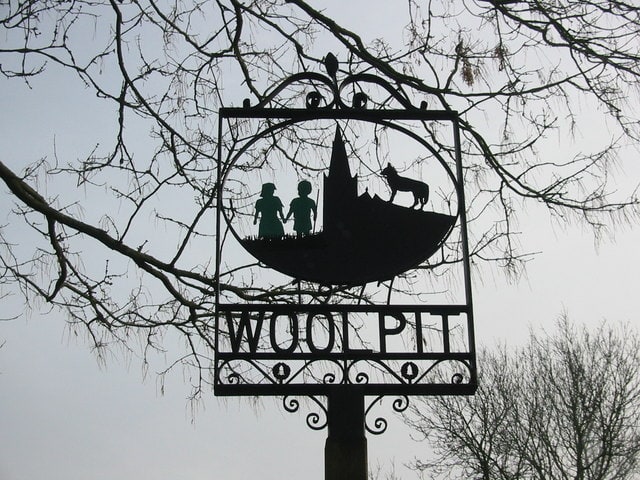
The village of Woolpit still exists in Suffolk. A sign depicting the green children marks the village to this day. The village of Woolpit itself has embraced the legend as part of its identity, though no one has ever provided a complete answer.
The Green Children of Woolpit crawled out of the earth nearly 900 years ago. They brought no explanation with them. The boy died. The girl assimilated. And the question of where they truly came from has never been answered. Some mysteries don’t get solved. They just get stranger the longer you look at them.