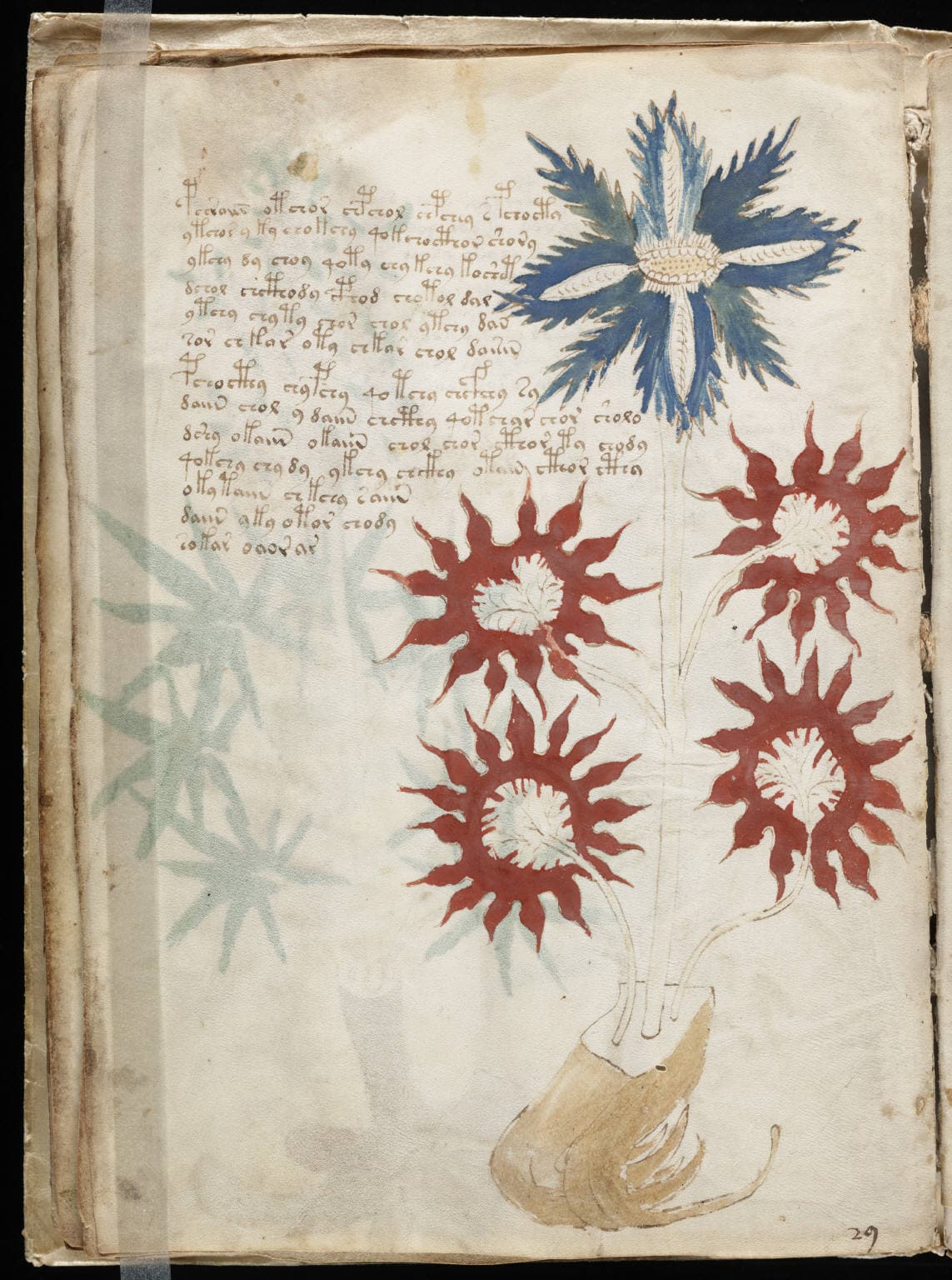
The Voynich Manuscript stands as history’s most enigmatic book. This 15th-century codex contains 240 pages of undeciphered text written in an unknown script called “Voynichese.” No scholar has successfully translated its mysterious contents despite centuries of attempts. The manuscript’s bizarre illustrations show unidentifiable plants, naked women in strange pools, and astronomical diagrams that match no known system.
Carbon dating places the vellum between 1404 and 1438. Yet the manuscript’s origins remain completely unknown. Some researchers believe it originated in northern Italy during the Renaissance. Others suggest it could be an elaborate hoax or the product of glossolalia – speaking in tongues. The truth continues to elude even the world’s best cryptographers.
What makes this medieval mystery even stranger is its recent history. The manuscript vanished for centuries before resurfacing in Prague. A 17th-century alchemist named Georg Baresch owned it and desperately tried to decode its secrets. He sent copies to Jesuit scholar Athanasius Kircher in Rome, hoping the renowned polymath could crack the code. Kircher failed completely.
The Voynich Manuscript’s Impossible Script Baffles Experts
The manuscript’s writing system defies classification. Voynichese contains roughly 20-25 unique characters that don’t match any known alphabet. The script flows from left to right like Latin text. However, its statistical properties are unlike any natural language.
Professional codebreakers from both World Wars examined the manuscript. William Friedman, who broke Japanese diplomatic codes, spent decades studying it. His wife Elizebeth, another legendary cryptographer, also failed to crack it. British codebreaker John Tiltman called it “the most mysterious manuscript in the world.”
Modern computer analysis reveals disturbing patterns. The text shows characteristics of both natural language and gibberish. Words appear to follow grammatical rules, yet they don’t correspond to any known vocabulary. Some researchers believe multiple scribes created the text. Recent handwriting analysis suggests five different people contributed to the manuscript.
The script’s repetitive nature troubles linguists. Certain character combinations appear far too frequently for natural language. Yet the text isn’t random either. It contains patterns that suggest meaning – patterns that remain maddeningly out of reach.
Bizarre Illustrations in the Voynich Manuscript Defy Botanical Knowledge
For more strange history, see: Phantom Barber of Pascagoula: The Hair-Cutting Terror That Haunted Mississippi in 1942
The manuscript’s illustrations are as mysterious as its text. The herbal section contains over 100 plant drawings. Not one matches any known species. The plants display impossible characteristics – roots that spiral in unnatural ways, leaves that sprout from stems at wrong angles, and flowers that violate basic botanical principles.
Women appear throughout the manuscript in disturbing contexts. They bathe naked in green pools connected by elaborate pipe systems. Some hold unidentifiable objects. Others seem to emerge from or merge with plant forms. These “balneological” sections suggest bathing rituals or alchemical processes that scholars can’t identify.
The astronomical diagrams present equally puzzling imagery. Star charts don’t match historical sky maps. Zodiacal symbols appear alongside unrecognizable celestial objects. Some pages fold out to reveal complex circular diagrams with concentric rings of text and symbols. These formations don’t correspond to any known astronomical or astrological system from medieval Europe.
Most unsettling are the pharmaceutical sections. These pages show vessels, containers, and what appear to be body parts. Some drawings suggest medical procedures or alchemical experiments. The accompanying text offers no clues about these mysterious processes.
Modern Technology Reveals Hidden Secrets of the Manuscript
Recent technological advances have uncovered new mysteries within the manuscript. Multispectral imaging in 2024 revealed hidden text on the first page. Three columns of letters appeared under special lighting – two containing alphabet characters and one showing Voynichese script. These additions were likely made by Johannes Marcus Marci, a 17th-century owner who tried desperately to decode the text.
The imaging also revealed extensive marginalia throughout the manuscript. Previous owners added notes in German, Arabic, and Greek. These annotations attempt to identify plant colors and provide translation clues. None succeeded in unlocking the manuscript’s secrets.
Computer analysis has identified statistical anomalies that deepen the mystery. The text shows properties of both constructed languages and elaborate ciphers. Some researchers propose it represents a “verbose cipher” – a system that uses multiple symbols to represent single letters. However, no proposed decryption method has produced meaningful results.
Yale University digitized the entire manuscript in 2020. Online interest has exploded, with over 150,000 searches in 2024 alone. Amateur cryptographers worldwide continue attempting to crack the code. Their efforts have produced hundreds of proposed solutions. None have gained scholarly acceptance.
The Enduring Mystery That Haunts Medieval Studies
The manuscript’s provenance adds another layer of mystery. Emperor Rudolf II allegedly purchased it for 600 gold ducats – an enormous sum suggesting he believed it contained valuable secrets. The emperor was obsessed with alchemy and the occult. His court attracted scholars, mystics, and charlatans from across Europe.
After Rudolf’s death, the manuscript passed through several hands before disappearing. It resurfaced in 1912 when Polish book dealer Wilfrid Voynich acquired it from a Jesuit college. Voynich spent years promoting the manuscript and seeking translations. He died without solving its mystery.
Modern hoax theories suggest the manuscript might be an elaborate forgery. Some propose Voynich himself created it to make money. Others blame medieval con artists who fooled wealthy collectors. However, carbon dating and historical evidence support the manuscript’s genuine 15th-century origins.
The Voynich Manuscript continues to tantalize researchers with its secrets. Each new discovery raises more questions than answers. Its undeciphered pages represent one of history’s greatest intellectual challenges – a medieval puzzle that may never yield its secrets to modern minds.