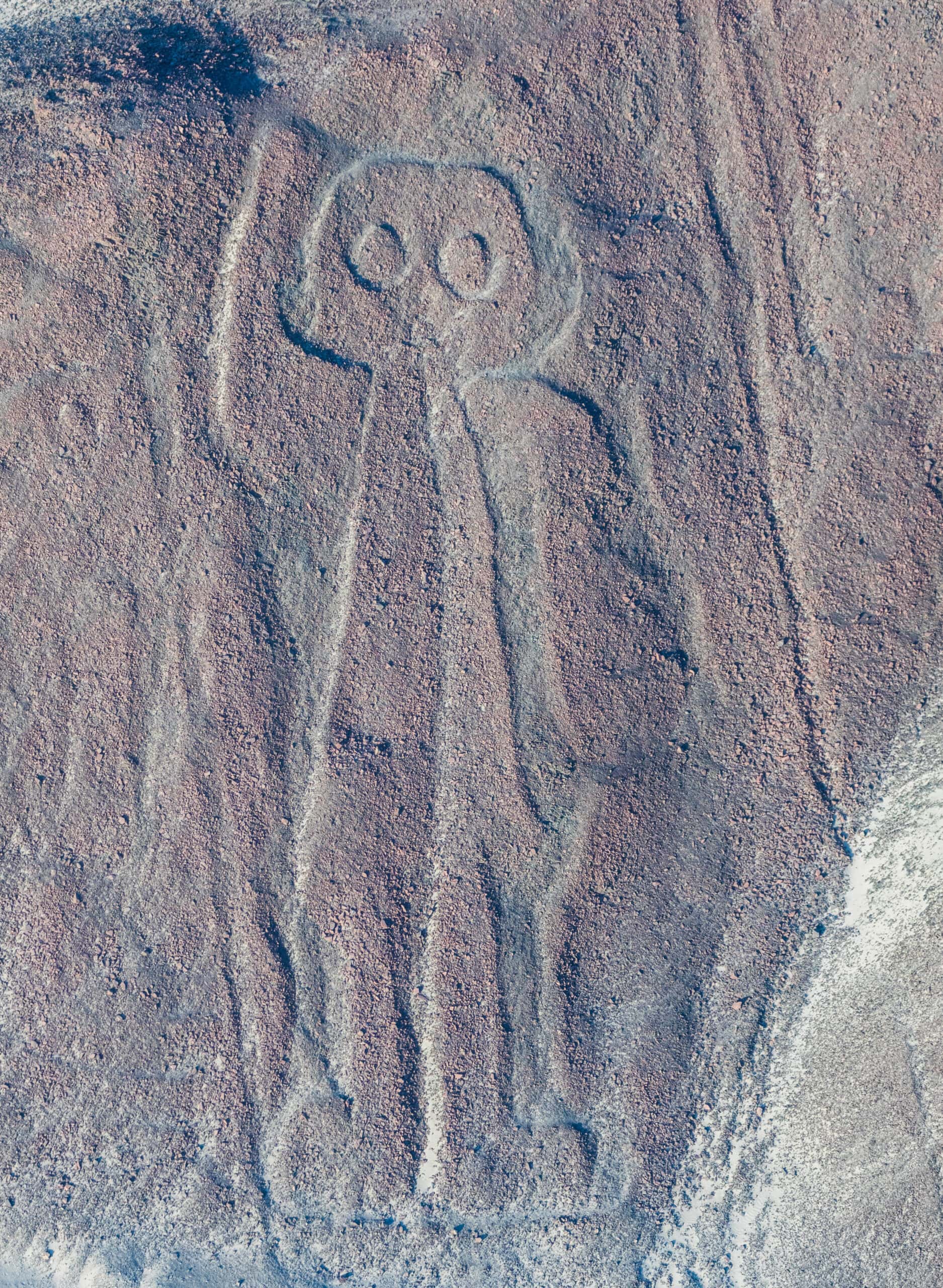
The Nazca Lines are one of the strangest things humans have ever created. Carved into the dry coastal desert of southern Peru over 2,000 years ago, these massive drawings stretch across nearly 400 square miles of barren earth. Some are simple lines. Others are enormous animals , monkeys, hummingbirds, spiders. A few depict something far darker. You can’t see most of them from the ground. You need to be in the sky. And that raises a question that has haunted archaeologists for over a century: who were these drawings made for?
Nobody knows. That’s the honest answer. And the deeper researchers dig, the stranger the story gets.
The Nazca people lived in this desert between roughly 100 BCE and 800 CE. They built no pyramids. They left no written language. What they left behind was scraped into the ground , thousands of lines, shapes, and figures that have survived because the desert is one of the driest places on Earth. Barely any wind. Almost no rain. The lines just… stayed.
Wikipedia’s overview of the Nazca Lines provides a solid foundation, but it barely scratches the surface of how deeply strange this place really is.
The Nazca Lines and the Killer Whale That Holds a Knife
Here’s where things get genuinely unsettling.
In recent years, researchers discovered a 72-foot-long geoglyph depicting a killer whale. That alone would be remarkable. But this whale is holding a knife. Not a fish. A knife.
This isn’t random imagery. The same motif , a killer whale gripping a blade , appears on Nazca pottery recovered from burial sites. Archaeologists believe it’s directly linked to human sacrifice. The whale wasn’t a symbol of the ocean or abundance. It was a symbol of death. Of ritual killing.
And this figure was placed near an ancient footpath. People walked past it. Regularly. It was meant to be seen and remembered.
This discovery was part of a massive recent survey that uncovered 303 new geoglyphs in just six months. For context, it took nearly a century of human surveying to find 430 figurative geoglyphs total. The new batch included decapitated heads, strange humanoid figures, domesticated animals, and what researchers are calling a “ceremonial scene.” The images aren’t peaceful. They’re not decorative. They feel like warnings , or offerings.
Many of the new figures show human and animal interactions that don’t look friendly. Some depict scenes that align with what we know about Nazca ritual violence. The desert floor, it turns out, was a canvas for something deeply ritualistic. And possibly terrifying.
How AI Is Rewriting What We Know About the Nazca Lines
Related article: Phantom Time Conspiracy Theory: The Missing 297 Years That Never Existed
The 303-geoglyph discovery wasn’t made by human eyes alone. It was made with artificial intelligence.
A team from Japan’s Yamagata University, led by archaeologist Masato Sakai, partnered with IBM’s Thomas J. Watson Research Center. They fed thousands of high-resolution satellite images into an AI system. The program scanned for faint soil contrasts , subtle differences in color and texture that human surveyors had missed for generations.
The results were staggering. The AI spotted geoglyph outlines 20 times faster than any human team. In August 2025, the same team announced 248 additional new geoglyphs. The findings were presented at Expo 2025 Osaka-Kansai. The discoveries keep coming.
What’s unsettling about this isn’t just the speed. It’s the implication. If AI can find 303 geoglyphs in six months , after a century of human searching , how many more are out there? The desert may be hiding hundreds, possibly thousands, of figures we haven’t found yet. What else is down there? What other rituals? What other symbols of death and sacrifice?
The Library of Congress digital collections holds early 20th-century research materials that document the first Western encounters with the lines , a reminder of just how long this mystery has endured without resolution.
Blood, Rain, and the Dark Purpose of the Nazca Lines
For decades, people assumed the lines were astronomical calendars. Others claimed they were alien landing strips , a theory that’s entertaining but archaeologically worthless. The real leading theory is far darker and more human.
Researchers now believe the geoglyphs were part of water rituals. The Nazca desert is brutally dry. The people who lived there were desperate for rain. The lines weren’t irrigation channels. They weren’t maps to water sources. They were prayers. Massive, ground-level prayers scratched into the earth and aimed at the gods above.
Walking the lines may have been part of the ritual itself. Pilgrims or priests would walk the paths during ceremonies. The act of moving through the figure , becoming part of the drawing , may have been the offering. Combined with what we know about Nazca sacrifice culture, some researchers believe the rituals weren’t just symbolic.
Blood may have been part of the equation. The decapitated head motifs found in the new AI-assisted survey aren’t accidental. Nazca culture had a documented practice of taking trophy heads , severed human heads preserved and used in ceremonies. These heads appear in their pottery, their textiles, and now, apparently, carved into the desert floor at massive scale.
The lines weren’t art for art’s sake. They were desperate pleas from a people living on the edge of survival. Every figure, every line, every knife-wielding whale was a message sent upward , to whatever they believed lived above the clouds.
A Mystery That Only Gets Stranger
No one has solved this. After a century of research, satellite imaging, AI analysis, and thousands of excavations, we still don’t fully understand why these figures exist.
We know who made them , the Nazca people. We have a rough idea of when. We have theories about purpose. But the core question remains wide open. Why build something you can only see from the sky when you have no aircraft? Who was the intended audience?
Some researchers suggest the figures were meant for mountain gods , deities believed to live in the peaks above the desert. Others think the scale itself was the point. Bigger meant more powerful. More heard.
Smithsonian Magazine’s deep dive into the lines captures just how divided the academic world remains on basic questions of purpose and meaning.
What we’re left with is a 400-square-mile canvas of ritual, sacrifice, and desperation. A desert full of figures that keep multiplying the more closely we look. A killer whale with a knife. Decapitated heads. Humanoid figures doing things we can’t quite interpret.
The desert kept these secrets for 2,000 years. It’s only now, with AI scanning every pixel of ancient soil, that the full picture is beginning to emerge. And honestly? The more we find, the stranger it gets.