
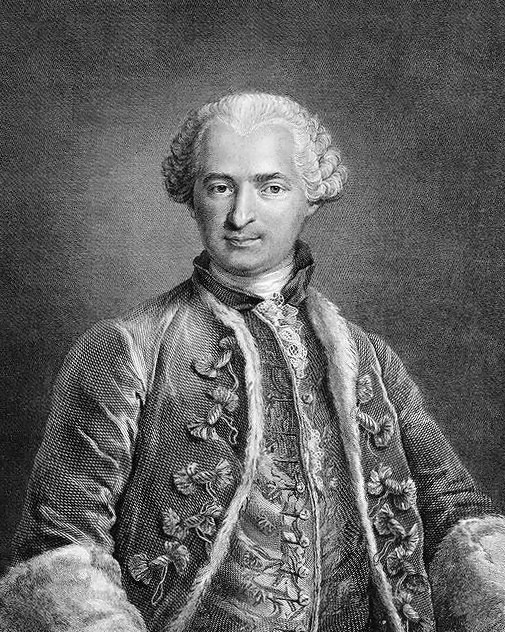
The Count of St. Germain is one of history’s most baffling figures. He walked through 18th-century European courts like a ghost , dazzling, mysterious, and seemingly ageless. Nobody knew where he came from. Nobody could prove when he was born. And strangest of all, multiple credible witnesses swore he never seemed to age. Voltaire himself called him “a man who does not die, and who knows everything.” That’s a remarkable thing to say about anyone. But for this particular man, it felt oddly believable. He spoke dozens of languages. He painted masterpieces. He composed music. He claimed to have met Jesus Christ personally. Whether he was the greatest con artist in history or something far more unsettling, his story refuses to stay dead , much like the man himself.
The Count of St. Germain and the Mystery of His Origins
Nobody knows who he really was. His birth records don’t exist , or if they do, no one has found them. Official records list his birth as “supposedly 1691 or 1712.” That’s an enormous gap. Even historians who’ve spent careers studying him can’t pin it down.
He used at least eight different names. These included the Marquess of Montferrat, Count Bellamarre, Count Weldon, and Prince Ragoczy. Each identity came with a different backstory. Some researchers believe he was the illegitimate son of a Transylvanian prince. Others think he was a Portuguese Jew who reinvented himself. A few have suggested he was a trained spy working for multiple European governments simultaneously.
What’s undeniable is that he appeared in the highest circles of European power. He mingled with Casanova, Mozart, and Voltaire. King Louis XV of France treated him as a close confidant. He was reportedly involved in diplomatic missions across Europe , missions that official channels had no record of authorizing.
Wikipedia’s overview of the Count of St. Germain notes that he rose to prominence in European high society during the mid-18th century. But “prominence” barely scratches the surface. He didn’t just attend parties. He seemed to run things from the shadows.
The Count of St. Germain’s Strangest Claims and Abilities
For more strange history, see: Busby’s Stoop Chair: The Cursed Seat That Kills Everyone Who Sits In It
Here’s where things get genuinely weird. He told people he was 500 years old. He claimed to remember the wedding feast at Cana , the one where Jesus turned water into wine. He spoke about historical events from centuries past as though he’d been there personally.
And people believed him. That’s the unsettling part.
Countess von Georgy met him at a party in Paris around 1760. She told him she remembered his father visiting Venice fifty years earlier. He smiled and told her she was mistaken , that he had been the one in Venice fifty years ago. She reportedly went pale. She said he looked exactly the same as the man she remembered from half a century before.
His skills seemed impossible for one person. He spoke French, English, German, Italian, Portuguese, Russian, Arabic, and Chinese fluently. He painted with a technique no one could replicate , his portraits seemed to glow from within. He claimed to have discovered a method for removing flaws from diamonds. King Louis XV actually gave him diamonds to work on, and the king was apparently satisfied with the results.
He also claimed to have created an elixir of life. His eating habits were famously bizarre , he rarely ate in public. Guests at dinners reported that he would sit at the table, speak brilliantly for hours, but never touch his food or wine.
Was it performance? Possibly. But the consistency across dozens of independent witness accounts is hard to dismiss.
The Count of St. Germain’s Death , and the Sightings After
He supposedly died on February 27, 1784, in Eckernförde, in what is now northern Germany. He’d been living under the protection of Prince Charles of Hesse-Kassel, working on secret projects in a factory the prince had set up for him.
But almost immediately, the sightings began.
Freemasons claimed he appeared at a Paris lodge meeting in 1785 , a year after his death. He was allegedly spotted at the French Revolutionary court in 1789. Madame de Adhémar claimed to have met him multiple times after his supposed death, each time looking exactly the same as before. She wrote that he warned her about the coming Reign of Terror, predicting specific events with eerie accuracy.
Napoleon Bonaparte reportedly sought information about him. So did later European rulers. His influence didn’t fade , it grew.
The Musical Quarterly from 1950 published a scholarly analysis of his musical compositions, confirming they were genuinely sophisticated works. This wasn’t a charlatan banging out simple tunes. This was someone with real, deep musical knowledge.
Theosophists later adopted him as an “Ascended Master” , a being who had transcended death entirely. Helena Blavatsky and her followers placed him alongside figures like Kuthumi and Master Hilarion as guides to humanity from a higher plane. Whether you believe that or not, it tells you something about the impression he left on people.
The Immortal Legend That Won’t Die
So what was he? The theories range from the mundane to the truly mind-bending.
The skeptics say he was an extraordinarily gifted con man. He studied his marks, learned their histories, and performed calculated miracles. The “agelessness” was simply good genes combined with careful self-presentation. The multiple identities were cover stories for espionage work.
But skeptics struggle to explain the sheer volume of independent accounts. These weren’t gullible peasants. These were kings, philosophers, and scientists , people trained to spot deception.
The more unusual theories suggest he possessed genuine alchemical knowledge. Some researchers point to his diamond-working abilities and his supposed elixir as evidence of real, lost scientific techniques. Others suggest he was part of a secret brotherhood , the Rosicrucians, the Freemasons, or something older , that possessed knowledge the public never had access to.
And then there’s the simplest strange explanation: maybe he was exactly what he said he was. An old man. A very, very old man.
His death record exists. His grave exists. But his legend has never stopped breathing. People still report feeling his presence at historical sites connected to him. New researchers still find gaps in the official record that don’t add up. His music still plays. His portraits still seem to glow.
Some mysteries don’t get solved. They just get deeper. The story of this impossible man is one of history’s most enduring puzzles , and it shows no signs of ending anytime soon.
Related Posts
 The Adventure of the German Student: Washington Irving’s Chilling Tale of Revolutionary Terror and Supernatural Horror
 Prillwitz Idols: The Bronze Forgeries That Fooled European Nobility for Decades
 Mary Toft: The Woman Who Fooled Doctors Into Believing She Gave Birth to Rabbits
 French Guillotine Blinking Experiment: The Macabre Quest to Prove Consciousness After Death