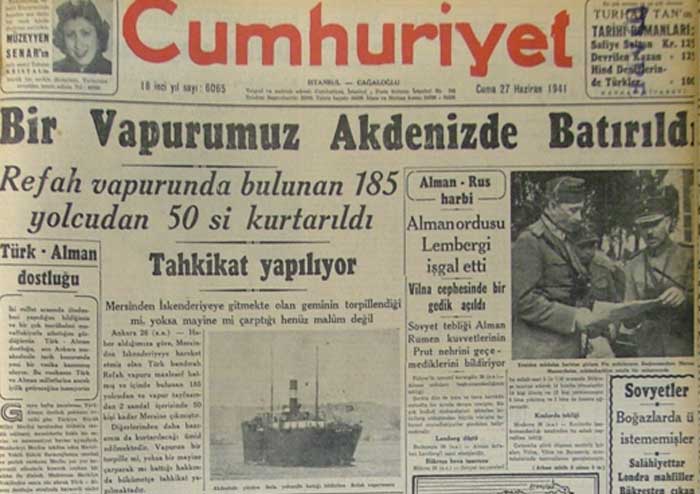
The Refah Tragedy is one of World War II’s most haunting unsolved mysteries. A neutral Turkish ship. A brightly lit hull. A torpedo from nowhere. On the night of June 23, 1941, 168 people vanished into the dark waters of the eastern Mediterranean , and the world never got a satisfying answer about who killed them. Decades later, the questions still echo. Who fired that torpedo? Why target a neutral vessel sailing in full light? And why did the truth get buried so quietly?
The Refah Tragedy: A Doomed Ship Before It Even Sailed
The story starts badly and gets worse. The Turkish government needed to move military personnel to Egypt. From there, they’d fly to Britain for training on newly purchased submarines and aircraft. Simple enough , except nothing about this mission was simple.
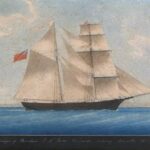
Turkey chartered the steamer Refah, a 40-year-old coal cargo ship built back in 1901. She was ancient, slow, and completely wrong for the job. Commander Zeki Işın inspected her in the port of Mersin and sent an alarming report to Ankara. The ship had too few cabins. Not enough toilets. Only two lifeboats , each holding just 24 people. He called the vessel unfit for a Mediterranean crossing carrying 170 passengers.
Ankara ignored him.
The ship got a hasty makeover. Workers bolted on extra toilets and dragged beds from a nearby naval school. Most critically, workers painted giant Turkish flags on both sides of the hull. They lit the ship up like a Christmas tree. The idea was clear: we are neutral, see us, don’t shoot us.
According to historical records, the Refah departed Istanbul on June 16, 1941, and arrived in Mersin five days later. On June 23 at 5:30 PM, she weighed anchor with 200 souls aboard , 171 military personnel, 28 crew, and one British liaison officer who handed the captain his route details just before departure.
That British officer’s presence would later fuel dark speculation.
Night Terror: The Refah Tragedy Unfolds in Darkness
For more strange history, see: Okinoshima: Japan’s Forbidden Island Where Ancient Gods Dwell and Women Are Banned Forever
The night of June 23 seemed calm. The Refah moved through eastern Mediterranean waters at her sluggish 8.5-knot pace. She was brightly lit. Her neutral markings were visible. Passengers were eating their evening rations, scattered throughout the ship.
Then, at around 10:30 PM, the sea exploded.
A torpedo struck the Refah about 10 nautical miles east of Cyprus. The blast was catastrophic. The electrical system died instantly. The radio went silent , no distress call could be sent. Passengers were thrown into chaos in complete darkness. One lifeboat crashed into the sea with sleeping passengers still inside. People fell. People jumped. The cold Mediterranean swallowed them fast.
Lieutenant Nevzat Erül managed to reach the second lifeboat. He pulled survivors from the water. Others clung to wreckage, floating in darkness, waiting for a rescue that wouldn’t come for hours.
Of the 200 people aboard, only 32 survived. That means 168 people died. Sailors. Officers. Air Force cadets. Young men sent on what should have been a routine wartime transfer.
The wreck happened fast. The Refah was gone. And the submarine that fired the torpedo? It vanished too , leaving no trace, no signal, no claim of responsibility.
Who Fired the Shot? The Refah Tragedy’s Unanswered Question
This is where history gets genuinely disturbing. No country ever admitted to sinking the Refah. No submarine was ever officially identified. The investigation hit a wall.
Turkey was neutral in June 1941. The ship was lit up and clearly marked. Sinking her made no obvious military sense. So who did it?
Several suspects have been discussed over the decades. British submarines operated in the eastern Mediterranean in 1941. So did Italian and German ones. The British had a complicated relationship with Turkey at the time. Just days before the sinking, on June 18, Turkey had signed a friendship treaty with Nazi Germany , which infuriated London. Some researchers have pointed to this timing as suspicious. Did someone in the Allied command decide the Turkish military mission needed to be stopped?
Others point to Italy or Germany. Both operated submarines aggressively in the Mediterranean. A neutral ship sailing at night could have been misidentified , or deliberately targeted.
Period newspaper accounts from 1941 reflect the confusion and diplomatic tension surrounding the sinking. Turkey demanded answers. None came. The mystery was quietly absorbed into the chaos of a world already drowning in wartime tragedy.
The eerie detail that haunts historians most? The British liaison officer who boarded at the last minute gave the captain his route. That route took the Refah directly through the waters where she was torpedoed. Was it coincidence? Bad luck? Or something darker?
Ghosts of the Mediterranean: The Legacy Lives On
A monument was eventually built to honor the dead. The inscription carries the words of Fevzi Çakmak, Turkey’s chief of general staff , a solemn acknowledgment of a loss that shook the Turkish military to its core.
But monuments don’t answer questions. The families of the 168 victims never got closure. Turkey never received a formal admission of guilt from any nation. The submarine responsible sailed away into history, unnamed and unpunished.
What makes this story so persistently unsettling isn’t just the scale of the loss. It’s the deliberateness of it. Someone looked through a periscope. Someone saw a brightly lit ship with neutral markings. Someone gave the order to fire anyway.
The cold calculation behind that act , whoever committed it , is what transforms this from a wartime accident into something far more sinister. A neutral nation. A clearly marked vessel. A crew and passengers who posed zero military threat. And yet the torpedo came.
The Refah Tragedy remains an open wound in Turkish naval history. It’s a reminder that in wartime, neutrality offers no real protection. The sea keeps its secrets. And somewhere on the floor of the eastern Mediterranean, the wreck of the Refah still lies , a silent grave for 168 people who never made it to Egypt.