
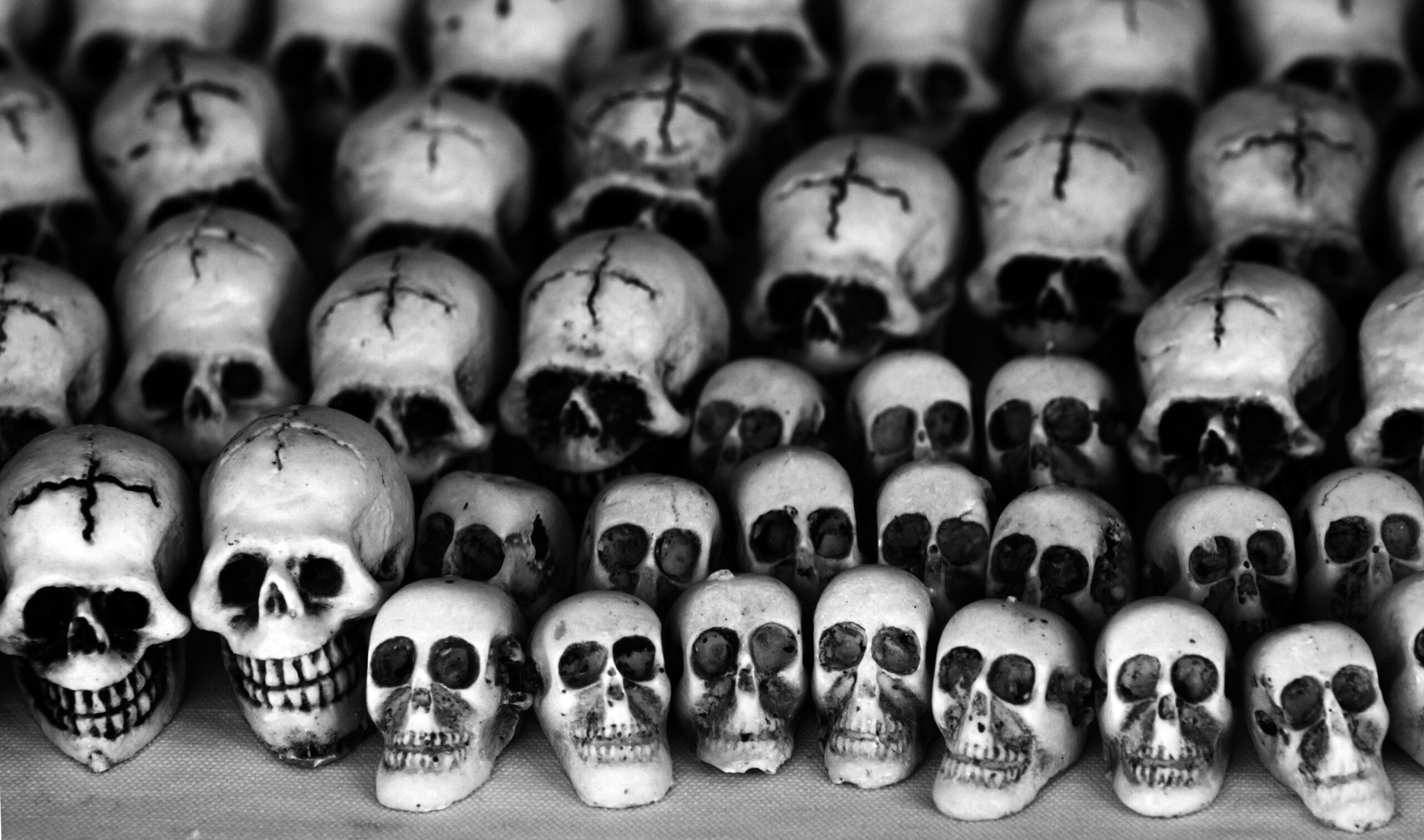
The Calaveras Skull is one of the strangest and most audacious hoaxes in American scientific history. In 1866, miners deep in California’s gold country pulled a human skull from beneath 130 feet of earth and lava. They handed it to one of the most respected geologists in the country. What followed was decades of academic chaos, bitter feuds, and a mystery that refused to die quietly. Was it a prank? A conspiracy? Or something even weirder? The story has everything , scheming miners, gullible professors, and a skull that wasn’t even the original skull. Welcome to the strange, muddy, and deeply human tale of California’s most infamous fossil fraud.
The Calaveras Skull Rises from the Mine
On February 25, 1866, miners working in Calaveras County, California, made a startling claim. They said they had found a human skull buried 130 feet underground. It sat beneath a thick layer of hardened lava. That detail alone was explosive. Lava layers take enormous amounts of time to form. If the skull was genuinely beneath that lava, it would be millions of years old.
The skull quickly reached Josiah Whitney. He was California’s state geologist and a professor at Harvard University. Whitney was already convinced that ancient humans had lived alongside mastodons and mammoths. He had published that belief just a year earlier. The skull felt like destiny. It confirmed everything he already thought.
Whitney announced his findings at the California Academy of Sciences on July 16, 1866. He declared the skull proof of Pliocene-age man in North America. That would make it at least two million years old. It would rewrite human prehistory entirely.
The scientific world buzzed with excitement. Then the skeptics started sharpening their knives.
Almost immediately, doubts surfaced. By 1869, the San Francisco Evening Bulletin reported something damning. A miner had allegedly confessed to a minister. The skull, he said, was a planted joke. The miners apparently disliked Whitney. They found him stiff, reserved, and very much an “Easterner.” Tricking him was apparently irresistible.
The full documented history of the skull reveals just how many people were involved in both the hoax and the cover-up.
The Calaveras Skull and the Science That Tried to Expose It
Related article: Prillwitz Idols: The Bronze Forgeries That Fooled European Nobility for Decades
The scientific community didn’t just take Whitney’s word for it. Investigators started digging , metaphorically this time.
In 1879, Thomas Wilson of Harvard ran a fluorine analysis on the skull. This was the first time such a test had ever been performed on human bone. The results were damning. The skull showed none of the fluorine absorption you’d expect from something millions of years old. It was recent. Very recent.
But Whitney refused to budge. He died still believing in the skull’s authenticity. His successor at Harvard, Frederic Ward Putnam, also believed it was real. Putnam traveled to California in 1901 determined to settle the matter once and for all.
What he found made things stranger, not clearer. He heard a story that in 1865, someone had dug up a Native American skull from a nearby burial site. They had then planted it in the mine specifically for the miners to find. Putnam still couldn’t bring himself to call it a fake. He simply admitted that the truth might never be known.
Then came an even more unsettling detail. Careful comparison of the skull with early descriptions revealed something shocking. The skull Whitney had been studying wasn’t even the original one found in the mine. At some point, it had been switched.
Anthropologist William Henry Holmes of the Smithsonian Institution investigated around the turn of the century. He concluded that the plant and animal fossils near the site were genuine. But the skull itself was far too modern. Holmes put it bluntly. To believe a human skull could remain unchanged for a million years, he said, “is to suppose a miracle.”
Confessions, Poems, and the Calaveras Skull’s Lasting Infamy
The hoax didn’t unravel all at once. It leaked out slowly, confession by confession.
In 1911, investigator J.M. Boutwell traveled to Calaveras County. One of the original participants in the discovery told him plainly. The whole thing had been a hoax from the start.
Even more damning was the story of John C. Scribner. He was a local shopkeeper. He claimed to have personally planted the skull in the mine. His sister revealed this story only after his death. She apparently felt the world deserved to know.
The miners, it seems, had pulled off one of the greatest pranks in scientific history. They despised Whitney for his cold, superior attitude. Tricking him into announcing a world-changing discovery to the California Academy of Sciences must have been deeply satisfying. The joke just kept running , for decades.
Popular culture noticed too. In 1899, the famous writer Bret Harte published a satirical poem called “To the Pliocene Skull.” It mocked the whole affair with gleeful sarcasm. The skull had become a cultural punchline.
But not everyone was laughing. Followers of Theosophy, a mystical spiritual movement popular in the late 19th century, clung to the skull’s authenticity. They saw it as proof of ancient lost civilizations. No amount of scientific debunking could shake their faith.
The final nail came in 1992. Radiocarbon dating placed the skull at less than a thousand years old. It wasn’t from the Pliocene. It wasn’t even from the age of mammoths. It was a relatively recent Native American skull, almost certainly disturbed from a burial site and used as a prop in a miner’s revenge fantasy.
Why the Hoax Still Haunts Us Today
The story of this remarkable fraud raises uncomfortable questions. How did so many smart people get fooled for so long? Whitney was no amateur. He was Harvard-trained, experienced, and respected. Yet he spent years defending a skull that miners had planted as a joke.
Part of the answer is confirmation bias. Whitney already believed ancient humans had roamed North America. The skull fit his theory perfectly. That made him blind to its flaws.
There’s also the strange fact that the skull was switched at some point. Who did that? Why? Was someone trying to make the hoax more convincing? Or less? That particular mystery has never been fully solved.
Historical accounts of famous hoaxes often show the same pattern: a believable setup, an eager audience, and an authority figure too proud to admit defeat.
Today, some creationists still cite this case. They argue it proves that scientists ignore evidence that challenges mainstream theories. The irony is painful. The skull wasn’t ignored , it was eventually exposed through science itself.
The Calaveras Skull remains a fascinating ghost in the halls of American scientific history. It’s a story about pride, gullibility, and the lengths ordinary people will go to embarrass someone they dislike. The miners of Calaveras County aimed their prank at one pompous geologist. They accidentally created a legend that would haunt American archaeology for over a century. That’s a pretty good return on one stolen skull.
Related Posts
 The Calaveras Skull: California’s Greatest Archaeological Hoax and the Miners Who Fooled Harvard
 Calaveras Skull: The Archaeological Hoax That Fooled Harvard Scientists
 Prillwitz Idols: The Bronze Forgeries That Fooled European Nobility for Decades
 Pompey Stone: The 70-Year Archaeological Hoax That Fooled New York’s Best Scholars