
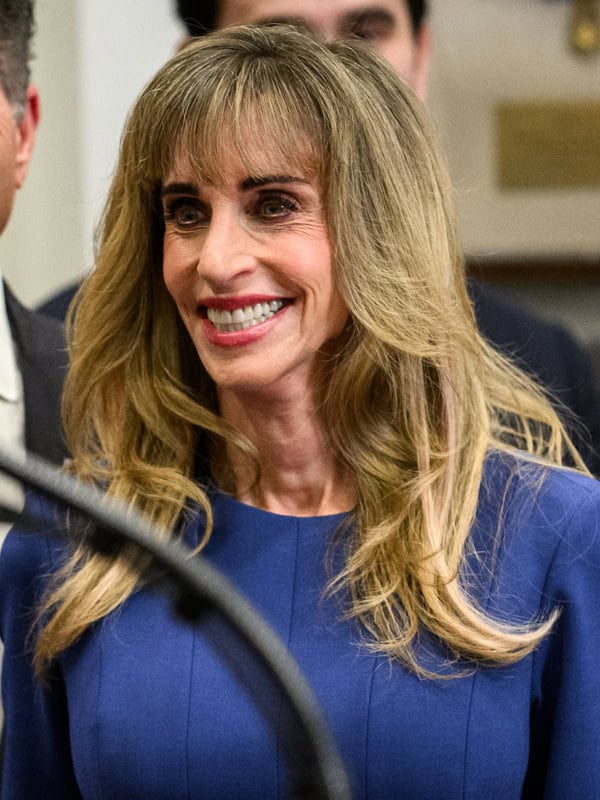
Susan Dell isn’t your typical billionaire’s wife. She’s an athlete, a fashion designer, a philanthropist , and the woman behind one of the most jaw-dropping financial moves in modern history. In 2025, she and her husband Michael Dell made a pledge so enormous it left economists, politicians, and ordinary Americans stunned. We’re talking about $6.25 billion directed toward 25 million American children. That’s not a typo. It’s a number so staggering it barely feels real. But strange as it sounds, it happened. And the story behind it is even more fascinating than the headline. Who is this woman? How did she go from marrying a college dropout in 1988 to standing in the Oval Office decades later, praised by a sitting president? The answers reveal a life full of unexpected turns, quiet power moves, and a philanthropic vision that some are calling the most ambitious private commitment to American children ever made.
Susan Dell and the $6.25 Billion Pledge That Stunned the World
On December 2, 2025 , GivingTuesday , something extraordinary happened. Michael and Susan Dell announced a $6.25 billion pledge. The target? Children born between 2014 and 2024. The mechanism? So-called “Trump Accounts” , new investment accounts designed to give young Americans a financial head start. The Dells believe it’s the largest single private commitment ever made to American children. Few charitable pledges in the past 25 years have exceeded $1 billion. This one blew past that threshold six times over.
The plan was specific and targeted. Children living in ZIP codes where median family income is $150,000 or less would each receive a $250 contribution. That sounds modest. But multiply it across 25 million kids and you start to understand the scale. This wasn’t a vague donation to a feel-good cause. It was a calculated, structural intervention in American inequality.
By October 2026, Susan Dell appeared at the White House alongside President Trump. He praised her publicly. The moment went viral. For many people, it was the first time they’d ever heard her name. But those who follow philanthropy knew she’d been quietly doing this kind of work for decades. The announcement didn’t come from nowhere. It came from a lifetime of building something most people never see coming.
The Susan Dell Foundation: Billions Quietly Changing Education
For more strange history, see: Operation Snow White: The Church of Scientology’s Massive Government Infiltration Conspiracy
Long before the Trump Accounts made headlines, Susan Dell was reshaping education behind the scenes. She and Michael founded the Michael and Susan Dell Foundation in 1999. Since then, they’ve given away $2.8 billion. The foundation’s assets sit at roughly $7.5 billion. Education is the beating heart of everything they fund.
In 2024 alone, the Dells poured an estimated $1.45 billion into their foundation and donor-advised fund. That included $120 million to support high-performing charter schools across the U.S. It also included $100 million to launch the Dell Catalyst Fund. And she personally pledged $100 million to the Charter School Development Fund. This money goes directly toward building new school buildings for charter schools. Brick and mortar. Real classrooms. Kids who need them.
Then in April 2026, something even bigger dropped. The Michael and Susan Dell Foundation announced a gift of more than $750 million to the University of Texas at Austin. The money will fund the UT Dell Campus for Advanced Research and the UT Dell Medical Center. These facilities will rise at the university’s West Pickle Research Campus in North Austin. TIME magazine called it the largest gift Americans have ever received from fellow U.S. citizens. That’s a staggering claim. And it appears to be true.
The Michael & Susan Dell Foundation has operated for over two decades. Yet most Americans only learned about it when the Trump Accounts story broke. That’s the strange paradox of her story. The bigger the impact, the more invisible she seemed to remain.
From Fashion Label to Forbes: The Many Lives of Susan Dell
Here’s where the story gets genuinely strange. Before the billion-dollar pledges, before the White House visits, she was a fashion designer. In 2003, she launched a label called Phi. It ran until 2009. That’s six years of runway shows and editorial spreads , a completely different world from foundation boardrooms and ZIP code targeting algorithms.
She’s also an athlete. That detail tends to get buried under the philanthropy headlines. But it matters. It speaks to a discipline and drive that runs beneath the surface of everything she does. She didn’t drift into philanthropy because her husband made money. She built something intentional.
In 2026, Forbes ranked her 16th on their “America’s 25 Most Generous Philanthropists” list. Her lifetime donations at that point totaled $3.3 billion. That’s a number that puts her alongside names most people would recognize immediately. Yet she remains oddly under the radar for someone operating at that level.
She married Michael Dell in 1988. He had started his computer company four years earlier. They’ve built four children and a foundation together. The foundation’s focus on education isn’t accidental. It reflects a belief that the strangest, most powerful thing you can do with money is give a child a better shot at the future.
The Oval Office Moment and What It All Means
October 7, 2026 is a date worth remembering. That’s when she walked into the Oval Office. President Trump praised her publicly. Cameras captured it. The internet noticed. For millions of Americans scrolling their feeds that day, it was a jarring image. A billionaire philanthropist standing in the most famous room in the world, celebrated for writing the largest check in the history of American childhood investment.
Strange doesn’t even cover it. We live in an era of cynicism about wealth. People assume billionaires hoard. They assume foundations are tax shelters. They assume the ultra-rich give just enough to look good. And sometimes that’s true. But the scale of what happened here doesn’t fit that narrative neatly. $6.25 billion directed at 25 million children in lower-income ZIP codes isn’t a PR stunt. It’s a structural intervention.
Coverage of the announcement spread rapidly across major outlets. USA TODAY, the AP, the Texas Tribune , all scrambled to explain what had just happened. Most struggled to find historical precedent. Because there isn’t much.
The story of Susan Dell is ultimately a story about invisible power. It’s about a woman who built enormous influence without becoming a household name. It’s about money deployed at a scale that genuinely has no modern parallel in American philanthropy for children. Whether you find that inspiring or unsettling probably depends on how you feel about billionaires shaping public life. But the strangeness of it , the sheer, almost incomprehensible weirdness of one person redirecting $6.25 billion toward millions of children , is undeniable. And that’s exactly the kind of story that deserves to be told.
Related Posts
 Sovetskaya Belorussiya (telegram Channel): The Satirical Voice That Vanished Into Belarus’s Digital Underground
 2024 Manila Bay Oil Spill: The Mysterious Sinking That Sparked Smuggling Suspicions
 El Callao Mine Disaster: Venezuela’s Cursed Gold Mine Claims Lives in Deadly 2025 Flood
 Freeman on the Land Movement: The Strange Cult That Believes Laws Don’t Apply to Them