
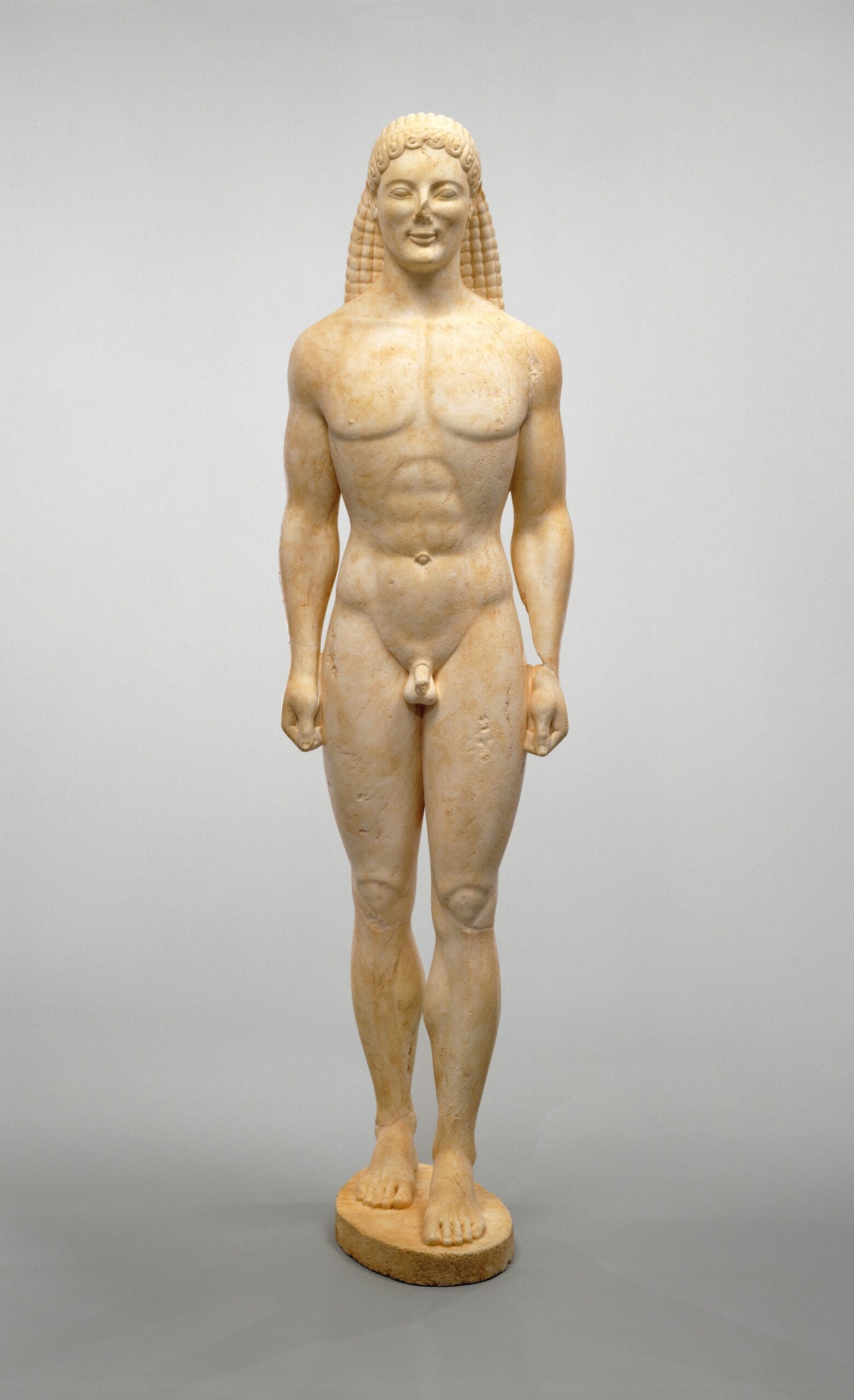
The Getty Kouros stands as one of the most perplexing mysteries in the art world today. This towering marble statue has divided experts for decades. Is it a genuine ancient Greek masterpiece worth millions? Or is it an elaborate modern forgery that fooled some of the world’s most respected scholars?
The mystery began in 1983 when this over-life-sized kouros first appeared on the black market. The J. Paul Getty Museum purchased it two years later for a staggering $10 million. From the moment it arrived at the museum, something felt wrong. The statue’s authenticity sparked fierce debates that continue to this day.
What makes this case truly bizarre is how the sculpture seems to exist in multiple time periods at once. Its features span nearly a century of ancient Greek artistic development. The hair resembles work from the late 7th century. The hands mirror styles from the mid-6th century. The feet appear to be from the late 6th century. No authentic ancient statue has ever displayed such dramatic stylistic inconsistencies.
The Getty Kouros and Its Fabricated Past
The statue’s documented history reads like a poorly written thriller novel. When dealer Gianfranco Becchina offered the piece to the Getty, he provided what appeared to be legitimate provenance documents. These papers claimed the kouros had belonged to a Swiss collector since 1930.
But investigators soon discovered the documents were elaborate fakes. A letter supposedly written by renowned scholar Ernst Langlotz in 1952 contained a postal code that didn’t exist until 1972. Another document referenced a bank account that wasn’t opened until 1963. The entire paper trail was a carefully constructed lie.
Even more disturbing, rumors began circulating about the statue’s true origins. Some claimed it had been recently looted from Sicily. Others whispered about a mysterious forger named Fernando Onore working in Rome. The trafficking culture surrounding ancient artifacts had created a perfect storm of deception and greed.
The Getty’s own board split over the purchase. Federico Zeri, a founding trustee appointed by J. Paul Getty himself, resigned in protest. He insisted the statue was fake and warned against the acquisition. His concerns were ignored.
Scientific Analysis Reveals the Getty Kouros Potato Mold Secret
For more strange history, see: Poniatowski Gems: The Greatest Art Forgery Scandal of the 19th Century
Initial scientific tests seemed to support the statue’s authenticity. The marble showed signs of natural aging and weathering. The surface displayed a patina that appeared to have formed over centuries. Geologists examined the stone and declared it genuine ancient Thasian marble.
But then came a discovery that changed everything. Scientists found they could artificially create the same aging effects using an unexpected ingredient: potato mold. In just three months, potato juices could produce the exact type of surface weathering seen on the kouros.
This revelation sent shockwaves through the art world. If forgers could fake the aging process so easily, how could anyone trust scientific analysis? The potato mold discovery suggested that whoever created this piece possessed sophisticated knowledge of both ancient techniques and modern chemistry.
The statue’s physical anomalies became even more suspicious under scrutiny. Its oval plinth was unusually large and shaped differently from authentic examples. The ears were asymmetrical, positioned at different heights with completely different shapes. These details suggested either an incompetent ancient sculptor or a modern forger working without proper references.
The Getty Kouros Brother and Underground Forgery Network
Perhaps the most chilling aspect of this mystery involves reports of a “brother” statue. In 1990, another kouros torso surfaced that bore striking similarities to the Getty piece. This second sculpture was definitively proven to be a modern forgery.
According to investigators, both statues allegedly came from the same Roman workshop in the early 1980s. The story claimed that forgers had obtained an ancient marble block from Sicily, split it in two, and carved both pieces into kouroi. If true, this suggested an organized forgery operation of unprecedented sophistication.
The alleged mastermind behind this operation was Fernando Onore, a shadowy figure based in Rome. Onore supposedly sold the kouros to intermediaries who then passed it to Becchina for $100,000. The dealer then sold it to the Getty for $10 million, making an enormous profit on what may have been a modern fake.
What makes this network particularly unsettling is its apparent expertise. The forgers didn’t just copy existing statues. They created something new that incorporated authentic ancient techniques and materials. They understood Greek sculptural development well enough to create deliberate anachronisms that would confuse experts.
Current Status and Ongoing Mystery
In 2018, the Getty Museum quietly removed the kouros from public display. Museum director Timothy Potts stated bluntly: “It’s fake, so it’s not helpful to show it along with authentic material.” The statue now sits in storage, viewable only by special appointment.
But officially, the museum still hedges its position. The label reads “Greek, about 530 B.C., or modern forgery.” This diplomatic language reflects the ongoing uncertainty surrounding the piece. Despite decades of investigation, no one has definitively proven whether it’s ancient or modern.
The mystery has consumed careers and reputations. Scholars who initially authenticated the piece later changed their minds. Others who called it fake from the beginning feel vindicated. The statue has become a symbol of everything wrong with the antiquities trade.
What’s particularly haunting is how this case exposed the vulnerability of even the most prestigious institutions. The Getty Museum, with all its resources and expertise, may have been fooled by a sophisticated forgery operation. If true, it raises disturbing questions about how many other fakes might be hiding in museum collections worldwide.
The Getty Kouros remains one of art history’s greatest unsolved mysteries. Whether ancient masterpiece or modern deception, it continues to challenge our understanding of authenticity, expertise, and truth. In a world where million-dollar decisions rest on scholarly opinions, this marble figure serves as a permanent reminder that sometimes, we simply cannot know for certain what is real.
Related Posts
 Valamo Monastery Art Sales Scandal: The Holy Deception That Fooled Finland
 Longyou Caves: China’s 2,000-Year-Old Underground Mystery That Defies Explanation
 Derinkuyu Underground City: Turkey’s Mysterious 18-Level Subterranean Labyrinth
 Xin Zhui (Lady Dai) Mummification Mystery: The 2,000-Year-Old Body That Defies Science