
On a cold November morning in 1970, a father hiking with his two young daughters stumbled upon something horrifying. Deep in a remote Norwegian valley, they found a charred body among the rocks. That body became known as the Isdal Woman , and more than fifty years later, nobody knows who she really was. The case has everything: false identities, possible espionage, a burned corpse, and a verdict that has never satisfied anyone. This isn’t just a cold case. It’s one of the strangest, most unsettling mysteries in modern European history.
The Isdal Woman Discovery That Shocked Norway
The valley where she was found is called Isdalen. In English, that translates to “Ice Valley.” Locals had another name for it: Dødsdalen , “Death Valley.” The nickname came from its grim history. Suicides and hiking accidents had plagued the area for centuries. It was already a place people feared.
But nothing had prepared Bergen for this.
According to investigators, the woman lay on her back among the scree. Her body and clothes were severely burned. Her face was completely unrecognizable. Nearby sat an eerie collection of objects: an empty liquor bottle, plastic water bottles, rubber boots, a fur hat soaked in petrol, sleeping pills, and a matchbox. Every single label and identifying mark had been deliberately removed from every item. Someone had worked very hard to make sure this woman could never be identified.
Three days later, police found two abandoned suitcases at Bergen railway station. Inside were wigs, makeup, non-prescription glasses, multiple currencies, maps, and timetables. Again , every name tag, every label, every trace of identity had been stripped away. Hidden in the lining of one suitcase were five 100 Deutsche Mark notes.
The autopsy results were deeply disturbing. She had consumed between 50 and 70 phenobarbital sleeping pills. Carbon monoxide was found in her blood. Soot was discovered in her lungs , meaning she was still alive while the fire burned around her. Her neck showed bruising consistent with a blow or strangulation. Investigators also made a chilling decision: her teeth and jaw were removed for analysis because her dental work was so unusual and distinctive.
The Isdal Woman’s Web of False Identities
Related article: Avion Pirata: Bolivia’s Mysterious Ghost Plane That Defied Death
This is where the case turns from tragedy into something far darker.
Police traced the woman’s movements across Norway using hotel records. She had checked into multiple hotels under at least seven different names. Geneviève Lancier. Claudia Tielt. Alexia Zarne-Merchez. Vera Jarle. Fenella Lorck. Elisabeth Leenhouwer. Each name was fake. Each identity was carefully constructed and then abandoned.
Witnesses described her as well-dressed and foreign. She spoke multiple languages fluently. She claimed to be a travelling saleswoman. She claimed to deal in antiques. Nobody believed either story.
She was estimated to be between 25 and 40 years old. She stood 5 feet 4 inches tall. She was possibly Belgian. Possibly educated in France. Possibly born near Nuremberg in southeastern Germany. Every detail comes with that word: possibly.
Investigators noted something else strange. She seemed to deliberately avoid being photographed. She moved frequently between cities. She paid in cash. She used coded notes. A notepad found in her suitcase contained what appeared to be a cipher , a secret system of numbers and symbols that police struggled to decode.
The spy theory emerged quickly. Norway in 1970 was Cold War territory. NATO had significant operations there. Bergen itself was strategically important. Was this woman an intelligence operative? Had she been silenced? BBC investigations decades later suggested her behavior was consistent with tradecraft , the careful, practiced habits of someone trained in espionage.
The Isdal Woman Case: Suicide or Murder?
Norwegian police officially ruled the death a probable suicide. Many people have never accepted that verdict.
Think about it. Could someone really swallow 50 to 70 sleeping pills, lie down in a remote valley, pour petrol on themselves, and set themselves on fire? The logistics alone strain belief. The bruising on her neck added another layer of suspicion. And why would someone planning suicide take such extraordinary measures to destroy their own identity first?
The murder theory has always felt more compelling to those who’ve studied the case closely. Someone may have drugged her, transported her body to Isdalen, and staged the scene. The removal of all labels and identifying information suggests premeditation. This wasn’t panic. This was planning.
Other theories have circulated over the decades. Some suggested she was a sex worker who had encountered a violent client. Others pointed to organized crime. A few researchers have even proposed she was involved in arms trafficking.
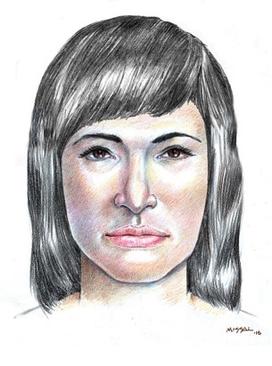
Forensic advances have kept the case alive. In 2017, a major reinvestigation used DNA analysis, isotope testing, and facial reconstruction. Scientists analyzed her teeth, her hair, and her bones. The isotope data suggested she had spent significant time in German-speaking central Europe. A forensic artist created a new sketch of what she may have looked like in life. It was haunting , a face reconstructed from death, staring back at a world that still couldn’t name her.
A Ghost Without a Name
She was buried in Bergen’s Møllendal cemetery. Her coffin was carried by police officers. The local community attended. A priest said words over a woman whose real name nobody knew.
Her grave marker simply reads: “Ukjent Kvinne” , Unknown Woman.
That phrase captures everything. She moved through hotels, crossed borders, spoke in multiple tongues, and left behind a trail of false names. She was clearly intelligent. She was clearly hiding something. And someone , or something , ended her life in one of the most remote and foreboding valleys in Norway.
The case remains officially unsolved. No arrest has ever been made. No identity has ever been confirmed. The coded notepad has never been fully deciphered. The mystery of who she was, who sent her, and who may have killed her continues to echo through Norwegian criminal history.
The Isdal Woman left behind only questions. A burned body. Seven fake names. And a valley that locals still call Death Valley , now with very good reason.
More strange stories
 The Wow! Signal: The 72-Second Alien Transmission That Still Has No Explanation
 Beaver County Jane Doe: The Severed Head With Bubblegum Eyes Nobody Can Identify
 The Disappearance of Frederick Valentich: The Pilot Who Vanished After Reporting a UFO
 Somerton Man: Australia’s Most Chilling Cold War Mystery