
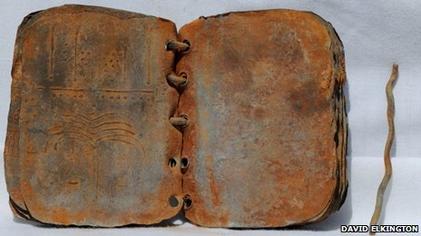
The Jordan Lead Codices burst onto the world stage in March 2011. They promised to rewrite Christian history. Tiny metal books, sealed with lead rings, supposedly pulled from a cave in Jordan. Some scholars called them the greatest discovery since the Dead Sea Scrolls. Others smelled a rat immediately. What followed was one of archaeology’s most bizarre, dramatic, and deeply weird controversies , a story involving Bedouin farmers, shadowy smugglers, coded scripts, and accusations flying across three continents.
So what were these mysterious objects? And why did so many people desperately want them to be real?
The Jordan Lead Codices and Their Explosive Debut
On March 3, 2011, The Jewish Chronicle ran a startling interview. A metallurgist named Robert Feather was trying to authenticate a collection of roughly 20 small metal books. They were in the possession of an Israeli Bedouin farmer named Hassan Saeda. He claimed his great-grandfather found them in a cave about a century ago.
The books were tiny. About the size of a credit card. Made of lead and copper. Bound together with lead rings. Many were sealed shut on all four sides. Some appeared to carry inscriptions in Paleo-Hebrew , an ancient archaic script. Others seemed to show a seven-branched menorah. There were crosses. Images of a tomb. A depiction of Jerusalem.
A piece of leather found alongside the collection had already been carbon-dated. The results suggested it was roughly 2,000 years old. That single detail sent imaginations into overdrive.
Then, on March 22, a man named David Elkington issued a press release that detonated across global media. Elkington described himself as a scholar of ancient religious archaeology. He claimed the hoard consisted of up to 70 ring-bound books. He said they might predate the writings of St. Paul. He said they could be “the major discovery of Christian history.” The director of Jordan’s Department of Antiquities, Ziad al-Saad, suggested the books might have been made by followers of Jesus in the decades immediately following his crucifixion.
The world went wild. Here, supposedly, were physical relics from the earliest days of Christianity. Sealed. Coded. Hidden in a cave for two thousand years.
The Dead Sea Scrolls had set the benchmark for ancient religious discovery. Now people whispered that this could be even bigger.
What the Jordan Lead Codices Actually Revealed
Related article: The Cottingley Fairies: How Two Girls Fooled the World with Cardboard Cutouts
Not everyone was convinced. Not even close.
The Israel Antiquities Authority (IAA) didn’t mince words. They called the books a “mixture of incompatible periods and styles without any connection or logic.” They said forged motifs like these could be found “in their thousands” in antiquities markets across Jordan and the Middle East.
Professor André Lemaire is an epigrapher and director of studies at the École pratique des hautes études. He examined the inscriptions. His verdict was brutal. The text made no sense. He called them “sophisticated fakes.”
Then came the letter that changed everything.
On March 31, 2011, a letter surfaced online. It had been written in 2010 by Elkington himself. He had contacted Oxford academic Peter Thonemann. He sent images of a copper tablet and asked for help translating the Greek text on it. Thonemann’s reply was damning. The item was a modern forgery. The Greek text had been copied directly from a known ancient coin , but copied incorrectly, scrambling the letters into nonsense.
This wasn’t just embarrassing. It was devastating. Elkington had been seeking authentication for an object that a genuine expert had already identified as fake. And yet the press release machine kept rolling.
The Smithsonian Institution has documented how archaeological forgeries often exploit public hunger for religious relics. The Smithsonian notes that forgers frequently target objects connected to early Christianity or Judaism, knowing the emotional stakes drive people to believe before they think.
The Strange Characters Behind the Jordan Lead Codices Scandal
The cast of characters in this story is genuinely unsettling.
David Elkington remains a murky figure. His academic credentials were questioned almost immediately. He described himself as heading a “British team” trying to get the books safely into a Jordanian museum. But experts struggled to verify his qualifications or his team’s legitimacy.
Hassan Saeda, the Israeli Bedouin farmer who possessed the books, told conflicting stories about their origin. Were they found by his great-grandfather a century ago? Or did a Jordanian Bedouin find them between 2005 and 2007? The accounts kept shifting.
Then there were the books themselves. Some scholars pointed out that the lead appeared artificially aged. The patina , the coating that develops on old metal , looked wrong to trained eyes. Tests on the lead suggested it could have been cast from ancient lead sources, which muddied the dating evidence. Forgers had apparently done their homework.
The coded script added another layer of creepiness. Nobody could read it. Nobody could agree on what language it even was. Some claimed it was Paleo-Hebrew. Others said it was gibberish , random symbols strung together to mimic the look of ancient writing without actually saying anything.
A November 2012 BBC regional investigation concluded they were fakes. By 2017, both the Israeli Antiquities Authority and Jordan’s archaeological department officially maintained the same position. Forgeries. Full stop.
Why So Many People Desperately Wanted to Believe
Here’s where the story gets psychologically fascinating.
Despite the expert consensus, a devoted community of believers kept the faith. Online forums buzzed. Books were written. Elkington continued to promote the find for years.
Why? Because the promise was intoxicating. Physical books. Sealed. From the time of Jesus. Possibly written by his earliest followers. Possibly connected to the Kabbalah. Possibly coded messages from a lost world.
Human beings are wired to want that kind of discovery. We want the cave. We want the sealed box. We want the ancient secret waiting inside.
Biblical scholars Margaret Barker and Philip R. Davies were initially named as part of Elkington’s team. Their involvement gave the story credibility. Davies later distanced himself significantly from the claims as the evidence against authenticity mounted.
The carbon dating of the leather fragment haunted the story too. Leather can be ancient even when the objects found alongside it are not. Forgers know this. A scrap of genuinely old material can lend false credibility to a fake. It’s a classic trick.
The full documented history of the Jordan Lead Codices reads like a thriller , part archaeological mystery, part con artistry, part mass hysteria.
The Jordan Lead Codices remain one of the strangest episodes in modern archaeological history. They weren’t just fakes. They were seductive fakes. They exploited our deepest hunger for connection to ancient mysteries. And for one brief, electric moment in 2011, they almost convinced the world that a cave in Jordan had changed everything we knew about the origins of Christianity. The cave gave up its secret eventually. The secret was that there was no secret at all , just lead, and longing, and a very clever forgery.
Related Posts
 Russian Sleep Experiment: The Terrifying Creepypasta That Fooled the World
 Ursal: The Fake Socialist Conspiracy That Became Brazil’s Most Viral Political Hoax
 Gospel of Jesus’ Wife: The Bizarre Forgery That Fooled Harvard and Hid a Pornographer’s Secret
 Bananadine: The Great Banana Peel Hoax That Fooled America in 1967