The Newark Holy Stones are one of the most bizarre and brazen forgeries in American archaeological history. Discovered in 1860 near Newark, Ohio, these carved stones appeared to rewrite everything scholars knew about ancient America. They seemed to prove that ancient Israelites had walked the same ground as Ohio’s mysterious Hopewell mound builders. The story behind them is stranger than fiction. It involves a desperate man, a sacred burial site, and inscriptions that fooled , and outraged , the world. Even today, the stones sit in a museum, daring visitors to decide what to believe.
The Newark Holy Stones and Their Shocking Discovery
In June 1860, a surveyor named David Wyrick was digging near the Newark Earthworks in Ohio. These earthworks are enormous. They represent one of the largest surviving complexes built by the ancient Hopewell culture. The Hopewell people lived from roughly 100 BC to AD 500. They constructed massive ceremonial mounds across the Ohio River Valley. No one fully understands their beliefs or rituals even today.
Wyrick’s team pulled something extraordinary from the earth. It was a stone shaped like a keystone. But this wasn’t any ordinary rock. It was carved with Hebrew text. Four phrases covered its four sides. “Holy of Holies.” “King of the Earth.” “The Law of God.” “The Word of God.”
The archaeological world erupted. Hebrew inscriptions inside an ancient Native American burial mound? It was either the discovery of the century , or a spectacular lie.
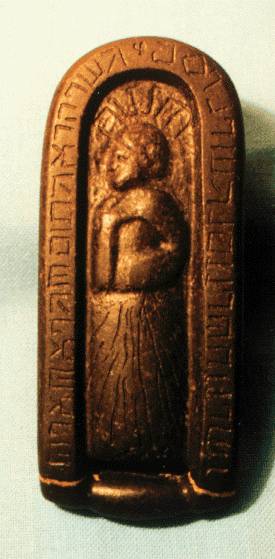
Wyrick wasn’t done. In November 1860, his team dug up a sandstone box. Inside it sat a small black stone. Geologists later identified it as limestone. Carved across its surface was a condensed version of the Ten Commandments. The inscription spiraled around all sides of the stone. It was designed to be read in a continuous loop. Above a carved figure of a robed, bearded man holding a tablet sat a single word: “Moses.”
The stones seemed to scream one message. Ancient Israelites had been in Ohio long before Columbus ever sailed.
The Newark Holy Stones and the “Lost Tribes” Obsession
Related article: Crystal Skull: The Victorian Hoax That Fooled Museums and Spawned Supernatural Legends
To understand why these stones caused such a frenzy, you need to understand the 1860s American mindset. Many people desperately wanted to believe in the “Lost Tribes” theory. This idea claimed that ancient Israelites had crossed the ocean and settled in the Americas. It gave a biblical explanation for the mysterious mound builders. It also conveniently stripped Native Americans of their own rich heritage and history.
The Newark Holy Stones arrived at the perfect cultural moment. America was on the edge of civil war. Racial pseudoscience was everywhere. Some scholars used the “Lost Tribes” theory to argue that Native Americans weren’t truly native at all. It was archaeology twisted into a political weapon.
But experts weren’t fooled for long. In July 1860, scholar Abraham Geiger wrote in the New York Times that the Keystone showed all the signs of clumsy modern forgery. He pointed to strange letter formations. He noted obvious mistakes and transpositions in the Hebrew text. The inscription wasn’t ancient post-Exilic Hebrew. It was derived directly from the modern Hebrew alphabet. An ancient Hopewell craftsman couldn’t have known modern Hebrew. Someone in 1860 could.
The Hebrew text was wrong in ways that only a modern forger , working from a contemporary source , would get wrong. The mistakes weren’t random. They were the specific mistakes of someone copying Hebrew letters they didn’t fully understand.
The Strange Science Behind the Newark Holy Stones Fraud
Here’s where things get genuinely eerie. The wooden burial platform beneath the Decalogue Stone was preserved. For over 150 years, nobody tested it. Then in 2014, researcher Bradley Lepper tracked down a fragment of that platform. It had been sitting quietly at Yale’s Peabody Museum of Natural History all along.
Scientists ran radiocarbon dating on the wood. The results came back startling. The platform dated to between CAL AD 85 and CAL AD 135. That’s squarely within the Hopewell cultural period. The mound itself was completely authentic.
So what does that mean? It means Wyrick , or someone else , planted the carved stones inside a genuinely ancient Hopewell burial site. They defiled a sacred space. They placed a modern forgery among the bones and artifacts of a civilization that died over a thousand years before Hebrew letters were ever written that way.
The mound was real. The stones were fake. Someone crawled into a sacred ancient site and buried a lie.
Why would Wyrick do it? He was a local surveyor with no particular fame. Some historians think he genuinely believed in the Lost Tribes theory and wanted to prove it. Others suggest he was manipulated by someone else. A few researchers have pointed fingers at local religious figures who had theological reasons to want such proof. Wyrick died by suicide in 1864. He never confessed. He never explained. The truth went with him.
The Stones That Refuse to Stay Buried
The stones didn’t disappear after experts called them fakes. They survived. They traveled. They found a permanent home at the Johnson-Humrickhouse Museum in Coshocton, Ohio. For years, the museum displayed them without judgment. Visitors could look at them and make up their own minds.
That changed recently. Museum officials decided that staying “neutral” about a known forgery wasn’t actually neutral at all. The stones are now displayed with full context. The exhibit connects them to the racial politics of 1860s Ohio. It explains how pseudoarchaeology was used to deny Native Americans their heritage. Visitors can now examine the stones from all four sides. An iPad kiosk shows close-up photos and historical documentation.
Some visitors still believe the stones are genuine. Online communities dedicated to fringe archaeology treat them as suppressed proof of ancient Israelite migration. They argue that mainstream science is hiding the truth. The stones have become a rallying point for people who distrust academic authority.
That’s the strangest part of this whole story. A clumsy 19th-century forgery , one that experts debunked within months of its discovery , still has true believers today. The Newark Holy Stones were never about ancient history. They were always about what people desperately needed to believe. And that need, it turns out, never really goes away.
—
The Newark Holy Stones stunned 1860s America. Were they proof of ancient Israelites in Ohio , or one of history’s most brazen archaeological frauds?