
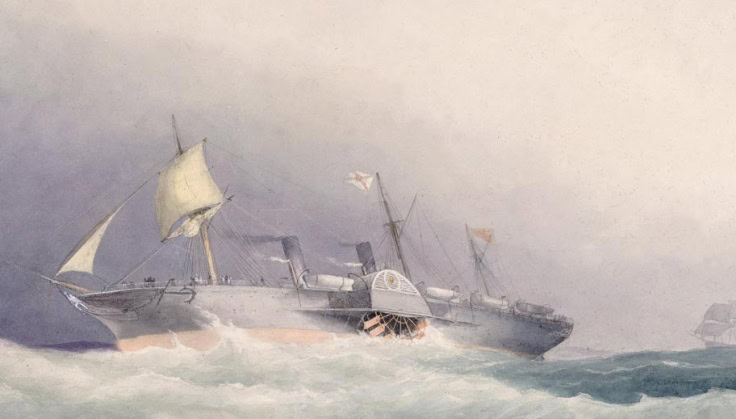
The RMS Atrato (1853) had one of the strangest lives of any ship ever built. She launched as the world’s largest passenger ship. She ended her days as a renamed wreck on the ocean floor. In between, her story twisted through cursed sister ships, mysterious conversions, and a final plunge into darkness that left more questions than answers. This iron-hulled giant sailed Caribbean routes, crossed oceans under a new identity, and ultimately met a fate that felt almost inevitable. For a ship born from disaster, perhaps sinking was always written in the hull.
How RMS Atrato (1853) Rose From Another Ship’s Catastrophe
The Atrato’s origin story is soaked in bad luck. It didn’t start with her , it started with her sister ship.
The Royal Mail Steam Packet Company needed new vessels. They ordered five large wooden-hulled ships for Caribbean mail routes. One of those ships was the Demerara, built in Bristol by William Patterson Shipbuilders. Her engines came from Caird & Company of Greenock, the same yard that would later build the Atrato.
Here’s where things went horribly wrong. A steam tug tried to tow the Demerara from Bristol to Greenock. The tug master didn’t know the winding River Avon well enough. He lost control. The massive ship became wedged against both riverbanks. When the tide dropped, the hull bridged the river like a dead whale. Over 1,200 tons of ballast sat in her engine room. The structural damage was catastrophic.
RMSP rejected the Demerara entirely. She was a constructive total loss before she ever carried a single passenger.
That disaster forced RMSP to act fast. They turned to Caird & Company again. The result was the Atrato , bigger, bolder, and built with iron instead of wood. She launched on April 26, 1853, from Greenock. At 3,466 gross registered tons and 350 feet long, she was the largest passenger ship on earth.
She ran on a two-cylinder side-lever steam engine. She churned through water on side paddles. She also carried three masts rigged as a barquentine. She was a hybrid creature , part steamship, part sailing vessel. Strange from the very beginning.
The RMS Atrato (1853) and Her Caribbean Ghost Route
Related article: Tunguska Event: The Mysterious Siberian Explosion That Defies Explanation
For nearly two decades, the Atrato worked the Southampton to Caribbean route. She carried Royal Mail. She carried passengers. She carried the weight of being RMSP’s crown jewel.
But something shifted in 1870. RMSP traded her away. Just like that, she lost her “Royal Mail Ship” designation. The title that defined her was stripped away. She became something lesser , a ship without a name that matched her past.
Then came the conversion. In 1872, engineers transformed her from a paddle steamer into a screw-propelled vessel. They ripped out her iconic side paddles. They replaced her engine with a two-cylinder compound steam engine. Her hull shrank slightly in the process , down to 335.9 feet and 3,184 gross tons.
She looked different. She moved differently. Was she even the same ship anymore?
Under charter to the Aberdeen Line, she ran routes to Victoria and New Zealand. She crossed oceans she was never designed for. New owners passed her along like an unwanted inheritance. John Morrison & Company took her in 1872. Henry T. Horn acquired her in 1879. Then Adamson & Ronaldson picked her up in 1880.
Each handoff felt like another step toward oblivion. Nobody kept her long. Nobody seemed to want her permanently.
The Mysterious Final Days of RMS Atrato (1853)
In 1880, she received the final indignity. They renamed her Rochester , after Rochester, Kent. The great Atrato, named for a river in Colombia, became a place name in England. Her original identity was erased.
She sailed as the Rochester for four years. Those years are murky. Records thin out. The ship that was once the world’s largest passenger vessel had faded into near-invisibility.
Then came June 25, 1884.
She ran aground. The details are sparse and unsettling in their vagueness. No dramatic storm is recorded. No famous last words from her captain. She simply struck something she shouldn’t have. The iron hull that had carried thousands of passengers across the Caribbean and around the world gave way.
She sank.
The ship that began her life as a replacement for a cursed, broken vessel ended her days broken on the seafloor. There’s a grim symmetry to it. The Demerara was destroyed before she could serve. The Atrato served for thirty-one years, changed her name, changed her engines, changed her routes , and still wound up on the bottom.
What exactly caused the grounding? That question doesn’t have a clean answer. The historical record goes quiet exactly when you want it to speak. Maritime historians note the date and the fate. Beyond that, the sea keeps its secrets.
For a vessel with such a dramatic beginning, the ending feels deliberately obscure. Almost as if the ocean wanted to swallow her whole and leave nothing behind to explain why.
What the Wreck Tells Us About Victorian Hubris
The story of this ship isn’t just about one vessel. It’s about an era that believed iron and steam could conquer anything.
Victorian shipbuilders pushed boundaries constantly. The Atrato was proof of that ambition. Being the world’s largest passenger ship in 1853 meant something. It meant power. It meant prestige. It meant Britain ruled the waves.
But the sea doesn’t care about records. It didn’t care about the Demerara. It didn’t care about the Atrato either.
You can find detailed records of Victorian-era maritime disasters and ship registrations through Archive.org’s historical newspaper collections. Accounts from the period reveal just how many “unsinkable” iron ships met quiet, undignified ends.
The Atrato’s fate mirrors dozens of her contemporaries. Built with pride. Sold off when inconvenient. Renamed to hide a fading legacy. Then gone.
The RMS Atrato (1853) deserves to be remembered not just as a record-holder, but as a ghost story in iron and steam. She haunts maritime history. She rose from one ship’s catastrophe, outlived her own identity, and slipped beneath the waves without ceremony. If any wreck deserves a paranormal investigator with a diving suit, it might just be hers , somewhere on the ocean floor, the world’s once-greatest passenger ship sits in permanent silence.
Related Posts
 Mary Celeste: The Ghost Ship That Sailed Itself to Infamy
 Women and Children First: The Deadly Maritime Code That Failed When It Mattered Most
 The Captain Goes Down with the Ship: The Eerie Code That Haunts Maritime History
 Spontaneous Human Combustion: The Terrifying Mystery of Bodies That Burn From Within