
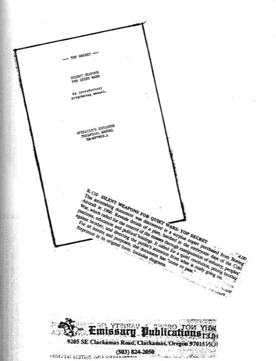
The Silent Weapons for Quiet Wars (document) is one of the strangest texts ever to surface in American conspiracy culture. It didn’t arrive through a whistleblower. It didn’t leak from a government server. Instead, it allegedly tumbled out of a used photocopier bought at a military base auction in 1986. That bizarre origin alone makes it worth examining. The pamphlet claims that a secret “Third World War” has been raging for decades. No bullets. No bombs. Just data, economic manipulation, and silent psychological control. Whether it’s a genuine elite blueprint, a deliberate hoax, or something stranger in between , its story is genuinely unsettling.
The Silent Weapons for Quiet Wars (document) and Its Eerie Discovery
The story begins in July 1986. An employee of Boeing Aircraft Company purchased a surplus IBM photocopier at a government auction. The copier had come from McChord Air Force Base in Washington State. Hidden inside the machine was a single copy of a pamphlet. Nobody knows how long it had been sitting there. Nobody knows who put it there.
The pamphlet was titled Silent Weapons for Quiet Wars: An Introduction Programming Manual. It claimed to outline strategies for controlling entire populations. Not through armies. Through economics, data systems, and engineered social chaos. The employee passed it along. It eventually reached the Promise Newsletter in Phoenix, Arizona, where it began circulating in fringe circles.
The document’s own text is deeply strange. It opens by declaring: “This publication marks the 25th Anniversary of the Third World War, called the ‘Quiet War,’ being conducted using subjective biological warfare, fought with ‘silent weapons.'” It describes society as a giant computer network. People are nodes. Industries are circuits. And somewhere, unseen operators are running the program.
Wikipedia’s overview of the document notes that the text includes technical-looking diagrams. Many readers found these convincing. Others saw them as deliberate window dressing , fake credibility for a fabricated text.
The sheer coldness of the writing disturbs people most. It doesn’t read like a manifesto. It reads like a technical manual. Detached. Clinical. As if human beings are simply variables in an equation.
The Silent Weapons for Quiet Wars (document) and the Man Who Claimed to Write It
Related article: Phantom Time Conspiracy Theory: The Missing 297 Years That Never Existed
For years, nobody knew who wrote the pamphlet. Then a man named Lyle Hartford Van Dyke Jr. came forward. He was incarcerated at the time. In a letter dated December 2003, written to Paranoia Magazine, Van Dyke claimed he had compiled the manual around October 1978.
He said he sent roughly 65 copies to personal contacts. One copy, he claimed, he gave to a hitchhiking military individual near McChord Air Force Base. That copy, he believed, ended up inside the photocopier that later went to auction. The chain of custody is almost impossibly strange. A handout to a stranger. A forgotten copier. A government auction. And then , discovery.
Van Dyke insisted the document was a “collage of ideas.” He didn’t claim to have invented the concepts. He said he compiled them as a warning. He wanted people to understand how systems of institutional control actually work. He described it as an intentional alarm about the suppression of collective consciousness.
But here’s where it gets murkier. Van Dyke’s claims can’t be fully verified. His letter exists. His account is plausible. But no original 1978 copies have surfaced. No corroborating witnesses have emerged. The document’s true origin remains genuinely unknown.
Archive.org hosts Milton William Cooper’s Behold a Pale Horse, the 1991 book that blasted the pamphlet into mainstream conspiracy culture. Cooper was a radio host with a massive following. He presented the text as a genuine elite blueprint for world domination. His endorsement turned a fringe pamphlet into a cultural phenomenon.
What the Silent Weapons for Quiet Wars (document) Actually Claims
The content itself is worth examining closely. The pamphlet draws heavily on Operations Research , a real field developed during World War II to optimize military logistics. It also references cybernetics, the science of systems and control. These are legitimate academic disciplines. The document weaponizes their language.
It argues that the same mathematical tools used to model economies can be used to control them. It claims that economic shocks, media manipulation, and data systems can render populations passive and compliant. Citizens who can’t manage their finances, it states bluntly, “become totally enslaved, a source of cheap labor.”
The text even names institutions. It points to the Rockefeller Foundation and Harvard College as early participants in developing these control systems. These references gave the document an air of specificity that fueled its credibility in conspiracy circles.
The “silent weapons” of the title aren’t guns or bombs. They’re algorithms. They’re debt cycles. They’re information systems that shape what people believe and how they behave. The document argues these tools are more powerful than any military force. And that’s what makes it so genuinely creepy , not because it’s necessarily true, but because it’s not entirely impossible to imagine.
Scholars and skeptics have largely dismissed the text as a hoax. They categorize it alongside other “New World Order” mythology. But the document refuses to disappear. It keeps circulating. It keeps finding new readers.
Why This Pamphlet Still Haunts People Today
There’s something about this story that doesn’t sit still. A military base. A used photocopier. A pamphlet describing invisible warfare against ordinary citizens. Even if every word is fabricated, the way it was found feels staged. Almost theatrical. Like someone wanted it to be discovered.
Van Dyke’s account raises more questions than it answers. Why did a hitchhiker at a military base end up with a copy? Why did that copy survive inside a copier for years? Why did the document surface in Phoenix, of all places, through an obscure newsletter?
The text itself taps into anxieties that feel more relevant today than ever. Mass data collection. Algorithmic control of information. Economic systems that seem designed to keep ordinary people powerless. Whether or not the document is genuine, the fears it describes are real.
Researchers studying social engineering as a political science concept note that institutional manipulation of public behavior is a documented phenomenon. The document’s crime, if it has one, is dressing real concepts in the language of secret conspiracy.
The Silent Weapons for Quiet Wars (document) remains officially classified as a conspiracy text and probable hoax. But its persistence is its own kind of mystery. Hoaxes usually fade. This one keeps returning , from used copiers, from fringe newsletters, from the pages of a radio host’s bestselling book. It surfaces. It circulates. And then it disappears again, waiting to be rediscovered by the next person who stumbles across a strange old pamphlet and wonders: what if they’re not wrong?