
The Tarim Basin Mummies represent one of archaeology’s most perplexing mysteries, hidden beneath China’s vast Taklamakan Desert for nearly four millennia. These remarkably preserved remains have sparked international controversy and overturned everything scientists thought they knew about ancient Central Asia. With their European features, mysterious burial practices, and bizarre sexual symbolism, these ancient people challenge our understanding of early human migration and cultural development.
Discovered in the early 20th century, these mummies have become the center of heated political debates and groundbreaking genetic research. Their story isn’t just about ancient history,it’s about identity, nationalism, and the strange rituals of a lost civilization that defied explanation.
The Mysterious Origins of the Tarim Basin Mummies
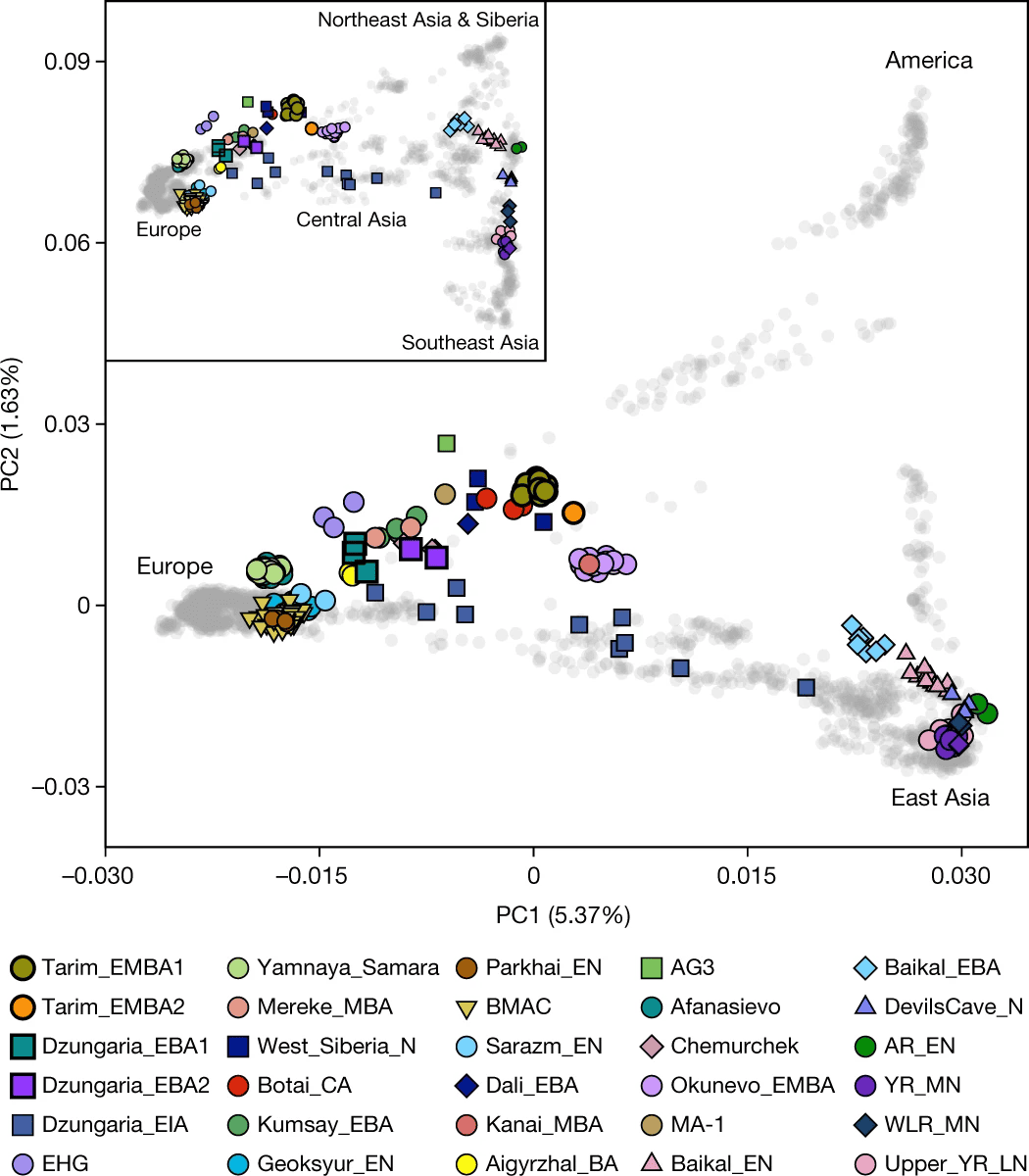
For decades, scientists believed the Tarim Basin Mummies were migrants from the west. Their Caucasian features and advanced textile work suggested they came from Europe or Central Asia. But a shocking 2021 genetic study published in Nature completely shattered this theory.
The research examined 13 individuals dating to 2100-1700 BCE. Scientists discovered these people weren’t migrants at all. Instead, they were direct descendants of the Ancient North Eurasians (ANE), a Pleistocene population that had mostly vanished by the Ice Age’s end. This genetic lineage survives today only in small percentages among Indigenous Siberians and Americans.
The Tarim Basin Mummies formed a completely isolated genetic group. They showed no mixing with other populations for thousands of years. This isolation makes them a unique window into humanity’s deep past. How did they survive in such a harsh desert environment? Why didn’t they intermarry with neighboring groups? These questions remain unanswered.
Their preservation is equally mysterious. The desert’s extreme dryness naturally mummified their bodies. Some retain hair, skin, and even clothing after 4,000 years. The famous “Beauty of Loulan” still has her blonde hair and serene expression intact.
Bizarre Sexual Symbolism at Xiaohe Cemetery
Related article: Phantom Barber of Pascagoula: The Hair-Cutting Terror That Haunted Mississippi in 1942
The most shocking discovery about the Tarim Basin Mummies comes from Xiaohe Cemetery. Here, archaeologists found burial practices so strange they seemed almost supernatural. The dead were buried in upside-down boats, as if prepared for a journey across an otherworldly river.
But the boats weren’t the strangest part. Rising from each burial were massive wooden poles,some reaching 13 feet high. Archaeologists quickly realized these weren’t simple markers. They were giant phallic symbols and vulva representations, creating what researchers called “a vigorous forest of sexual symbolism.”
The gender associations were deliberately reversed. Female burials received phallic posts, while male burials got vulva-shaped markers. This wasn’t random,it suggested deep spiritual beliefs about death and rebirth. Some burials contained life-sized wooden phalluses placed directly on or beside the bodies.
Chinese archaeologists described entering “a mysterious world permeated with an original, religious atmosphere.” They found wooden masks, carved animals, and explicit representations of male and female genitalia. The site felt more like an ancient temple to fertility than a typical cemetery.
Dr. Gino Caspari offers an alternative theory. He suggests the poles might represent paddles and mooring posts for the boat burials. The water symbolism could indicate their belief in crossing a metaphorical river to reach the afterlife. But even this explanation doesn’t fully account for the explicit sexual imagery found throughout the site.
Political Controversy and Hidden Tarim Basin Mummies
The discovery of the Tarim Basin Mummies created an unexpected political firestorm. In 2011, the Chinese government suddenly withdrew mummies from a Philadelphia museum exhibition without explanation. The University of Pennsylvania Museum’s “Secrets of the Silk Road” exhibit opened without its star attractions.
Museum officials were baffled. “The artifacts have been in our storeroom for almost a month, but the Chinese government suddenly told us,without giving any explanation why,that we are not permitted to open the crates,” they reported. China claimed the mummies were too fragile to transport, but many suspected political motives.
The controversy stems from the mummies’ appearance and location. Their Caucasian features contradict Chinese claims that the Xinjiang region has always been part of China. Uyghur nationalist groups seized on the mummies as evidence of their prior claim to the land.
“If East Turkestan was indeed an inalienable part of China since ancient times, then why were the original and ancient inhabitants of this region not Chinese, but Uyghur-looking Caucasians?” Uyghur activists argued. The Beauty of Loulan became a symbol of their cause in the 1970s and 1980s.
However, genetic research has complicated this narrative. The Tarim mummies predate both Han Chinese and Uyghur presence in the region. The Uyghurs didn’t arrive until nearly a millennium after the Han Chinese. This makes the mummies neutral in modern territorial disputes, belonging to neither group’s direct ancestry.
Ongoing Mysteries and Research Challenges
Despite decades of study, the Tarim Basin Mummies continue to baffle researchers. Their language remains completely unknown. No written records exist to explain their beliefs, social structure, or daily lives. We can only guess at their thoughts and motivations based on burial practices and artifacts.
Access to the region remains extremely difficult, even for Chinese researchers. This has slowed scientific progress and left many questions unanswered. The political sensitivity surrounding the mummies has made international collaboration nearly impossible.
Recent studies have revealed more puzzling details. Some mummies show evidence of advanced medical knowledge, including successful brain surgery. Others display sophisticated textile work that rivals modern techniques. Their cheese-making and wheat cultivation suggest complex trade relationships with distant peoples.
The boat burials raise additional questions. Why did a desert people choose water symbolism for death? Did they remember ancient migrations across seas or rivers? Or did the boats represent something else entirely,perhaps vessels for spiritual journeys we can’t comprehend?
Archaeological evidence suggests these people lived in shifting oasis communities. They adapted to the desert’s harsh conditions while maintaining their unique cultural identity. But how they organized their society, chose their leaders, or passed down knowledge remains a complete mystery.
The Tarim Basin Mummies represent one of archaeology’s greatest enigmas. Their genetic isolation, bizarre burial customs, and mysterious disappearance challenge our understanding of ancient human societies. As political tensions continue to restrict research access, many of their secrets may remain buried forever in the shifting sands of the Taklamakan Desert. These ancient people took their stories to the grave, leaving behind only tantalizing clues about a civilization unlike any other in human history.
Related Posts
 Longyou Caves: China’s 2,000-Year-Old Underground Mystery That Defies Explanation
 Llangaffo: The Welsh Village Where Ancient Rituals Meet Modern Earthquakes
 Okinoshima: Japan’s Forbidden Island Where Ancient Gods Dwell and Women Are Banned Forever
 Ballista Balls of Gamla: The Cursed Ancient Weapons That Keep Coming Home