
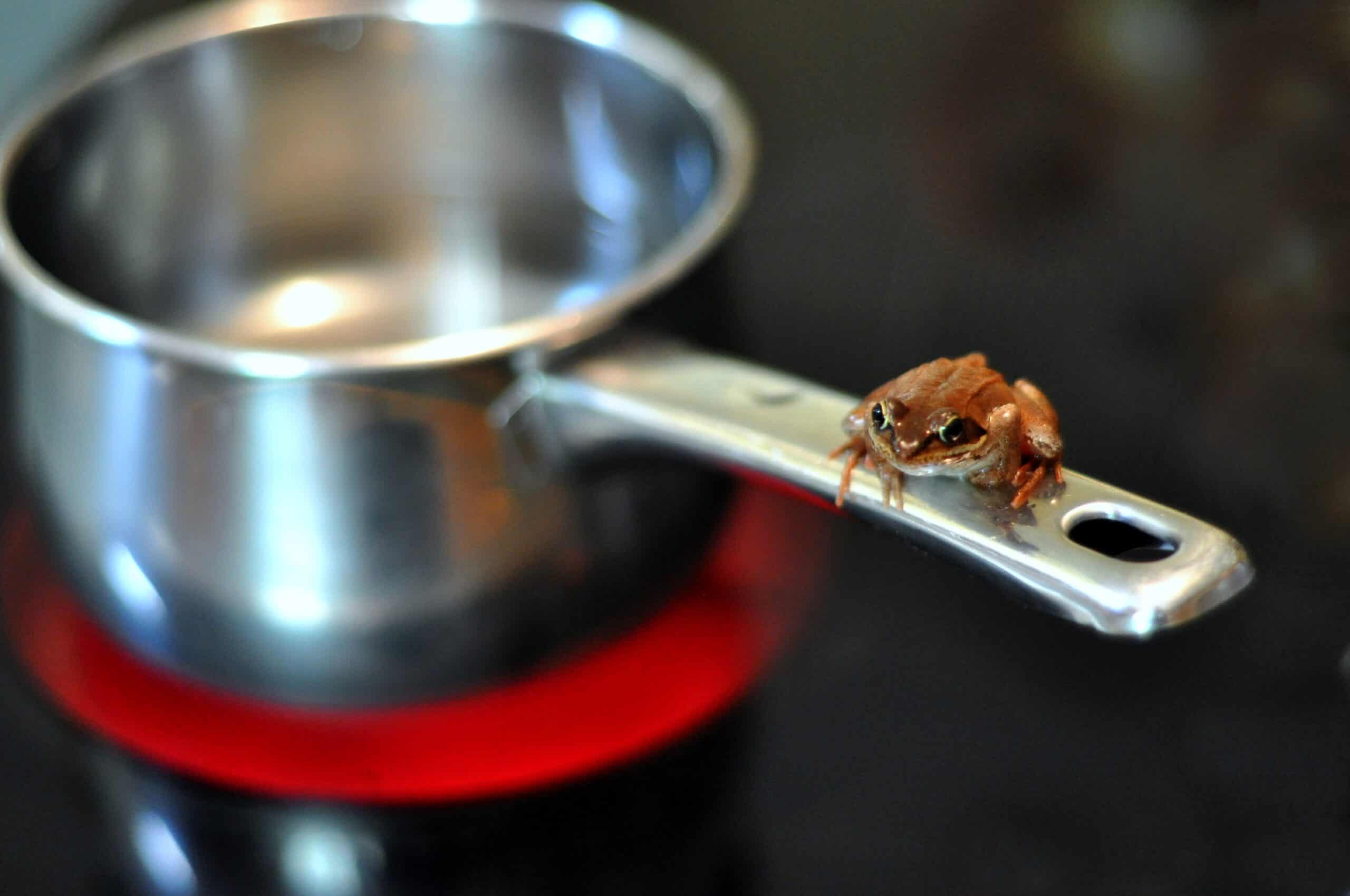
The Boiling Frog story is one of history’s most unsettling parables. It describes a frog placed in cool water that slowly heats to a fatal boil. The frog never jumps out. It simply… sits there. And dies. Most people hear this and feel a chill of recognition. Not because of the frog. Because of what it says about us. This dark little tale has roots in real 19th-century laboratory experiments. Scientists literally boiled frogs alive to prove a point. And the conclusions they reached have haunted philosophers, politicians, and everyday people ever since. The story raises a question that nobody wants to answer honestly: Are we the frog? Are we already sitting in water that’s getting dangerously hot , and simply failing to notice?
The Boiling Frog Experiments That Started It All
The story isn’t pure fiction. It has a genuinely disturbing origin in real science.
In 1869, German physiologist Friedrich Goltz conducted experiments that would make modern ethics boards shudder. He was searching for the location of the soul. His method? Removing a frog’s brain entirely. A brainless frog, he discovered, would remain completely still in slowly heated water. It never tried to escape. It cooked without resistance.
That finding was unsettling enough. But it got worse.
In 1875, a researcher named Fratscher pushed further. His experiments suggested that an intact frog , brain fully functional , would also fail to escape if the water heated gradually enough. The frog’s own nervous system, it seemed, couldn’t register slow-creeping danger.
These weren’t fringe findings. They circulated through scientific literature for decades. The boiling frog premise became accepted fact in many academic circles, even as later biologists challenged it fiercely.
Modern scientists now argue the original experiments were flawed. Real frogs, they say, will jump out of gradually heated water. Their thermoregulation instincts kick in. But here’s the truly eerie part: it doesn’t matter whether the frog escapes. The metaphor had already escaped the laboratory. It had taken on a life of its own.
How the Boiling Frog Became a Warning for the Ages
Related article: Salinella Salve: The Vanishing Creature That Defied Science for Over a Century
Once the story left the lab, it spread like a slow fever through culture and politics.
By 1960, writers were using the Boiling Frog tale to warn against complacency during the Cold War. The argument was chilling in its simplicity: nuclear threat doesn’t always arrive as a sudden explosion. Sometimes it creeps. Sometimes nations normalize the unthinkable, one small compromise at a time.
In the 1980s, survivalists grabbed the metaphor. They used it to describe civilization’s slow collapse. They weren’t wrong that society changes gradually. They just disagreed on what the boiling point would look like.
Then came the climate crisis. Al Gore famously used the story in his landmark 2006 film An Inconvenient Truth. He described humanity as the frog. Carbon emissions as the heat. The audience as witnesses to a slow catastrophe unfolding in real time. Notably, Gore’s version gave the frog a rescue. Real life has offered no such comfort.
Legal scholar Eugene Volokh made an interesting observation in 2003. He argued that even if real frogs jump out, the metaphor remains valuable. It works the same way the image of an ostrich burying its head in sand works , factually dubious, emotionally true.
The phrase “boiling frog syndrome” entered psychological and sociological vocabulary. It describes a specific failure mode of human cognition. We are wired to respond to sudden threats. Gradual ones slip past our defenses. That’s not a flaw. It’s how our brains evolved. But in a world of slow-moving crises, it’s terrifying.
The Boiling Frog in Philosophy and the Paradox of Slow Change
Philosophers found the story irresistible. And they used it to explore something even stranger than death by ignorance.
The Boiling Frog tale connects directly to an ancient puzzle called the sorites paradox. The paradox asks: if you have a heap of sand and remove one grain at a time, when does it stop being a heap? There’s no clear answer. Change happens so gradually that no single moment marks the transformation.
Apply that to human experience. When does a democracy become an authoritarian state? When does a relationship become abusive? When does an environment become uninhabitable? 19th-century scientific journals wrestled with questions of gradual biological change in ways that eerily mirrored these philosophical puzzles.
The answer, in every case, is the same. There is no single moment. That’s what makes it so frightening.
Libertarian thinkers latched onto this. They used the frog story to warn about civil liberties. Each small erosion of freedom seems minor. One surveillance law. One restriction on speech. One emergency measure that never quite ends. Alone, each step seems manageable. Together, they cook you alive.
Daniel Quinn’s 1996 novel The Story of B devoted an entire chapter to this idea. Quinn applied the metaphor to human civilization itself , specifically to population growth and food surplus. His argument was stark. Humanity has been in the pot for thousands of years. The water is nearly boiling. And most of us are still floating there with a smile on our faces.
Why This Dark Tale Still Haunts Us Today
The frog story refuses to die. And that refusal is itself a kind of proof.
We keep telling it because we keep needing it. Every generation finds a new pot, a new heat source, a new reason to wonder if they’re already too comfortable to notice the danger.
Journalist James Fallows spent years trying to kill the story. He called it a “stupid canard.” He pointed out the biology is wrong. But even he eventually gave up. He declared peace on the subject in 2009. The story, he admitted, does something true even if it describes something false.
That tension is what gives the tale its strange, lingering power. It isn’t really about frogs. It never was. It’s about the human capacity for denial. Our remarkable ability to adapt to worsening conditions. Our tendency to call catastrophe normal because it arrived slowly.
The creepiest part? The story might be wrong about frogs. But it might be exactly right about us. We don’t need our brains removed to sit still in heating water. We manage that perfectly well on our own. The real Boiling Frog was never the amphibian in the pot. It was the storyteller. It was the audience. It was everyone who heard the tale, nodded in recognition, and then went back to floating in the warm, comfortable, slowly heating water of their own lives.
Related Posts
 Museum of Hoaxes: The Website That Exposes History’s Most Shocking Deceptions
 Mummy Forgeries: The Shocking Fakes That Fooled Museums and Historians for Decades
 Humbug: The Dark and Mysterious History of History’s Greatest Word for Deception
 The Barometer Question: The Strange Exam Puzzle That Broke Academic Minds