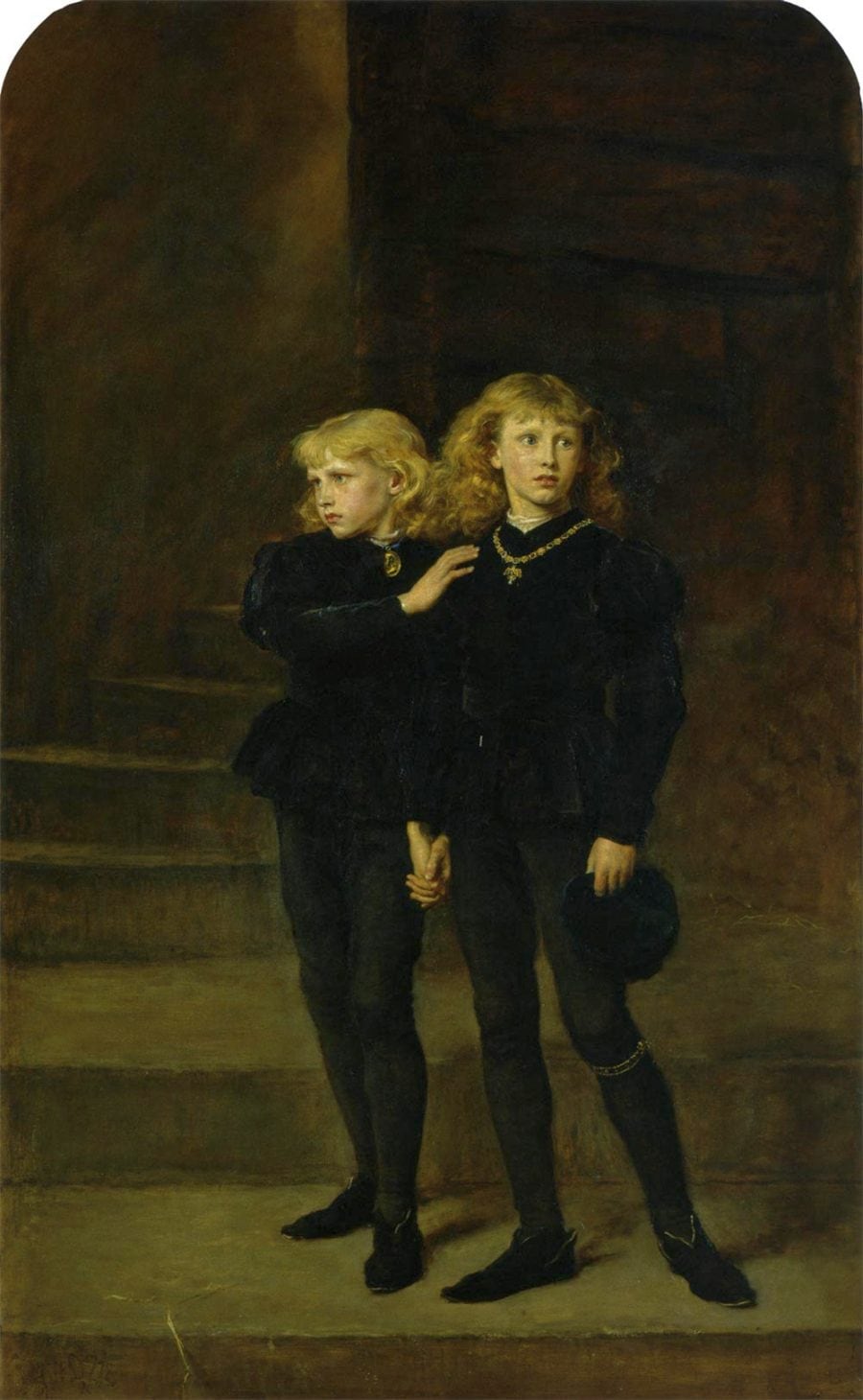
The Princes in the Tower is one of history’s most chilling unsolved mysteries. Two young boys , royal heirs to the English throne , walked into the Tower of London in 1483. They were never seen again. No bodies were ever officially confirmed. No killer was ever named. Centuries later, we still don’t know what truly happened inside those cold stone walls. The case has haunted historians, conspiracy theorists, and ghost hunters alike. And the Tower of London itself? It remains one of the most haunted buildings in all of England. The disappearance of these two boys sits at the dark heart of that reputation.
The Princes in the Tower: How Two Royal Boys Vanished
King Edward IV died suddenly in April 1483. He left behind two young sons. Edward V was just 12 years old. His brother Richard, Duke of York, was only 9.
Their uncle, Richard, Duke of Gloucester, stepped in as Lord Protector. He was supposed to prepare young Edward for his coronation. Instead, something far darker unfolded.
Richard moved quickly. He arrested the boys’ uncle Anthony Woodville and their half-brother Richard Grey. Both men were later beheaded at Pontefract Castle. Then he took custody of Edward V himself. Their mother, Queen Elizabeth Woodville, panicked. She fled with her daughters into sanctuary at Westminster Abbey.
On May 19, 1483, Edward V was lodged in the Tower of London. It was framed as tradition , kings stayed there before their coronations. On June 16, young Richard joined his brother there. The coronation date kept getting pushed back. Then it was cancelled entirely.
On June 22, a sermon declared Richard of Gloucester the only legitimate heir. Three days later, Parliament declared both boys illegitimate. Richard III took the throne. The boys were never seen in public again.
That last detail is the one that chills the blood. Two living, breathing princes , simply gone.
Who Murdered the Princes in the Tower? The Suspects Are Grim
Related article: The Flannan Isles Lighthouse Mystery: Three Men Vanished Without a Trace
The most obvious suspect is Richard III himself. He had the most to gain. With the boys dead, no rival could use them to challenge his crown. Most historians point the finger squarely at him. But proof? There is none.
Henry Stafford, the 2nd Duke of Buckingham, is another name that surfaces. He was Richard’s closest ally , until he wasn’t. Buckingham later rebelled against Richard III and was executed. Some historians believe he ordered the murders himself. Perhaps he wanted to curry favor with the future Henry VII.
Then there’s Henry VII. He took the throne in 1485 after defeating Richard at Bosworth Field. If the princes were still alive at that point, Henry had every reason to want them dead. His own claim to the throne was shaky at best. Two living Yorkist heirs would have been a constant threat.
Henry’s mother, Lady Margaret Beaufort, has also been named. She was ruthless, ambitious, and deeply devoted to her son’s rise to power. Could she have arranged the killings? Some think so.
The truth is, nobody knows. The mystery has never been solved. Every suspect has a motive. None has definitive proof against them.
Bones, Pretenders, and the Princes in the Tower Mystery Deepens
In 1674, workers at the Tower of London made a grim discovery. While demolishing a staircase, they found a wooden box. Inside were two small human skeletons. The bones were assumed to be those of the missing boys. King Charles II had them reinterred at Westminster Abbey.
But were they really the princes? Nobody can say for certain. The British Museum holds artifacts from this era, but the bones themselves have never undergone modern DNA testing. Requests to examine them have been repeatedly denied. The mystery stays sealed , literally.
Meanwhile, imposters crawled out of the shadows. In 1487, a boy named Lambert Simnel claimed to be Prince Richard. He was crowned in Dublin as “King Edward VI.” His rebellion failed. He ended up working in the royal kitchens.
Then came Perkin Warbeck. From 1491 to 1497, he claimed to be the younger prince Richard. He said he had escaped to Flanders. He gained serious support , including from Margaret, Duchess of Burgundy, who was the princes’ own aunt. Henry VII eventually captured him. Warbeck was executed in 1499.
Why did so many people believe these pretenders? Perhaps because nobody truly knew the princes were dead. Perhaps because the truth was so carefully buried that even contemporaries weren’t sure what had happened.
The Tower’s Dark Legacy and Ghostly Echoes
The Tower of London has always attracted ghost stories. But the ghosts of two small boys are among its most persistent legends. Visitors and guards over the centuries have reported seeing two young figures. They appear in white nightgowns. They wander the corridors near the Bloody Tower , the area where the boys are believed to have been held.
The sightings are eerily consistent. Two children. Holding hands. Silent. Then gone.
In the 1800s, two guards reportedly fled their posts after seeing the apparitions. They refused to return. The Tower’s resident ravens , long said to protect the kingdom , still stalk those same grounds today.
The story gets stranger still. In 1933, an examination of the bones found in 1674 suggested they belonged to children aged roughly 10 and 12. That matched the ages of the princes at the time of their disappearance. But the science of the era was limited. Later scientific discussions raised serious doubts about whether the bones were even male, let alone royal.
The Tower keeps its secrets well.
The story of the Princes in the Tower refuses to die. It has lasted over 500 years. Two boys entered a fortress and vanished. Their uncle became king. Pretenders rose and fell. Bones were found and never properly tested. Ghosts still reportedly walk the halls where the children once played. History offers us suspects, theories, and fragments. But it offers no answers. The cold stone walls of the Tower of London swallowed the truth whole , and it has never given it back.