
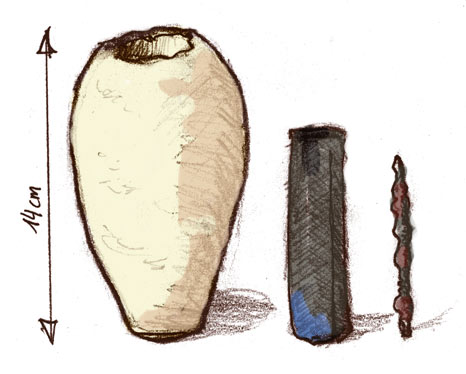
The Baghdad Battery is one of the strangest archaeological finds ever pulled from the ground. Discovered in 1936 near the ancient city of Ctesiphon in modern-day Iraq, this small clay pot has haunted scientists and historians ever since. It looks ordinary. But what’s inside is anything but. A copper cylinder. An iron rod. Traces of bitumen holding it all together. Fill it with an acidic liquid , vinegar, grape juice, even lemon juice , and you get a working electrical cell. The question that nobody can fully answer is chilling: did people living 2,000 years ago actually know how to generate electricity? Or is something even stranger going on?
What the Baghdad Battery Actually Looks Like
When Austrian archaeologist Wilhelm König first examined the artifact in 1936, he couldn’t believe what he was seeing. The object was a yellow clay vessel about 15 centimeters tall. Its neck had been snapped off. Inside sat a copper cylinder sealed with asphalt. And inside that cylinder? A completely corroded iron rod, also held in place with a bitumen stopper.
König described the copper as “fairly pure” with traces of zinc, lead, and iron. The copper cylinder wasn’t watertight. That detail matters enormously. If you poured any acidic liquid into the jar, it would surround the iron rod completely. You’d have a functioning galvanic cell. You’d have a battery.
König believed the object dated to the Parthian period , somewhere between 250 BC and 224 AD. However, experts at the British Museum later pointed out that the pottery style looks more Sasanian, placing it between 224 and 640 AD. The original excavation records were poorly kept. Nobody logged the exact context of the find. That missing information still haunts researchers today.
The artifact suffered corrosion from years of exposure to the elements before anyone properly examined it. And then, after the 2003 US-led invasion of Iraq, most of the similar artifacts vanished entirely. Their current whereabouts remain unknown.
The Baghdad Battery and the Electroplating Theory
This event shares similarities with: Two-toed Tom: The Legendary Monster Gator That Terrorized the Deep South
König didn’t stop at simply identifying the object. He went further. He suggested the Baghdad Battery might have been used for electroplating , coating metal objects with a thin layer of gold or silver using electrical current. It sounds outrageous. But researchers have actually tested this theory.
German Egyptologist Arne Eggebrecht claimed in the 1970s that he successfully electroplated a silver statuette using a replica of the artifact filled with grape juice. He reportedly achieved a gold coating just one ten-thousandth of a millimeter thick. The result seemed to validate König’s wildest theory.
But here’s where it gets complicated. No electroplated objects from this era have ever been confirmed by archaeologists. Not one. Mainstream archaeology firmly rejects the electroplating theory. They argue that beautiful gold-covered objects from this period were created using fire gilding , a well-documented ancient technique that requires no electricity whatsoever.
So either ancient craftspeople stumbled onto electrical technology and left zero other evidence behind. Or something else entirely was happening with these strange jars.
The Baghdad Battery as a Vessel for Dark Magic
Here’s the theory that archaeologists find most credible , and arguably the most unsettling. These jars weren’t batteries at all. They were containers for magic spells.
Ten similar vessels were found across the region. Four came from Seleucia in 1930. Six more turned up at Ctesiphon. Many were sealed with bitumen and contained bronze cylinders packed with tightly rolled organic material , possibly papyrus scrolls. Some held iron nails. Others contained lead plates. These objects were sometimes buried horizontally, pinned to the ground with metal rods driven into the earth on all sides.
That image is striking. Jars nailed to the ground. Sealed shut. Containing rolled-up writings. This matches known practices of curse magic in the ancient world. Archaeologists call these objects “curse tablets” or binding spells. You wrote your curse, sealed it inside a vessel, and buried it , sometimes pinning it down to trap the magic or the spirit inside. The lead, iron, and bitumen weren’t components of a battery. They were materials chosen for their protective or malevolent spiritual properties.
Curse tablets were widespread across the ancient Mediterranean and Middle East. Finding them in Parthian and Sasanian contexts makes perfect cultural sense. The “battery” interpretation may have been a spectacular misreading of ritual objects.
A Mystery That Still Has No Answer
One surviving jar from the Ctesiphon group now sits in the collection of the Metropolitan Museum of Art in New York. Most of the others disappeared after 2003. The looting of Iraqi museums during the invasion scattered countless irreplaceable artifacts. Some were recovered. Many were not. The loss is devastating for researchers who might one day crack this puzzle.
What makes this story so maddening is the uncertainty baked into every layer of it. The original dig was poorly documented. The dating is disputed. The contents of similar jars suggest ritual use. But the physics of the object genuinely works as a power source. Replicas generate between 0.8 and 2 volts of electricity when filled with acidic liquid.
Could ancient people have discovered electrical principles by accident? Could these objects have served multiple purposes , both magical and practical? Or was König simply wrong from the start, seeing a battery where there was only a jar for spells?
Historical archives from the early 20th century show how quickly Western archaeologists sometimes imposed modern frameworks onto ancient finds. The Baghdad Battery may be a perfect example of that impulse , a mysterious object forced into a familiar shape.
The truth is, nobody knows. And that uncertainty is exactly what makes this artifact so extraordinary. A 2,000-year-old clay pot with a copper tube inside shouldn’t raise this many questions. But it does. And until more evidence surfaces , if it ever does , the Baghdad Battery will remain one of history’s most electrifying unsolved mysteries.
Related Posts
 Baghdad Battery: The Ancient Mystery That Could Rewrite History
 Tarim Basin Mummies: Ancient Secrets and Bizarre Burial Rituals in China’s Desert
 The Nazca Lines: Ancient Desert Drawings, Blood Rituals, and the Mystery Nobody Can Solve
 The Antikythera Mechanism: Ancient Greece’s Most Terrifying Secret Computer