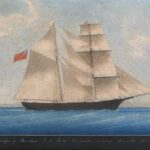

The USS Insurgent carries one of the most chilling mysteries in early American naval history. A warship that changed hands between nations, survived a famous battle, and then simply… vanished. No wreckage. No survivors. No explanation. Just 340 men swallowed whole by the Atlantic Ocean in September 1800. The sea gave nothing back. That kind of disappearance doesn’t just haunt history books. It haunts the imagination.
This wasn’t a forgotten vessel. It was a prize of war. A trophy. And yet it disappeared as completely as if the ocean itself had decided to reclaim it.
The USS Insurgent’s Violent Origins: From French Predator to American Prize
Before she flew American colors, this ship was a hunter. Launched in 1793 at Lorient, France, the frigate Insurgente was built for aggression. She captured merchant vessels with ruthless efficiency. In January 1794, she seized the American ship John and James off the coast, stripping it of 450 hogsheads of tobacco. In December 1797, she attacked the British vessel Prince Frederick so savagely that the ship sank shortly after the engagement.
She was fast. Terrifyingly fast. Sailors of the era called her one of the fastest frigates in the world. That reputation made her capture all the more shocking.
The Quasi-War between France and the United States was a strange, undeclared naval conflict. Both nations were technically at peace. But French ships were seizing American merchant vessels constantly. The USS Constellation, under the fierce Captain Thomas Truxtun, was sent to stop them.
On November 20, 1798, the Insurgente captured USS Retaliation near Guadalupe. She was riding high. Untouchable. Or so her crew believed.
Three months later, everything changed.
The Battle That Captured the USS Insurgent
Related article: Seven Gates of Hell: Pennsylvania’s Most Terrifying Urban Legend
February 9, 1799. Six leagues northeast of the island of Nevis. The sea was already turning ugly.
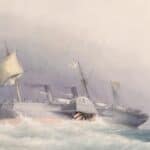
Constellation had spotted the French frigate three weeks earlier. The Insurgente simply outran her and vanished. But this time, fate intervened in a brutal way. A violent squall hit without warning. A savage gust of wind snapped the Insurgente’s main topmast clean off. Her legendary speed was gone in an instant.
Captain Michael-Pierre Barreaut tried everything. He made for St. Eustatius. He hoisted American colors to disguise his ship. When Constellation signaled for identification, he couldn’t respond correctly. The disguise collapsed. The trap closed.
What followed was a brutal engagement. Constellation tore into the crippled French frigate with devastating firepower. The USS Insurgent , as she would soon be known , was outgunned and outmaneuvered. Captain Barreaut had no choice but to surrender.
The human cost was staggering. The French lost 29 men killed and 41 wounded. The Americans lost just one man killed and two wounded. Lieutenant John Rodgers boarded the captured ship with a prize crew of just eleven men to sail her to port. Eleven Americans controlling a ship full of hostile French prisoners. The tension must have been unbearable.
USS Insurgent’s Final Voyage: 340 Men and a Merciless Storm
After her capture, the USS Insurgent was commissioned into the United States Navy in August 1799. She patrolled the West Indies, hunting the same kind of prey she had once been herself. The irony was thick. A French predator turned American watchdog.
But the sea has a long memory.
In September 1800, the USS Insurgent sailed from Havana with 340 officers and enlisted men aboard. She was heading toward the American coast. She sailed directly into a severe storm. And then she was gone.
No distress signals. No wreckage washing ashore. No bodies recovered. Just silence.
The Navy waited. Then it waited longer. Then it accepted the unthinkable. The ship was lost. All 340 men were presumed dead. It remains one of the largest single losses of life in early American naval history. The ocean offered no answers and no apologies.
What makes this disappearance so deeply unsettling is how complete it was. Ships sink in storms and leave something behind. Debris. Cargo. Bodies. The USS Insurgent left nothing. Naval records from the era confirm the loss but offer no details about what actually happened in those final hours.
Did the storm overwhelm her suddenly? Did she break apart in minutes? Were there survivors who simply drifted beyond rescue? Nobody knows. Nobody has ever known.
A Cursed Ship? The Strange Pattern Behind the Disappearance
Look at the Insurgente’s history and a dark pattern emerges. This was a ship that destroyed other vessels. The Prince Frederick sank after her attack. The John and James was seized and stripped. Dozens of merchant crews were terrorized across years of raiding.
Then her own topmast snapped at the worst possible moment. Then 340 Americans vanished without a trace.
Some maritime historians note that the ship seemed to carry misfortune wherever she sailed. Her capture itself was triggered by a freak weather event. Her final disappearance came in another storm. Weather seemed to follow this ship like a curse.
The waters around Nevis and the West Indies were already notorious among sailors of the period. Strange currents. Unpredictable squalls. Stories of ships that sailed into clear skies and never returned.
Three hundred and forty men. Gone. No graves. No memorial. Just a name on a naval register marked “lost at sea.”
The mystery of the USS Insurgent has never been solved. No wreck has been located. Modern technology has found ships lost for centuries in the deep Atlantic. This one remains hidden. Perhaps the ocean decided to keep her. Perhaps some stories aren’t meant to have endings.
What we know for certain is this: a ship that once terrorized the seas met a fate far darker than any battle could have delivered. The storm didn’t just sink her. It erased her completely.
—
The USS Insurgent vanished in a storm in 1800 with 340 men aboard. No wreckage was ever found. One of history’s most complete naval mysteries.