
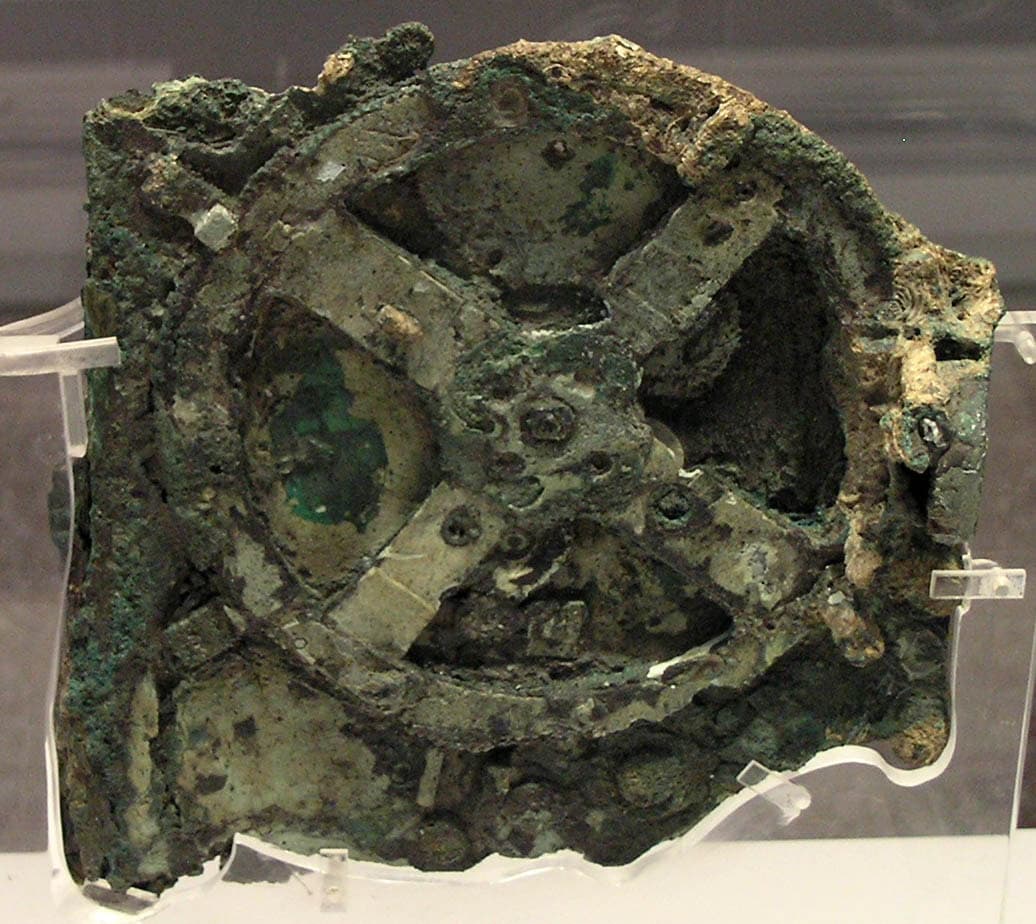
The Antikythera Mechanism shouldn’t exist. That’s the uncomfortable truth scientists keep circling back to. Pulled from a Roman shipwreck in 1901, this corroded bronze device could predict eclipses, track planetary cycles, and calculate astronomical events with stunning precision. It was built over 2,000 years ago. Nothing like it appeared again for another 1,400 years. So who really built it? And why was it lost to the deep sea? The mystery surrounding this ancient machine is one of history’s most genuinely unsettling puzzles. It forces us to ask hard questions about what ancient civilizations truly knew , and what knowledge died with them beneath the waves.
The Antikythera Mechanism Rises from the Deep
In early 1900, a crew of sponge divers from Symi island stumbled upon something extraordinary. Their captain, Dimitrios Kontos, had steered them toward the Greek island of Antikythera during a storm. What they found on the seafloor would change history. The wreck sat 45 meters down , a Roman cargo ship loaded with bronze statues, marble figures, glassware, and jewelry. Among the treasures hauled up was a lump of corroded bronze and rotting wood. Nobody paid it much attention at first.
Museum staff in Athens were dazzled by the statues. The lumpy bronze object sat ignored for two full years. Then, in 1902, Greek politician Spyridon Stais noticed something strange inside the crust. A gear. A perfectly formed, ancient gear. His cousin Valerios Stais, the museum director, began the first real investigation.
What they found inside was deeply strange. The device had originally been housed in a wooden case. It was packed with interlocking bronze gears of extraordinary precision. The largest gear measured about 13 centimeters across and once held 223 teeth. The whole thing was covered in Greek inscriptions. It looked, in short, like something that had no business existing in the ancient world.
Learn more about the discovery and its historical context on Wikipedia.
The bronze had transformed into a mineral called atacamite during its centuries underwater. When it hit open air, it cracked and shrank. Dimensions shifted. Pieces warped. The device had already begun destroying itself before anyone could properly study it.
What the Antikythera Mechanism Could Actually Do
Related article: The Green Children of Woolpit: Medieval England’s Most Baffling Mystery
Here’s where things get genuinely eerie. This wasn’t just a clock or a calendar. The device could predict solar and lunar eclipses decades into the future. It tracked the Moon’s irregular orbit , accounting for the fact that the Moon moves faster when it’s closer to Earth and slower when it’s farther away. That’s a complex mathematical relationship. Ancient Greek astronomer Hipparchus of Rhodes had studied this phenomenon in the 2nd century BC. Some researchers believe he may have been directly involved in the machine’s design.
The device also tracked the four-year cycle of the ancient Olympic Games. It followed the movements of the Sun and Moon through the zodiac. There’s strong evidence it may have calculated the positions of all five planets visible to the naked eye , Mercury, Venus, Mars, Jupiter, and Saturn. A portion of the mechanism appears to be missing entirely. What that missing section did, nobody knows for certain.
In 2005, a team from Cardiff University used X-ray tomography to peer inside the encrusted fragments. They identified 35 meshing bronze gears. Thirty of those are still visible today. The scans also revealed faint inscriptions hidden beneath centuries of corrosion. By 2016, researchers had deciphered numbers linked to the synodic cycles of Venus and Saturn. The machine was more sophisticated than anyone had imagined.
Read the full scientific report on the Antikythera Mechanism at Archive.org.
Machines of comparable mechanical complexity didn’t appear again in Western Europe until the 14th century AD. That’s a gap of roughly 1,400 years. That gap is what keeps researchers awake at night.
The Antikythera Mechanism’s Impossible Origins
Who built this thing? That question has no clean answer. The device is believed to have been constructed sometime between 205 BC and 87 BC. Researchers can’t fully agree on the date. Some propose the initial calibration date was December 23, 178 BC. Others argue for 204 BC. The shipwreck itself has been dated to around 70–60 BC. So the machine was already old when it sank.
The leading theory connects it to the island of Rhodes. Hipparchus worked there. The philosopher Posidonius ran a school there. Ancient Roman writer Cicero described a similar device , a mechanical sphere that showed the movements of the Sun, Moon, and planets. Could the Antikythera device be the very machine Cicero described? Some researchers think so.
But here’s what makes this truly unsettling. If Greek scientists could build this, why didn’t the technology spread? Why didn’t it evolve? Why did the knowledge simply… vanish? No similar device appears in the historical record for over a millennium. It’s as if the entire intellectual tradition that produced it was wiped clean. The ship that carried it to its watery grave was loaded with Greek treasures , possibly looted, possibly traded. Nobody knows where the device was headed or why.
The 82 surviving fragments now live at the National Archaeological Museum in Athens. Researchers continue to study them. Each new scan reveals something unexpected. The machine keeps giving up secrets slowly, reluctantly, like it doesn’t want to be fully understood.
A Mystery That Refuses to Stay Buried
The deeper you look at this ancient computer, the stranger it gets. Consider the craftsmanship alone. The gears were cut with a precision that shouldn’t have been possible with ancient tools. The inscriptions suggest a sophisticated understanding of astronomy that rivaled , and in some ways exceeded , what came centuries later. Whoever built this machine understood the cosmos in a way that feels almost alien compared to what we expect from the ancient world.
Modern researchers have built working replicas. They’ve used those replicas to confirm just how accurate the original device was. The eclipse predictions it could generate were genuinely reliable. This wasn’t decorative. It wasn’t symbolic. It was a working scientific instrument of remarkable power.
Some fringe theorists have pointed to the device as evidence of lost civilizations or outside influence. Most historians firmly reject that framing. The more disturbing truth is simpler. Human beings in ancient Greece were capable of extraordinary things. And somehow, that capability was lost. The knowledge died. The tradition collapsed. And the machine sank to the bottom of the sea, where it waited nearly 2,000 years for someone to find it.
The story of this ancient device is ultimately a ghost story. Not about spirits , but about lost knowledge. About a brilliance that flickered out and left the world in the dark for over a thousand years. That’s the real haunting here. Something extraordinary once existed. Then it didn’t. And we’re still not entirely sure why.
Related Posts
 The Antikythera Mechanism: Ancient Greece’s Impossible Computer from the Deep
 Tarim Basin Mummies: Ancient Secrets and Bizarre Burial Rituals in China’s Desert
 Baghdad Battery: The Ancient Mystery That Could Rewrite History
 The Nazca Lines: Ancient Desert Drawings, Blood Rituals, and the Mystery Nobody Can Solve