
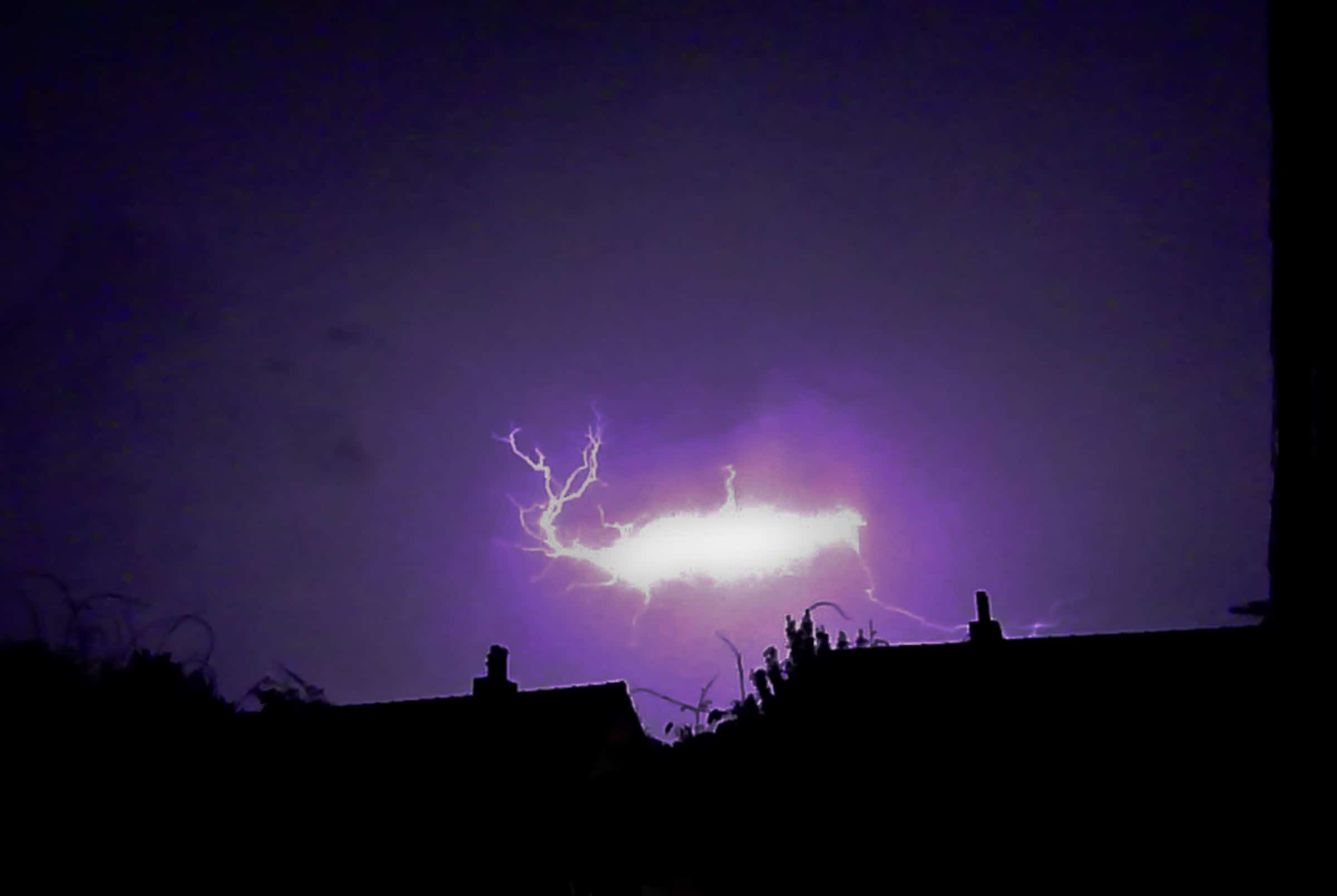
Ball lightning is one of the most baffling and terrifying phenomena ever witnessed by human eyes. Glowing spheres of light appear from nowhere. They drift through the air. They pass through solid walls. Sometimes they explode, leaving behind a choking stench of sulfur. Science still can’t fully explain what they are. Witnesses throughout history have described encounters that sound more like supernatural visitations than weather events. These aren’t distant flashes in a storm-dark sky. These are luminous, hovering orbs that get uncomfortably close , close enough to touch, close enough to kill. From medieval monks to modern pilots, the accounts are eerily consistent. Something is out there, drifting through our world, and nobody truly knows what it is.
The Ball Lightning Phenomenon: A History Soaked in Strangeness
The earliest recorded description may come from an English monk named Gervase of Canterbury. On June 7, 1195, he wrote about a “marvellous sign” that descended near London. A dense, dark cloud emitted a white substance. It grew into a spherical shape right before witnesses’ eyes. That account has survived over 800 years , and it sounds remarkably like what people still report today.
These glowing spheres aren’t rare curiosities confined to ancient chronicles. A 1960 statistical study at Oak Ridge National Laboratory surveyed nearly 16,000 personnel. Around 5% reported personally witnessing the phenomenon. A Scientific American article extrapolated that figure globally. The conclusion was staggering , roughly 5% of Earth’s entire population may have seen one.
Wikipedia’s extensive overview of ball lightning documents centuries of sightings across dozens of cultures. The Mapuche people of Argentina and Chile even wove it into mythology. They called the glowing orbs Anchimayen , supernatural entities with a life of their own. That’s not a coincidence. That’s a pattern. When independent cultures across centuries and continents describe the same terrifying light, something real is happening.
What makes the historical record so unsettling is how consistent the descriptions are. Red, orange, or yellow spheres. Fuzzy edges. Slow, drifting movement. A sudden, violent end. Witnesses weren’t comparing notes. They couldn’t have been. Yet they kept describing the same thing.
Ball Lightning Inside Homes, Planes, and Sealed Rooms
For more strange history, see: Avion Pirata: Bolivia’s Mysterious Ghost Plane That Defied Death
Here’s where things get genuinely disturbing. These orbs don’t respect physical barriers. Accounts describe them drifting through closed windows and locked doors. They’ve been reported inside metal aircraft , appearing from nowhere mid-flight, drifting through the cabin, and exiting without leaving a mark. No hole. No damage. Just gone.
That detail alone should send a chill down your spine. Whatever these things are, ordinary matter barely slows them down.
Eyewitness accounts describe orbs ranging from pea-sized to several meters across. Most hover between 10 and 20 centimeters in diameter , roughly the size of a grapefruit. They glow as brightly as a household lamp. You can see them clearly in full daylight. They move slowly, usually horizontally, at just a few meters per second. Some spin. Some wander erratically, as if searching for something.
The danger is wildly unpredictable. Some witnesses report no heat at all. Others describe the orb’s disappearance releasing a sudden, intense burst of thermal energy. Some orbs vanish silently. Others explode with tremendous force , damaging buildings, scorching surfaces, and leaving survivors shaken and confused. The odor left behind is frequently described as burning sulfur or ozone. That sulfur smell has haunted the accounts for centuries. It’s the same smell associated with demonic visitations in medieval folklore. Coincidence? Maybe. But it’s hard not to notice.
Ball Lightning Sightings That Defy Every Rational Explanation
Some individual cases stand out as particularly impossible to dismiss. Pilots have reported glowing orbs entering cockpits through solid fuselages. Families have watched spheres drift through their living rooms, hover near electrical appliances, and then silently vanish. In one widely cited case, a woman reportedly watched an orb enter her kitchen, circle the room slowly, and then exit through the same wall it entered , leaving no trace.
The orbs seem drawn to metal. Reports frequently describe them following power lines, metal fences, and railroad tracks. They move along conductors like they’re following a path. That suggests an electromagnetic connection. But the orbs also appear during calm, clear weather with no storm in sight. They appear indoors, far from any lightning strike. The thunderstorm connection isn’t the whole story.
Historical newspapers from the 1880s archived at Archive.org document early American fascination with atmospheric electrical phenomena. Even then, ordinary people were grappling with lights in the sky that didn’t behave like anything they understood.
Scientists have tried to recreate the phenomenon in laboratories. Some experiments have produced visually similar glowing orbs using microwave energy and plasma. But nobody can confirm these lab creations match what witnesses actually encounter. The real thing remains stubbornly out of reach.
Theories, Dead Ends, and the Mystery That Won’t Die
Dozens of theories have been proposed over the decades. Plasma vortices. Microwave radiation trapped in a bubble. Oxidizing aerosols. Anti-matter. Even tiny black holes. None of them fully explain every observed behavior. None of them account for orbs passing through solid walls. None explain why some explode and some simply vanish.
In January 2014, researchers published an optical spectrum of what appeared to be a genuine sighting captured on video at high frame rate. It was the closest science had come to hard data. The spectrum showed silicon, iron, and calcium , elements consistent with soil. One theory suggests lightning strikes vaporize minerals from the ground, creating a self-sustaining plasma ball. It’s plausible. But it still doesn’t explain the wall-passing. It doesn’t explain the indoor appearances.
The truth is, science is still largely in the dark. Sightings are too rare and too unpredictable to study systematically. You can’t schedule an encounter. You can’t set up instruments in advance. By the time anyone realizes what they’re seeing, it’s usually over in seconds.
What we’re left with is centuries of terrified witnesses, a handful of blurry photographs, one promising spectrum reading, and a phenomenon that refuses to be pinned down. Ball lightning sits in that uncomfortable space between physics and folklore , real enough to be seen by millions, strange enough to have inspired demon legends, and elusive enough to keep scientists arguing for another century.
Whatever these things are, they’re out there. Drifting. Glowing. Waiting to be seen by the next unlucky , or lucky , witness.
Related Posts
 Spontaneous Human Combustion: The Terrifying Mystery of Bodies That Burn From Within
 Women and Children First: The Deadly Maritime Code That Failed When It Mattered Most
 The Captain Goes Down with the Ship: The Eerie Code That Haunts Maritime History
 The Boiling Frog: The Creepy 19th-Century Experiment That Became History’s Most Disturbing Warning