
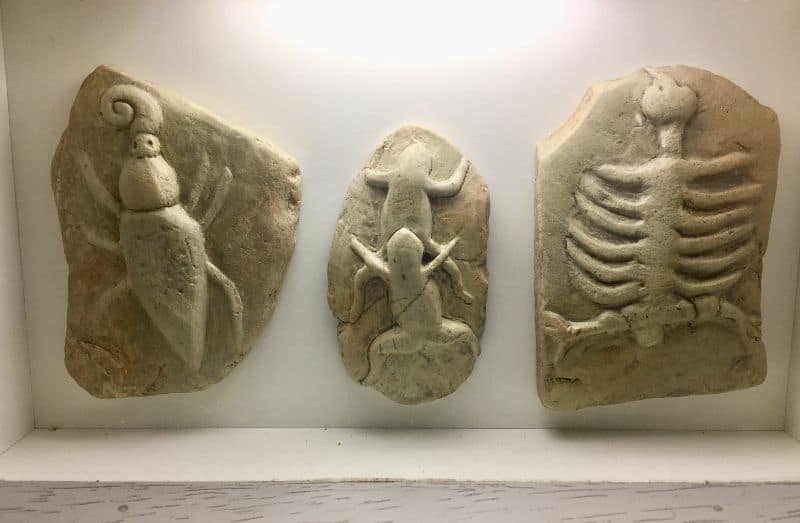
Beringer’s Lying Stones are one of history’s most bizarre and cruel academic pranks. In 1725, a respected German professor became convinced he had discovered miraculous fossils , stones carved with frogs, spiders, lizards, and even the name of God in Hebrew. He wasn’t wrong that they were carved. He was just wrong about who did the carving. The story that followed involves wounded pride, academic sabotage, a dramatic courtroom showdown, and a reputation shattered beyond repair. It’s the kind of tale that makes you question how far jealous colleagues will go , and how badly a brilliant man can fool himself.
The Strange Stones of Beringer’s Lying Stones Discovery
Johann Bartholomeus Adam Beringer was not a man who liked to be questioned. Born in 1667, he held powerful positions at the University of Würzburg. He was dean of the Faculty of Medicine. He was chief physician to the Julian Hospital. He carried himself with the confidence of someone who believed he was always the smartest man in the room.
That arrogance made him a target.
In 1725, Beringer hired three young assistants to help him dig for unusual rocks near Mount Eibelstadt outside Würzburg. The boys , Christian Zänger, age 17, and brothers Niklaus and Valentin Hehn, ages 18 and 14 , began unearthing extraordinary things. Lizards frozen mid-crawl. Frogs sitting on lily pads. Spiders suspended in limestone webs. Some stones bore inscriptions in Hebrew, Arabic, and Latin , including the name of God himself.
Beringer was stunned. He documented everything carefully. He examined each stone. Critics pointed out chisel marks. Some even suggested the stones looked suspiciously like carvings. Beringer had an answer for that. He wrote that the figures seemed to “bear unmistakable indications of the sculptor’s knife” , and concluded that the sculptor must have been God.
That leap of faith would cost him everything.
Who Planted Beringer’s Lying Stones , and Why
Related article: 2012 Phenomenon: When Ancient Maya Calendars Sparked Global Doomsday Panic
The hoax wasn’t random cruelty. It was personal.
Three men at the university despised Beringer. J. Ignace Roderique was a professor of geography and mathematics. Johann Georg von Eckhart was the university librarian. A local noble named Baron von Hof rounded out the trio. Together, they decided to teach the arrogant dean a lesson he’d never forget.
Roderique arranged for figures to be carved from limestone. The carvings were detailed and convincing. Frogs. Lizards. Spiders on webs. Then came the really twisted touch , some stones were inscribed with the sacred name of God in multiple ancient scripts. The hoaxers planted the stones on Mount Eibelstadt, where Beringer’s young assistants dug regularly. One of those assistants was secretly working with the conspirators.
The trap was perfectly set.
Beringer walked right into it. He found stone after stone, each one more remarkable than the last. He never stopped to ask why God’s name kept appearing in Hebrew on German hillsides. Instead, he compiled his findings into a lavish illustrated book. Lithographiae Wirceburgensis was published in 1726. It was detailed. It was confident. It was completely wrong.
Court records that still survive today reveal the hoaxers’ true motive. In testimony, they admitted they targeted Beringer because “he was so arrogant and despised us all.” This wasn’t science. It was revenge.
A digitized version of Beringer’s original 1726 publication is preserved at Archive.org.
The Horrifying Moment Beringer’s Lying Stones Were Exposed
Imagine spending months documenting what you believe are miraculous divine artifacts. Imagine publishing a book. Imagine your name attached to the discovery for eternity.
Now imagine finding one of those stones , and recognizing your own name carved into it.
That’s exactly what happened to Beringer. The hoaxers, perhaps getting cocky, carved his name onto one of the stones. When Beringer found it, the horror must have hit him like a physical blow. Every stone he’d ever celebrated. Every illustration in his book. Every theory about God’s hand wielding a chisel across limestone. All of it. A lie.
He immediately took legal action. He sued Roderique and von Eckhart. He won. The two men were stripped of their university positions. Roderique was banished from Würzburg entirely. Von Eckhart lost his access to the library and archives. That punishment actually derailed von Eckhart’s own historical research, which remained unfinished when he died.
Justice was served. But Beringer’s reputation never recovered.
He reportedly spent years desperately buying back copies of his own book. He wanted them destroyed. He wanted the evidence erased. But books have a way of surviving. A second edition was printed in 1767 , nearly three decades after Beringer died in 1740. The English translation didn’t appear until 1963. The stones themselves became known in German as Lügensteine , lying stones. Some survive today. A few are displayed at the Oxford University Museum and Teylers Museum in the Netherlands. They sit there quietly, still lying, just as they always did.
The Twisted Legacy of a Man Who Believed Too Hard
There’s something deeply unsettling about this story beyond the prank itself. Beringer wasn’t stupid. He was one of the most educated men in Germany. Yet he looked at chisel marks and saw God’s fingerprints. He found his own name carved in stone and still didn’t catch on until it was too late.
The 18th century was a genuinely strange time for science. Nobody fully agreed on what fossils even were. Some believed they were the remains of ancient creatures. Others thought they formed naturally inside rocks. Still others believed they were remnants of Noah’s Biblical flood. The idea that God might leave physical impressions in stone wasn’t fringe thinking , it was a legitimate hypothesis.
Beringer just took it further than anyone else dared.
A 2005 book added one final twist to the tale. Researchers pointed out that Roderique didn’t actually arrive at the University of Würzburg until December 1725. The stones were found in summer of that year. He was reportedly in Münster at the time. So who actually carved them? Some scholars now suggest Beringer himself may have been involved in the fraud , knowingly or not.
That theory has never been proven. But it hangs over the whole story like a shadow.
What we know for certain is this: the lying stones did their job. They lied. They destroyed a man’s career. They turned his greatest triumph into his greatest humiliation. And they’re still sitting in museum cases today, smooth and silent, carved with creatures that never lived and words that were never divine.
Some hoaxes fade into history. This one kept its teeth.