The most bizarre Emergency Landing in aviation history began with a number. Not a storm. Not a bomb. Just a number, written in the wrong units. On July 23, 1983, an Air Canada Boeing 767 was cruising peacefully at 41,000 feet. Then the engines quit. Both of them. Sixty-one passengers and eight crew sat inside a silent, dying machine. The cockpit screamed with alarms nobody had ever heard before. Pilots had never trained for this. Engineers had said it couldn’t happen. Yet it did.
What followed reads like fiction. A pilot with glider experience. A co-pilot who knew a forgotten airstrip. A runway turned into a family racetrack. The odds of everything lining up were so slim that some people still whisper about it. Was it luck? Was it skill? Or did something else guide that plane home? The full story is documented in the Gimli Glider article on Wikipedia, but the numbers only tell part of it.
The Emergency Landing Nobody Saw Coming
Air Canada Flight 143 left Montreal bound for Edmonton. The aircraft was brand new. It was one of the first 767s in the airline’s fleet. Its fuel gauges had a known problem. They were blank and unreliable.
Ground crews fell back on a manual method. They measured fuel with a dripstick. Then they converted the reading to weight. Here’s where it fell apart. The new 767s ran on kilograms. The old fleet ran on pounds. Someone used the wrong conversion factor.
A pound is about 0.45 kilograms. Crews loaded fuel as if the plane had twice what it truly had. The tanks held less than half the needed amount. Nobody caught it.
The flight lifted off and climbed smoothly. Captain Robert Pearson and First Officer Maurice Quintal settled in. Everything seemed normal. Then, over Red Lake, Ontario, a warning chimed. Fuel pressure was low in the left engine.
They assumed a bad pump. They turned the pumps off. Seconds later, a second alarm sounded. Then the left engine died. Pearson started planning a diversion to Winnipeg.
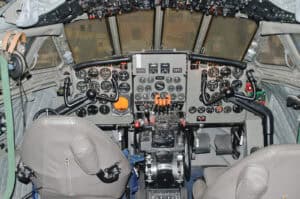
Before he could finish, the right engine flamed out too. The cockpit went quiet. The instrument panel went dark. The jet had become the world’s heaviest glider.
Silence Over Manitoba: Gliding Without Power
Related article: List of Bridge Failures Throughout History: Lessons from Catastrophic Collapses
A Boeing 767 needs engines for almost everything. Engines power the hydraulics. Hydraulics move the control surfaces. Without them, the plane should be nearly impossible to steer.
But the 767 carries a small backup. A ram air turbine drops from the belly and spins in the wind. It gives just enough hydraulic pressure to keep control. It was a lifeline, and it saved them.
Pearson was no ordinary airline pilot. He was an experienced glider pilot. He knew how to stretch a descent. He knew how to trade height for distance. That skill was about to matter more than anything.
The instruments went dead. No engine power meant no electric display. Pearson flew with a few basic gauges. He had no vertical speed indicator. He guessed the glide ratio instead.
Air traffic controllers in Winnipeg watched the radar. They realized the plane couldn’t make it. The jet was losing height too fast. Winnipeg was too far. They needed somewhere closer.
Quintal had an idea. He had once served in the Canadian Air Force. He remembered an old base near Gimli, Manitoba. It had been closed for years. He thought it was still a working runway.
He was wrong about that. It had been converted into a racetrack.
An Emergency Landing on a Racetrack
The Gimli airstrip had a strange new life. On that Saturday, a family day event was underway. Sports cars were racing. Kids were riding bikes. Families picnicked near the old runway.
Nobody knew a jetliner was coming. Nobody heard it, either. A dead 767 glides in near silence. Witnesses later said it came out of the sky like a ghost.
As the jet dropped lower, the crew faced a new problem. They were too high. Too fast. They needed to lose speed and altitude without engines. Pearson did something almost unheard of in a passenger jet. He performed a forward slip. He crossed the controls to bleed off height, like a glider pilot would.
The nose landing gear wouldn’t lock. Without power, gravity couldn’t push it into place. Quintal tried to release it manually. It dropped down but not securely.
The jet touched down hard. The nose gear collapsed. The nose scraped along the runway. Sparks flew. Pearson stood on the brakes. Tires burst. The plane skidded toward the crowd.
A guardrail down the middle of the strip helped slow the aircraft. The plane stopped just yards from families and racers. No one on the ground was seriously hurt. Everyone aboard walked away.
The old Air Force aerodrome had saved them. It’s the kind of coincidence that makes people wonder. You can browse the original news coverage and period records through the Internet Archive’s historical collections.
Aftermath, Legacy, and Lingering Questions
The investigation was swift and merciless. It found the real culprit was not one person. It was a chain of errors. Faulty fuel gauges. A confusing unit change. A maintenance mix-up. A missed double-check. Every safeguard failed at once.
Pearson and Quintal were first blamed in some quarters. But the inquiry cleared them. Both received praise for their calm. Pearson earned national recognition. Quintal’s memory of Gimli had saved everyone.
Air Canada repaired the jet. It returned to service and flew for decades. Pilots nicknamed it the “Gimli Glider.” The name stuck. It flew until 2008, when it was retired to the Mojave Desert.
The incident changed aviation. Airlines overhauled fuel procedures. Metric conversion rules tightened. Training now covers dual-engine failure at altitude. Cockpit crews check fuel calculations more than once.
Yet strange details linger. The racetrack was never meant to be an airstrip again. The timing was uncanny. The glider pilot happened to be the captain. The co-pilot happened to know the base. People who survived still talk about the eerie silence. They describe a jet floating down like a fallen leaf.
Skeptics call it fortunate math. Believers call it something more. The 767 still holds a place in aviation legend. A museum-grade account of the era’s flight safety lessons can be explored at the Smithsonian National Air and Space Museum.
On the strip at Gimli, a small monument now marks the spot. Visitors can stand where the nose gear dragged. They can look up at the same empty sky. It’s quiet there.
Every Emergency Landing is a story about survival.