Flight with Disabled Controls is one of aviation’s most terrifying scenarios. Imagine sitting in a cockpit at 35,000 feet. Your controls are dead. The plane won’t respond. You’re flying a metal tube full of passengers , and you have almost nothing left to work with. This isn’t fiction. It has happened. Multiple times. And the stories are far stranger and more harrowing than most people know. These incidents blur the line between survival and the supernatural. How does a pilot land a plane with no working controls? Sometimes, they don’t. But sometimes , against all logic , they do. The details of those moments reveal something deeply unsettling about the fragility of human life and the terrifying power of mechanical failure.
Flight with Disabled Controls: How Pilots Try to Steer the Unsteereable
When normal controls fail, pilots face a brutal problem. The standard tools , yoke, stick, rudder pedals , simply stop responding. The aircraft becomes a ghost. It moves through the sky on its own terms.
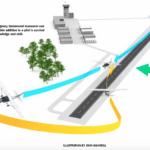
Some pilots have discovered a terrifying workaround. They use engine thrust to steer. On jets where engines hang beneath the wings, increasing power raises the nose. Cutting power drops it. It sounds simple. It isn’t.
The technique is deeply counterintuitive. When a plane dives, every instinct screams to pull back. But with disabled controls, you add power instead. Your hands want to do one thing. Physics demands another.
Asymmetric thrust adds another layer of horror. Throttle up the right engine, and the plane yaws left. Throttle up the left, and it yaws right. Pilots must essentially “steer” a massive aircraft using only the uneven push of its engines.
There’s another demon lurking in these situations. It’s called phugoid instability. The aircraft enters a cycle. It climbs, then dives, then climbs again. Over and over. Each cycle grows more extreme. Without careful throttle management, this oscillation can tear a plane apart or send it screaming into the ground.
Phugoid instability has been documented in multiple disabled-control emergencies. Pilots describe the sensation as riding a slow, deadly roller coaster , one they can’t get off.
Researchers have tried to program fly-by-wire computers to handle this automatically. Early attempts failed badly. Simulators modeled engines as “perfect” machines. Real engines are anything but. They lag. They surge. They don’t respond instantly. Modern software has improved. But the technology remains rare on commercial aircraft.
Flight with Disabled Controls: The United Airlines 232 Horror
Related article: Mining Accident at Benxihu: The Deadliest Underground Disaster in History
July 19, 1989. United Airlines Flight 232 was cruising over Iowa. Then the unthinkable happened. The tail-mounted engine exploded. Shrapnel shredded all three hydraulic systems simultaneously.
Every single control surface went dead.
Captain Al Haynes had nothing. No ailerons. No rudder. No elevator. Just two remaining wing-mounted engines and a plane full of 296 people.
What followed was one of aviation history’s most extraordinary survival stories , and one of its most disturbing. Haynes and his crew discovered they could control the aircraft only through differential thrust. Right engine up, left engine down. Up and down. Left and right. Tiny adjustments. Constant corrections.
The plane still entered a phugoid cycle. It oscillated up and down, bleeding altitude in great swooping arcs. The crew couldn’t stop it entirely. They could only manage it.
They aimed for Sioux City Gateway Airport. The approach was fast. Far too fast. The landing gear came down by gravity alone. The plane hit the runway at nearly 250 miles per hour , nearly double the normal speed.
Flight 232 cartwheeled. It broke apart. It burst into flames.
And yet , impossibly , 185 people survived. Investigators later called the survival rate a miracle. Some called it something else entirely. Witnesses described a strange calm that fell over survivors in the wreckage. Several reported hearing voices guiding them toward exits. One passenger said she felt a hand on her shoulder pulling her free. No one was there.
Historical aviation emergency records document dozens of similar near-miraculous outcomes that investigators struggle to fully explain.
When Flight with Disabled Controls Ends in the Impossible
United 232 wasn’t alone. Other cases push the boundaries of what seems physically possible.
In 2003, a DHL Airbus A300 cargo plane was struck by a surface-to-air missile over Baghdad. The missile hit the left wing. Hydraulic fluid poured out. All controls failed completely.
The crew , just two men , had nothing. They were over a war zone. The plane was on fire.
They used engine thrust alone. For over 16 minutes, they wrestled a burning, crippled cargo jet through the sky. They made a wide, looping turn back toward Baghdad Airport. They landed the aircraft successfully. No one died.
Aviation experts called it statistically improbable. Some called it impossible. The crew later said they felt strangely calm throughout. Almost detached. As if something else was guiding their hands.
Then there’s Japan Airlines Flight 123 from 1985. A faulty repair caused a rear bulkhead to explode. Hydraulic lines were severed. All controls failed. The crew fought for 32 minutes. They couldn’t land safely. The plane crashed into a mountain. Five hundred and twenty people died. It remains the deadliest single-aircraft accident in history.
The contrast between these cases is eerie. Same basic scenario. Wildly different outcomes. Why do some crews succeed against impossible odds while others perish despite heroic efforts? Nobody has a satisfying answer.
The Ghost in the Machine: What These Stories Really Tell Us
These incidents reveal something deeply strange about aviation. Modern aircraft are engineering marvels. They’re designed with redundant systems. Backup upon backup. Yet sometimes everything fails at once.
Investigators call these “cascading failures.” One thing breaks. It damages another. That damages another. Suddenly you’re sitting in a flying coffin with no way out.
The pilots who survive these events often describe the experience in almost mystical terms. Time slows down. Clarity descends. Decisions that should take minutes happen in seconds. Some describe a sensation of being watched. Or guided.
Whether that’s adrenaline, psychology, or something stranger , nobody can say for certain.
What we do know is this. Flight with Disabled Controls has claimed hundreds of lives. It has also produced moments of survival that defy easy explanation. The Smithsonian National Air and Space Museum documents many of these extraordinary cases in its aviation safety archives.
The sky is not always a friendly place. Sometimes the machine stops listening. And in those moments, pilots are left with nothing but raw instinct, desperate improvisation, and perhaps something else entirely , something that doesn’t show up in any accident report.
—
Flight with Disabled Controls has pushed pilots to their limits. These terrifying true stories reveal how crews survived the impossible.