
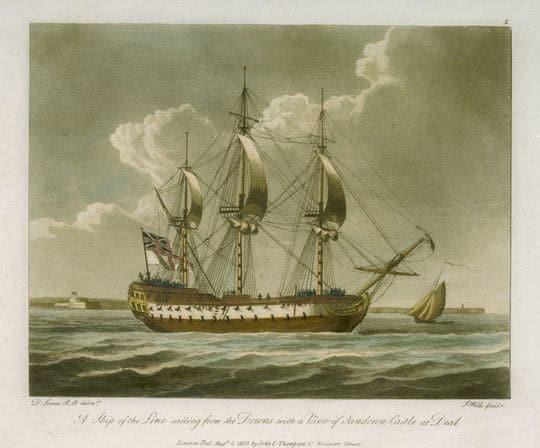
The John of Sandwich (ship) was one of Elizabethan England’s most brazen pirate vessels. She terrorized the waters off Spain, Ireland, and the Channel Islands during the early reign of Queen Elizabeth I. Her story doesn’t end with a glorious battle or a captain’s escape. It ends with a storm, a sinking, a dungeon, and two men dangling from a gallows at St Martin’s Point. It’s a tale soaked in stolen wine, treachery, and the cold justice of the Tudor crown. The crew members who survived the wreck didn’t get a hero’s welcome. They got chains, a castle prison, and a trial for their lives. Some escaped. Some were pardoned. And two were made into a very public example. This is the strange and brutal story of a pirate ship that history nearly forgot.
The John of Sandwich (ship) and Its Life of Crime
The vessel was either built in Sandwich, Kent, or in Ireland. Nobody is entirely sure. What is certain is that her owners and crew had crime on their minds from the start.
She was owned by a man named Thomas Bowes. Her first commanders were Captain Heidon, a former naval sailor from Bantry Bay in Ireland, and Richard Deigle. Together with their associate Corbet, they decided to arm the ship with cannons and a swivel gun. That decision turned a merchant vessel into a pirate ship.
The John of Sandwich (ship) operated as part of a small fleet based in Kent. She mainly preyed on ships off the coast of mainland Spain. In one notable raid, the crew captured a Flemish merchant vessel. The stolen goods , mostly wine , were transported to Bere Island in Bantry Bay, Ireland. There, they sold the plunder to a powerful local lord named Donal O’Sullivan Beare.
O’Sullivan wasn’t just a buyer. He was a protector. He made a deal with the crew. In exchange for their stolen goods, he would shield them from British authorities. On at least one occasion, he kept his word. He personally protected Heidon and a fellow pirate captain named Lusingham from arrest by Crown ships.
Lusingham’s end, though, was darkly absurd. He was killed by a cannonball fired from a British warship , while he was mocking the pursuing vessel. He was waving his hat at them. One moment of bravado, and a cannonball ended it. His associate Corbet was on the same ship. He survived.
Donal O’Sullivan Beare remains a fascinating and controversial figure in Irish history, later famous for his brutal winter march of 1603. His role sheltering pirates adds another dark layer to his legacy.
The Wreck of the John of Sandwich (ship) Off Alderney
Related article: Poniatowski Gems: The Greatest Art Forgery Scandal of the 19th Century
By 1566, the ship was under the command of Captain John Higgins. Heidon, Deigle, and Corbet had been arrested in Falmouth after a voyage to La Rochelle in June 1564. But they eventually escaped custody. They rejoined the crew. The criminal enterprise continued.
Then came 11 July 1566.
A storm hit the Channel Islands. The John of Sandwich (ship) sprang a leak. The crew couldn’t save her. She was driven onto the rocks off Alderney and wrecked. The survivors scrambled into two small pinnaces.
Captain Higgins, Robert Hitchins, Philip Readhead, and Roger Shaster reached the shore of Alderney in the first pinnace. They confessed immediately to being pirates. Perhaps they were exhausted. Perhaps they thought mercy was possible.
The second pinnace carried Heidon, Deigle, and Corbet. They fled. They escaped the Channel Islands entirely and were never brought to justice. The men who stayed behind would not be so lucky.
The waters around Alderney have a fearsome reputation. Strong tidal races and hidden rocks have claimed many vessels over the centuries. You can read more about the island’s treacherous maritime history through historical maritime records preserved at Archive.org.
Castle Cornet and the Trial of the John of Sandwich (ship) Crew
The surviving crew members were arrested and transported to Castle Cornet in Guernsey. This grim fortress prison sat on a rocky islet in Saint Peter Port harbour. Being locked inside was no small thing. The castle was cold, isolated, and escape seemed nearly impossible.
Yet several crew members managed to do exactly that. They escaped from Castle Cornet before their trial. Nobody recorded exactly how. It remains one of the stranger footnotes of this already strange story.
Those who stayed faced the Privy Council of Queen Elizabeth I. Three crew members , John Hawker, aged 25, Jenkin Lawrenson, aged 27, and Cornell Langton, aged 28 , testified that they had been deceived. They claimed they were recruited in Ireland under the belief they were joining a legal merchant voyage. They said they didn’t discover the ship’s true nature until they were already at sea. By then, abandoning ship meant a charge of mutiny.
The Queen’s council believed them. Almost everyone was pardoned. The pardon came with a sharp warning to “beware hereafter to fall again into the damage of our laws.” The pardoned men were ordered to return home and “get their living by honest labour.”
It sounds almost gentle. But two men didn’t receive that mercy.
Hanged at St Martin’s Point: A Brutal Warning
Captain John Higgins was condemned. The council declared he had lived a “most horrible and detestable” life. Robert Hitchins was condemned alongside him. Both men were hanged at St Martin’s Point in Guernsey.
The location wasn’t chosen by accident. St Martin’s Point is a headland visible from the sea. A hanging there sent a message to every sailor passing through those waters. The Tudor crown wanted pirates to see what happened to men like Higgins and Hitchins. The bodies would have served as a warning , a grotesque signpost at the edge of the Channel Islands.
Piracy was rampant during the early Elizabethan era. The Crown struggled to control it. Private ships were armed and sent out with the tacit understanding that raiding enemy vessels was acceptable. But the line between privateer and pirate was thin and often crossed. When it suited the Crown to make an example, men like Higgins paid the price.
The crew members who escaped , Heidon, Deigle, Corbet , vanished from the historical record. Whether they found new ships, new crimes, or quiet deaths, nobody knows. Their fates are simply gone.
The John of Sandwich (ship) herself lies somewhere beneath the cold waters off Alderney. Her stolen wine is long gone. Her cannons are rusted relics on the seabed. But the story of her crew , the pardoned men, the hanged captain, the pirates who slipped away , survives as one of the stranger chapters of Elizabethan maritime crime. It’s a reminder that the line between justice and survival in the 16th century was razor-thin, and often decided by who confessed first.
Related Posts
 2024 Manila Bay Oil Spill: The Mysterious Sinking That Sparked Smuggling Suspicions
 Mv Fremantle Highway Fire: When Electric Cars Became Scapegoats in a Maritime Mystery
 Tristan Da Cunha Lifeboat Disaster: 15 Men Vanished Without a Trace in 1885
 Bridgewater (1785 Eic Ship): The Cursed East Indiaman That Vanished Without a Trace