
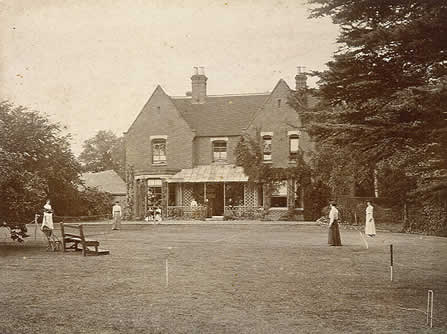
Borley Rectory was a Victorian house in rural Essex that earned the title “the most haunted house in England.” It stood quietly in the village of Borley for nearly a century. Then a newspaper story turned it into a national obsession. People reported ghostly footsteps, a phantom nun, and walls that seemed to write back. Some claimed bells rang with no hands to pull them. Others swore a spectral coach rattled across the lawn at night. The rectory burned in 1939 and was torn down in 1944. Yet the stories never died. Today, historians still argue over what really happened inside those 32 rooms. Was it a genuine haunting? Or was it one of the great paranormal hoaxes of the twentieth century? The truth, as usual, is stranger than either answer. You can read the basic history on Wikipedia, but the real tale lives in the details.
The Birth of Borley Rectory and Its Dark Legend
The Reverend Henry Dawson Ellis Bull built the big Gothic house in 1862. It replaced an older rectory that had burned down in 1841. Bull moved in a year later after being named rector. He eventually added a wing to fit his family of fourteen children.
It was a huge place. The house had four floors, 32 rooms, and 11 bedrooms. It sat on about eleven acres of grounds, close to Borley Church.
Almost at once, people whispered that something was wrong. A few locals later recalled hearing unexplained footsteps inside the house around 1863. That was barely a year after construction.
Then came the legend. The tale said a Benedictine monastery once stood nearby, around 1362. A monk there fell in love with a nun from a neighboring convent. They were caught. The monk was executed. The nun was bricked up alive inside the convent walls.
It’s a chilling story. It’s also almost certainly false. Researchers confirmed in 1938 that it had no known historical basis. Some think the rector’s children invented it to make their home more romantic. The tale may even have been borrowed from Walter Scott’s poem Marmion or a Rider Haggard novel.
But the legend stuck. And it gave the house a ghost.
The Phantom Nun Haunts Borley Rectory
This event shares similarities with: 30 East Drive Pontefract: Inside England’s Most Terrifying Haunted House
The first famous sighting came on 28 July 1900. Four of the Bull daughters were outside at twilight. About 40 yards from the house, they saw a figure. They thought it was a nun.
The girls tried to speak to her. They walked closer. She vanished.
That was only the start. Local organist Ernest Ambrose later said the Bull family were “very convinced that they had seen an apparition on several occasions.” These weren’t strangers chasing thrills. They were a clergyman’s children, describing what they thought they saw in their own garden.
Over the years, witnesses reported a long list of strange events. People spoke of unexplained footsteps and doors that opened on their own. Some heard bells ringing in empty rooms. Others described a ghostly coach drawn by horses, said to pass across the grounds. A headless man was also said to walk the property.
Each new resident seemed to bring a fresh story. Later rectors and their families reported odd sounds, moving objects, and a sense of being watched. The rooms were big and drafty. The countryside around them was dark and silent. It’s easy to see how a creaking floorboard could become a ghost.
Or was it? Skeptics point out that many of these stories grew louder with time. Believers say the sheer number of witnesses can’t be waved away. The debate has never really ended.
Harry Price and the Making of a Media Sensation
Everything changed in 1929. The Daily Mirror published an account of a visit by Harry Price, a famous psychic researcher. Price was a showman. He knew how to grab headlines. The Borley Rectory stands as a significant historical event.
After that article, reports at the rectory multiplied suddenly. Strange events that had been rare now seemed to happen constantly. Price later called the house “the most haunted house in England.” The label stuck.
Price went on to write two books supporting the claims of paranormal activity. He leased the rectory in 1937 and recruited volunteer observers. He asked them to watch the house and record anything unusual. Visitors reported thrown objects, odd noises, and strange messages appearing on the walls.
Those wall messages are among the eeriest details. Writing was said to appear on the plaster, as if scrawled by an unseen hand. Some of it seemed to plead for help. Was a spirit trying to speak? Or was someone playing a trick?
That question haunts the whole case. Price was a promoter as much as a researcher. He had every reason to want the house to be haunted. The more dramatic the reports, the more books he sold.
The public loved it. Crowds came to stare at the rectory. Newspapers couldn’t get enough. The house had become a celebrity.
Fire, Doubt, and the Death of the Haunting
The Society for Psychical Research took a hard look at the case. Its formal study rejected most of the sightings. The investigators decided many were either imagined or fabricated. They also cast serious doubt on Price’s credibility.
Ghost historians now widely regard Price’s claims as discredited. Some suspect he or his helpers staged key events. Others blame the house’s later occupants. The most famous of them was Marianne Foyster, wife of the last rector to live there. A BBC programme about the alleged manifestations, planned for September 1956, was cancelled. The reason was fear of a legal action by Marianne Foyster.
Then came the fire. In 1939, the rectory was badly damaged by flames. Some say a lamp was knocked over. Others whisper that the ghosts did it. Reports from that night mention strange figures in the windows as the blaze took hold. The ruined shell stood for years before demolition in 1944.
The ghosts didn’t leave quietly, though. People kept claiming to see things on the site. Interest never faded. In 1975, the BBC aired The Ghost Hunters, which interviewed researchers like Peter Underwood. It even featured a late-night psychic investigation of nearby Borley Church. You can browse old reporting and records through the Internet Archive, which holds period material on the case.
So what do we make of it all? Borley Rectory may never give up its secrets. The house is gone. The witnesses are gone. What remains is a pile of conflicting stories, a famous hoaxer, and a legend too good to die.
Maybe it was all invention. Maybe a nun really did walk the lawn at twilight. The Society for Psychical Research still
More strange stories
 Ghost Town Secrets: The World’s Most Haunted and Mysterious Abandoned Places
 Trans-allegheny Lunatic Asylum: America’s Most Haunted Psychiatric Hospital
 Chase Vault: The Barbados Mystery of Coffins That Refused to Stay Still
 The Oxfordian Theory of Shakespeare Authorship: History’s Greatest Literary Conspiracy?