The Sinking of the Roman Fleet (255 Bc) remains the deadliest maritime disaster ever recorded. Up to 100,000 men may have drowned off the coast of Sicily in a single summer storm. That’s more than the death toll of most naval wars. Yet most people have never heard of it.
Picture the scene. Hundreds of warships, stuffed with soldiers and rowers, crawling along a hostile coast. The sky turns black. The sea heaves. Within hours, the water is thick with timber, drowning men, and the dead. Bodies washed ashore for days.
The strangest part? Rome’s own captains warned against the voyage. Their commanders ignored them anyway. Ancient writers saw the catastrophe as a lesson in pride. Some modern historians suspect something more unsettling: that Rome’s famous new weapon helped drag its own fleet under. The Wikipedia article on the disaster sums up the scale. It’s staggering, and it’s still debated.
The Armada That Never Came Home: Sinking of the Roman Fleet (255 Bc)
The story begins in 255 BC, during the First Punic War. Rome had just suffered a humiliating defeat in North Africa. Survivors of the Battle of the Bagradas River were stranded and desperate. Rome needed to bring them home.
Two consuls took charge: Servius Fulvius Paetinus Nobilior and Marcus Aemilius Paullus. They received 350 warships for the rescue. Crews came from Rome’s “seafaring allies,” the socii navales. The fleet likely sailed in early June.
The outward voyage went well. Near Cape Hermaion, the consuls crushed a smaller Carthaginian fleet. They captured 114 enemy ships. Their armada swelled to more than 450 vessels.
Then they reached Clypea and collected the stranded survivors. They raided the African coast for good measure. But supplies ran short, and the consuls headed back toward Rome.
Here’s a chilling detail. Many ships ran with skeleton crews. Historians think Carthaginian prisoners may have manned some of the oars. Imagine chained enemies rowing a warship into a storm. If the ships went down, they went down together.
A Storm Off Kamarina and the Great Roman Fleet Disaster
Another fascinating historical case is: Vajont Dam: The Italian Disaster That Unleashed a 250-Meter Wall of Death
The consuls didn’t want to sail straight home. They wanted loot and glory. So they planned to raid Carthaginian territory along Sicily’s southern coast. This was the dangerous route. The helmsmen said so, loudly.
The consuls overruled them.
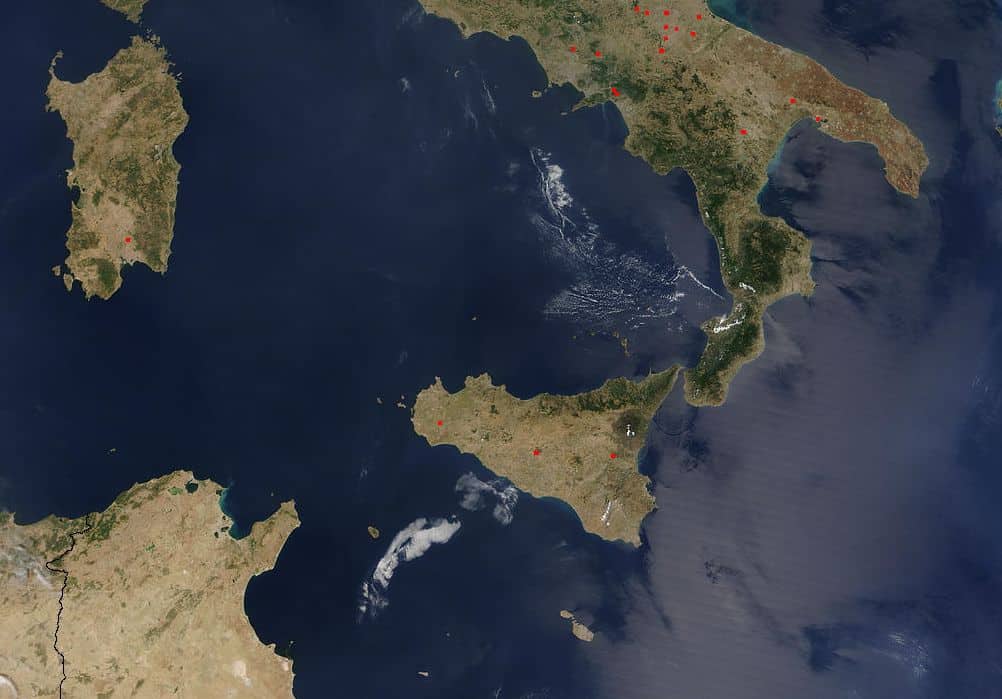
The coast near Kamikos and Agrigento was Roman-held. Past Heraclea Minoa, it belonged to Carthage. The rocky shoreline offered few safe harbors. A sailor could be trapped between hostile land and a rising sea.
In July, the storm hit near Kamarina. Ancient sailors feared this stretch of water. Sudden gales could rise from nowhere. Heavy ships packed with men had little room to maneuver.
The numbers are almost unreal. Of 464 ships, 384 sank or smashed against the rocks. Only about 80 escaped. Those survivors fought their way around Cape Pachynon and limped into the harbor at Syracuse.
Tens of thousands of rowers, sailors, and soldiers died. Wrecks and bodies littered the beaches. Locals must have woken to a coastline carpeted with the dead. Ancient accounts leave much to our imagination, but the horror is easy to picture. Whole communities probably spent weeks hauling corpses from the surf.
Did the Corvus Doom the Sinking of the Roman Fleet (255 Bc)?
Now for the eerie theory. Rome’s ships carried a strange weapon called the corvus. The name means “raven.” It was a heavy boarding bridge with a spike on the end. Sailors slammed it onto an enemy deck, then marched across to fight.
It won Rome battles. It turned sea combat into land combat, where Roman soldiers excelled. But it was top-heavy. Mounted on the bow, the corvus may have made ships dangerously unstable in rough water.
Some historians think this killed the fleet. A storm hit, and the corvus-laden ships rolled and capsized. Notice that Rome later stopped using the weapon. Maybe the sea taught them a lesson.
Nobody can prove it. No wreck has been definitively tied to this disaster. The theory rests on physics and circumstantial evidence. Still, it’s a haunting idea. Rome’s greatest invention may have become its executioner.
For broader context on Roman warships, the British Museum holds collections that show how ancient Mediterranean navies built and fought. It helps you understand just how risky these vessels were in bad weather.
The debate continues. Was it the corvus, the overloaded crews, or simple arrogance? Probably all three.
Triumph Over the Drowned
Here’s the part that feels almost unbelievable. Rome celebrated anyway.
Both consuls returned home and celebrated a triumph. They got their parade for the victory at Cape Hermaion and the raid on Cossyra, modern Pantelleria. Aemilius Paullus even received a columna rostrata, a victory column decorated with ship prows.
Think about that. Tens of thousands lay dead on the Sicilian shore. Rome threw a party.
The Greek historian Polybius had a theory. He blamed Roman stubbornness. In his view, the Romans pushed forward with a boldness that refused to bend to the laws of nature. Nature, he suggested, answered back.
It’s a creepy thought. A civilization so stubborn it tried to bully the sea itself. And lost nearly everything.
Rome rebuilt, though. Its Senate and shipyards kept going. Within a few years, new fleets took to the water. The empire survived its worst day at sea, and it learned grim lessons about weather and hubris.
The Sinking of the Roman Fleet (255 Bc) still haunts the historical record. It’s the greatest single loss of life in shipwreck history, according to naval historian Michael Pitassi. Yet few memorials mark the place. The coast near Kamarina looks peaceful today. Visitors walk the old archaeological site and gaze across calm blue water.
But somewhere beneath those waves, thousands of men may still rest. Their ships, their bones, and their secrets remain unfound. For anyone fascinated by ancient mysteries, the First Punic War offers a deep and dark story. This catastrophe is only one chapter. But it may be the most chilling one.