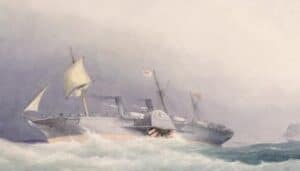
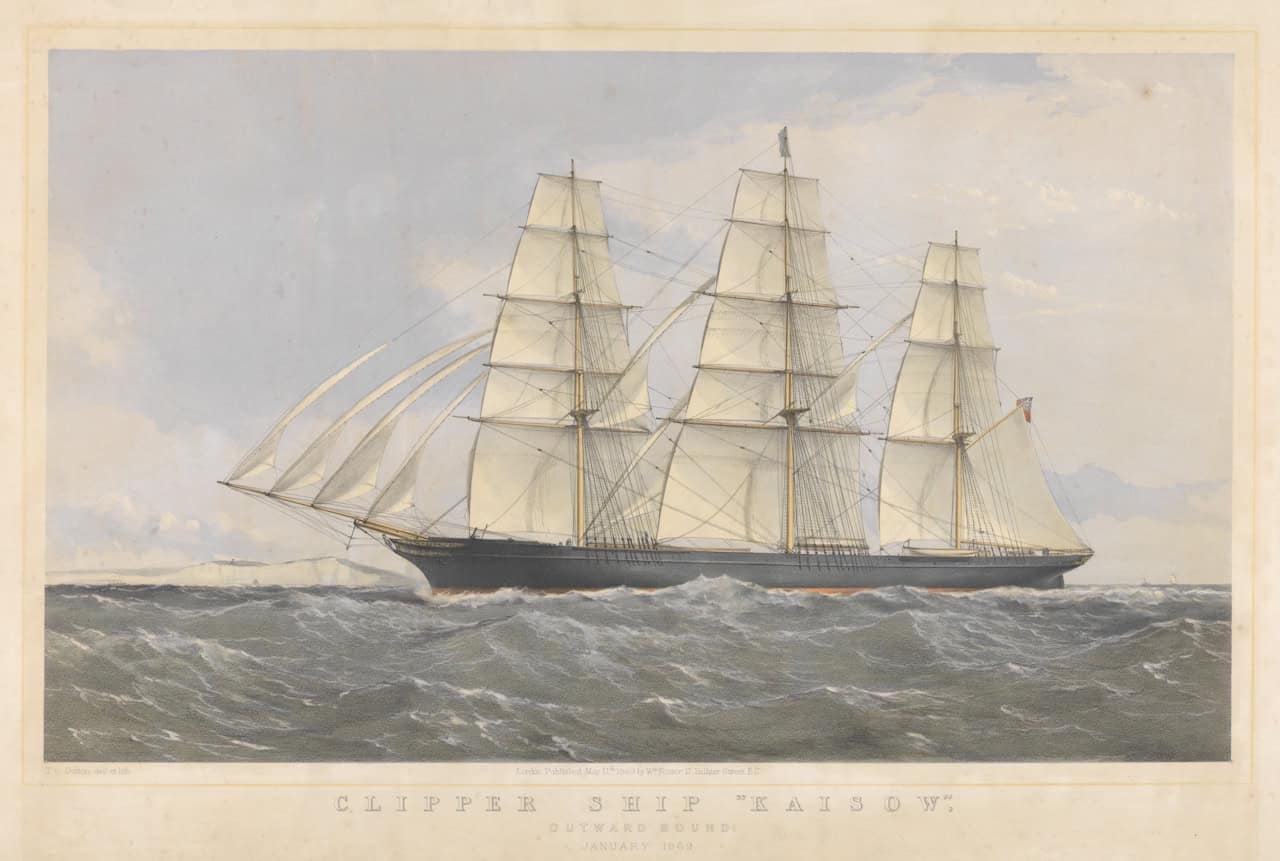
The Kaisow (clipper) was a graceful Scottish ship with a Chinese Mandarin glaring from her bow. She survived one of the deadliest volcanic eruptions in recorded history. Then she vanished into the Pacific swells in 1891, killed by nothing more than a shifting cargo and one cruel wave. Her story reads like a ghost tale of the sea. A ship thread through hell once, and nearly seemed protected by it. Then fate collected anyway.
Built in 1868, she was one of the last of her kind. The age of the great tea clippers was fading fast. Steam was coming, and the Suez Canal had changed everything. Yet the Kaisow kept sailing. She carried tea, ore, and the strange fortunes of the men who crewed her.
Her greatest brush with legend came in August 1883. She sailed straight past a dying world. You can read more about the cataclysm itself in this overview of the 1883 Krakatoa eruption. But the Kaisow’s account comes from the men who lived it.
The Birth of the Kaisow (clipper) at Greenock
The Kaisow was launched on 19 November 1868 from the yard of Robert Steele & Company at Greenock, Scotland. She was the 173rd vessel built by that yard. The same builders made the famous clippers Ariel and Taeping. Those two raced each other home with tea in the legendary race of 1866.
She was a composite clipper. That means her frame was iron, but her planking was wood. It was a clever design. Iron gave strength, while wood let sailors sheathe the hull in copper against rot and worms.
Her numbers were impressive. She measured 193.2 feet long, with a beam of 32 feet. Her depth was 20.3 feet. She weighed in at 820 gross register tons.
Then there was the figurehead. A Mandarin, carved in the half-length “demiman” style, stared forward from her bow. Sailors are a superstitious lot. Many believed a ship’s figurehead held its spirit. Imagine that stern Chinese official watching the horizon through storms, calms, and worse.
Her first owner was Alexander Rodger of Glasgow. Captain Anderson commanded her. In December 1869 she made the run from London to Shanghai in 99 days. In 1870 she returned from Foochow with a tea cargo, again in 99 days. Those were respectable, fast passages. She was no slouch.
In 1875 she passed to Killick Martin & Company of London. That firm ran her hard and well. Under Captain John Gadd, who commanded her from 1876 to 1885, she earned a reputation for steady, tough sailing.
Gadd’s Command and the Kaisow (clipper) Pacific Years
For more strange history, see: Yonaguni Monument: Japan’s Mysterious Underwater Ruins That Defy Explanation
Under Killick Martin, the ship never carried a tea cargo home from China to Britain. That’s odd for a tea clipper. Instead, she hauled tea to Cape Town and Port Elizabeth. She also crossed the Pacific three times between Shanghai and Victoria between 1877 and 1879.
Those crossings were remarkable. The times matched anything previously recorded on that route. Then came the long haul. She didn’t return to her home port of London for two years and four months. Think about that. More than two years away from home, living on salt beef, hardtack, and the whims of the weather.
In 1878 her owners made a practical change. They converted her to a barque rig. This let a smaller crew handle her sails. It was a sign of the times. Money was tight, and the clipper era’s glory days were slipping away.
Even so, the ship kept earning her keep. She was a sister ship in the Killick Martin fleet to the Wylo. The Wylo was the last vessel ever built by Robert Steele & Company. So the Kaisow belonged to a proud, vanishing family of ships.
But the real drama lay ahead. In 1883, the Kaisow sailed into the Sunda Strait. She was heading toward a place the sea itself seemed to be warning sailors about. The ship didn’t know it yet. The men aboard soon would.
Sailing Past Krakatoa: The Kaisow (clipper) Eyewitness Tale
In August 1883, the volcanic island of Krakatoa was tearing itself apart. The Kaisow was right there. Her second mate was a young man named Harry Davis. He later became a captain himself. He wrote a vivid, graphic account of what he saw.
Davis described how Captain Gadd drove the ship down the Straits. The yards were braced sharp up, hauled tight against the wind. The ship clawed her way past the erupting island. Ash, fire, and thunder filled the sky. Then she broke into open water.
What came next is chilling. The Kaisow felt the tail end of a colossal tidal wave. It tore north up the Straits behind her. The wave overwhelmed both shores. It wiped out the town of Anjer and killed some 30,000 people.
Think about the timing. A few hours’ difference, a shift in the wind, and the Kaisow might have joined the dead. Instead, she slipped through the gap between fire and flood. Was it luck? Was it Gadd’s skill? Or did the grim Mandarin on her bow bring some strange protection?
The story is documented in maritime histories and the clipper’s own records. For a window into the era’s daily shipping news, period newspapers on the Internet Archive mention the Kaisow regularly. Those faded columns show a ship woven into the working life of the China coast.
Davis’s account stands as one of the few firsthand sailor’s descriptions of Krakatoa’s eruption. It’s raw and frightening. And it tells us the Kaisow was a ship that cheated death at least once.
The Final Voyage and a Wave That Sealed Her Fate
In 1885, William Bowden Jr of Llanelly, Wales, bought the ship. He put her to work on a grinding, unglamorous route. She ran between Liverpool, Valparaiso, and Coquimbo. Her cargo was manganese ore. It’s heavy, dense stuff, and dangerous if it shifts.
On 14 November 1891, the Kaisow left Valparaiso at 5 p.m. She carried about 1,170 tons of manganese ore. She was bound for the United Kingdom. The ship had been reclassed in 1887 as A1 at Lloyd’s, a sign she was sound.
Around 2 a.m. on 15 November, disaster struck. A heavy sea slammed into her. The wave heaved the barque onto her beam ends. The cargo shifted to starboard. The crew tried to right her by turning before the wind. It didn’t work.
Water poured in. The ship was now sinking and unmanageable. By 5 a.m. the master and crew had no choice. They abandoned her in the lifeboat. She went down about 60 miles west-southwest of Valparaiso.
A Naval Court of Inquiry met at Valparaiso on 26 and 27 November 1