
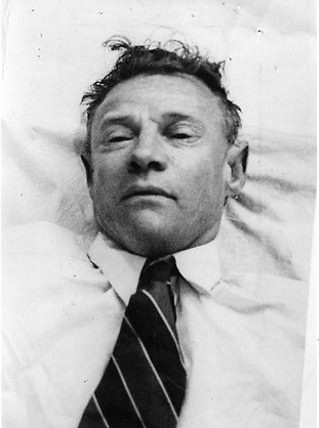
The Tamam Shud Case is one of the most bone-chilling unsolved mysteries in history. A dead man. No identity. A scrap of paper torn from a rare book. A coded message nobody has ever cracked. It happened on a sunny Australian beach in 1948. And over 75 years later, we still don’t have real answers. This case has everything , Cold War paranoia, a possible undetectable poison, a mysterious woman, and a cipher that has defeated the world’s best codebreakers. If you think you’ve heard strange stories before, this one will make you reconsider.
The Tamam Shud Case Begins on a Beach
On the morning of December 1, 1948, a couple walking along Somerton Park beach near Adelaide, Australia, made a disturbing discovery. A well-dressed man lay propped against the seawall. His legs were stretched out. His feet were crossed. A half-smoked cigarette rested on his collar. He looked almost peaceful , like he’d simply fallen asleep watching the ocean.
He hadn’t.
The man was dead.
What struck investigators immediately was how neat everything looked. There were no signs of a struggle. No obvious wounds. No vomit. No indication of drowning. His face showed mild congestion and his lips were slightly blue. A doctor who examined the body noted the state of his organs suggested acute poisoning , yet no poison was ever found.
Witnesses had actually seen him the night before. A couple spotted him around 7 pm. They watched him raise his right arm slowly and then drop it. They assumed he was drunk. Another couple observed him for thirty full minutes and never saw him move. They thought it was odd he wasn’t swatting mosquitoes. Nobody called for help.
He lay there dying , or already dead , while people walked past on a warm Australian evening.
His pockets held strange clues. An unused train ticket. A bus ticket. A packet of Juicy Fruit gum. A cigarette pack containing cigarettes of a different brand. An aluminum comb made in America. No wallet. No identification. Nothing with a name. It was as if someone had carefully stripped away every trace of who this man was.
The full Wikipedia entry on the Tamam Shud Case documents the exhaustive early investigation , and how quickly authorities realized they were dealing with something far outside the ordinary.
The Tamam Shud Case and Its Impossible Code
This event shares similarities with: Bridgewater (1785 Eic Ship): The Cursed East Indiaman That Vanished Without a Trace
Months after the body was found, investigators made a discovery that changed everything. Sewn into a hidden fob pocket inside the dead man’s trousers was a tiny scrap of paper. On it were two words printed in small type: tamám shud. Persian. Meaning “It is finished.” Or “It is over.”
The phrase came from the final page of the Rubáiyát of Omar Khayyám , a famous collection of Persian poetry about fate, mortality, and the mystery of existence. Someone had torn this tiny piece from the last page of their copy of that book.
Police launched a public appeal. Remarkably, someone came forward. A man had found a copy of the Rubáiyát tossed into the back seat of his unlocked car near Somerton Beach around the time of the death. The torn page matched perfectly.
But the real shock was on the book’s back cover. Under ultraviolet light, detectives found faint indentations , impressions left from handwriting on a previous page. What they revealed looked like a coded message. Five lines of capital letters, seemingly random:
WRGOABABD
MLIAOI
WTBIMPANETP
MLIABOAIAQC
ITTMTSAMSTGAB
Cryptographers, military intelligence experts, and amateur codebreakers have spent decades trying to crack it. Nobody has succeeded. Some believe it’s a one-time pad cipher , nearly impossible to break without the matching key. Others think it’s the first letters of words in a personal message. A few experts have suggested it may not be a code at all, but rather notes from a dying man’s final thoughts.
The book also contained a local phone number. It belonged to a woman investigators called “Jestyn” , a nurse who lived nearby. She claimed she didn’t know the dead man. But her reaction when shown a cast of his face reportedly made the detective interviewing her feel faint. She knew something. She never admitted what.
The Tamam Shud Case: Cold War Spy or Tragic Stranger?
The timing of this death matters enormously. It was 1948. The Cold War had just begun. Spy networks were active across the globe. Australia was a significant intelligence hub. The use of undetectable poisons was a known Soviet assassination technique.
Many investigators and researchers believe the Somerton Man was a spy. The hidden pocket. The removed labels from his clothing. The uncrackable code. The possible use of a poison that left no trace. The mysterious woman with apparent intelligence connections. It all points toward a world of shadows and secrets.
The U.S. National Archives’ Cold War research collection provides context for just how dangerous and deceptive this era truly was , a world where dead men on beaches with coded messages weren’t impossible at all.
“Jestyn” , later identified as Jo Thomson , had a son named Robin. Researchers who examined photographs of Robin noticed something startling. He shared extremely rare physical traits with the Somerton Man. Unusually shaped ears. Distinctive teeth. The same rare dental anomaly. Was Robin the dead man’s son? Did Jo Thomson know her child’s father had died on a beach a mile from her home?
Robin Thomson died in 2009. He reportedly suffered from the same rare physical characteristics. He never knew , or never said , who his father was.
A Name at Last , But More Questions Remain
In 2022, University of Adelaide professor Derek Abbott announced a potential breakthrough. Working with genealogist Colleen Fitzpatrick, he used DNA extracted from the dead man’s hair. The genetic genealogy pointed to a man named Carl “Charles” Webb. Born November 16, 1905, in Footscray, Victoria. An electrical engineer and instrument maker.
It should have been the ending. It wasn’t.
South Australia Police and Forensic Science South Australia have not officially confirmed the identification. Webb’s connections to Jo Thomson , if any , remain unclear. The coded message still hasn’t been deciphered. The cause of death remains officially unknown. And nobody has explained why a man from Victoria ended up dead on a South Australian beach with his identity erased.
The body of the Somerton Man rests today at West Terrace Cemetery in Adelaide. For decades, locals left flowers at his grave. Strangers mourned a man whose name they didn’t know.
The Tamam Shud Case remains a wound that history refuses to close. A man died. Someone knew why. Someone knew who he was. And whoever held those secrets took them to their own grave , leaving the rest of us with nothing but a scrap of paper and two words: It is finished.
Related Posts
 Bass Strait Triangle: Australia’s Paranormal Hotspot Where Planes and Ships Vanish Without a Trace
 Disappearance of Owen Parfitt: The 1760s Mystery That Defied All Logic
 The Disappearance of Owen Parfitt: England’s Most Baffling Vanishing Act
 The Flannan Isles Lighthouse Mystery: Three Men Vanished Without a Trace