The AVM Runestone is one of America’s most brazen archaeological pranks. In 1985, a group of University of Minnesota students grabbed a hammer and chisel. They hiked out to a quiet lake near Kensington, Minnesota, and started carving. What they created would sit unnoticed for sixteen years , until it exploded into a full-blown media frenzy. Experts were called in. Committees were formed. Money was raised. And all of it rested on the shoulders of a joke carved by bored graduate students on a summer afternoon. The story has everything: obsession, deception, a dramatic confession, and the very human hunger to believe that Vikings once roamed the American heartland.
How the AVM Runestone Was Discovered
In early 2001, stone carving expert Janey Westin was on a mission. She and her father, Robert G. Johnson , an adjunct geology professor at the University of Minnesota , were systematically surveying stones near the famous Kensington Runestone discovery site. The Kensington Runestone had been found in 1898 and sparked endless debate about Norse explorers in Minnesota. Westin’s team wanted to find more evidence.
On May 13, 2001, they were poking around a small island in a lake on the Sabolik farm. The island sat about 400 metres from the original 1898 find site. That’s when Westin spotted something strange on a lichen-covered granite boulder. The letters “AVM” were carved into the pinkish-brown stone. The boulder was roughly 110 centimetres long and weighed close to a tonne.
They had actually looked at this stone before. Different lighting conditions had hidden the carvings. Now, in the right light, the marks were impossible to miss.
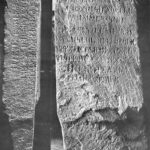
Two weeks later, they returned with Minneapolis geologist Scott Wolter. They scraped away lichen and found more. There was a date , 1363 , carved in the same pentadic numerals used on the Kensington Runestone. A second line showed three strange runes. The symbols didn’t quite match any known runic alphabet. But that didn’t stop the excitement from building fast.
The AVM Runestone Investigation Spirals Into Chaos
Related article: The Yuba County Five: Five Men Vanished Into the Mountains — Only Four Were Ever Found
News of the discovery hit the Minneapolis Star Tribune on August 11, 2001. The story spread quickly. Westin was careful to state publicly that she had not carved the stone herself. But the atmosphere was electric. Theories flew. Some researchers suggested the boulder might be a grave marker for Norse explorers who died far from home. The image was haunting , Vikings buried in the Minnesota wilderness, their only memorial a cryptic stone slowly swallowed by lichen.
The Runestone Museum in Alexandria formed a special committee. Archaeologists from three Minnesota institutions dug nine test holes around the site on July 25. They found no evidence of Norse presence. What they did find were Native American artifacts , a couple of quartz flakes, likely waste from arrowhead production. The land held old secrets, but not Viking ones.
State archaeologist Mark Dudzik stayed skeptical throughout. He argued that Scandinavian explorers specialized in coastal resources. The idea of them pushing deep into Minnesota by the 1360s was, in his words, “just not logical.” Russell Fridley, a former director of the Minnesota Historical Society, was more colorful in his dismissal. He called it “a great testimony to Scandinavian humor on the frontier.”
Then came a strange wrinkle. A local Norse enthusiast named Bob Berg came forward. He said he had found the same stone back in late 1994. He had reported it to his Viking research group in April 1995. Their conclusion? Obvious hoax. Not worth pursuing. The stone had been sitting there, hiding its secret, waiting for someone to take the bait.
The Confession Behind the AVM Runestone Hoax
On September 5, 2001, two letters arrived at the Minnesota Historical Society. They came from Kari Ellen Gade, then chair of the Department of Germanic Studies at Indiana University, and Jana K. Schulman, an associate professor at Southeastern Louisiana University. The letter was a confession.
Back in June 1985, Gade, Schulman, and three unnamed friends were students at the University of Minnesota. They took a hammer and chisel out to that lake. They carved the AVM stone as a deliberate test. They wanted to see how willing people were to believe in mysterious artifacts. They also did it, as they freely admitted, “for fun.”
The strange runes on the second line? Those were supposed to read “ALU” , an ancient pagan magical invocation used in early Germanic runic tradition. But the chisel slipped. The letters came out garbled. Even the hoax had its own weird little mystery baked in.
The confession came for a specific reason. Gade explained that the team had started asking the public for financial contributions to fund testing. That crossed a line. “We didn’t feel it would be right to carry this further,” she said. She also apologized for the time and resources wasted.
Scott Wolter, who had found “specific points that bothered me” during his analysis, accepted the confession gracefully. Westin was far less forgiving. She had paid for the stone’s transport and had poured her professional energy into the investigation. That time, she said, could have gone “into my work, where it belonged.” The skeptical community had long questioned runestone discoveries in North America, and this case became a textbook example of why.
Why People Still Want to Believe
The AVM Runestone hoax didn’t happen in a vacuum. It was born from , and fed into , a very real human obsession. The Kensington Runestone has been controversial since the day it was unearthed. Believers have spent decades trying to prove that Norse explorers reached the American interior centuries before Columbus. That longing to rewrite history is powerful. It makes people see what they want to see.
Westin and her team were serious professionals. They weren’t gullible fools. They were doing careful, systematic work. But the emotional pull of the find was enormous. A Viking grave marker on a lonely Minnesota island? The story was too good. And that’s exactly what the students had counted on sixteen years earlier.
The AVM Runestone also reveals something darker about hoaxes. They don’t just waste time and money. They poison the well. Every fake discovery makes it harder to take real archaeological questions seriously. The Minnesota landscape holds genuine mysteries about early human habitation. Pranks like this muddy those waters for years.
In the end, five students with a hammer and a sense of humor created a stone that fooled experts, generated headlines, and launched a formal archaeological investigation. The real artifact was never Viking at all. It was a monument to human credulity , and to the eternal, slightly dangerous desire to believe that the past holds secrets we haven’t found yet.